When Hackers Become Lenders: The ₹300 Crore Cyberattack Warning for India's Digital Finance
How attackers allegedly hijacked NBFC loan payouts, what CERT-In warned, and what to do if a loan you don't recognise appears.
*How criminals allegedly exploited trusted banking connections, automated loan disbursements and AI-assisted tools — and why India's fintech revolution needs stronger transaction-level security.*
Executive summary
India's digital lending industry is facing a disturbing new form of cybercrime. Instead of persuading customers to disclose OTPs or passwords, criminals are allegedly breaking into the financial institutions themselves, identifying loans awaiting disbursement and redirecting the money into accounts they control.
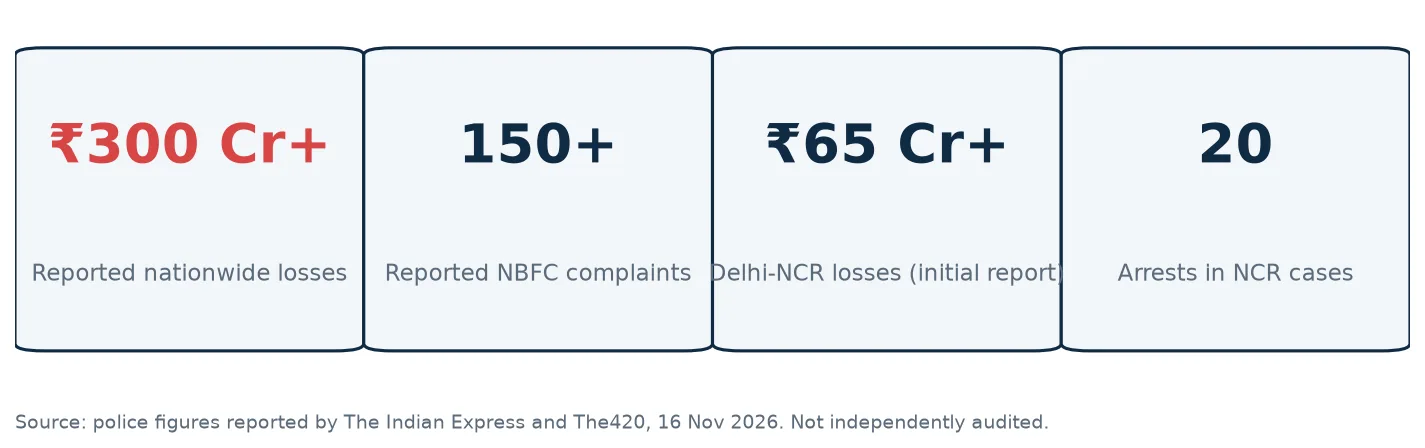
According to reporting published on 16 November 2026, 12 non-banking financial companies (NBFCs) in Delhi-NCR suffered reported losses exceeding ₹65 crore over approximately three months. Police described a wider pattern involving more than 150 complaints across India and alleged losses exceeding ₹300 crore.
A further case reported on 17 November alleges that another Delhi-based NBFC lost ₹41.27 crore through approximately 96 unauthorised transactions. Whether that amount is additional to the previously reported aggregate remains to be confirmed.
The deeper issue is not simply that hackers stole money. It is that apparently legitimate financial instructions may have passed through trusted technology infrastructure without sufficient independent verification of who authorised the payment, who should receive it, and whether it matched the approved loan.
For a rapidly digitising financial system, this represents a potentially serious weakness in the architecture of trust.
1. Fact-check: How reliable is the original report?
We examined the original report from The420.in, compared it with reporting by The Indian Express, Financial Express and PTI, and assessed the technical claims against the CERT-In advisory.
| Claim | Assessment | Evidence |
|---|---|---|
| 12 Delhi-NCR NBFCs lost more than ₹65 crore | ✅ Corroborated | Multiple reports citing Delhi Police |
| 150+ nationwide complaints, losses above ₹300 crore | ✅ Corroborated reporting | Police-sourced figures, not independently audited |
| 20 arrests connected to the NCR cases | ✅ Corroborated | Delhi Police statements |
| ₹18 crore detected and seized | 🟡 Reported by police | Recovery status needs further confirmation |
| AI-assisted attack tools were used | 🟡 Partially verified | Police indications; detailed forensic proof not public |
| A Chinese AI platform was involved | ⚪ Attribution unconfirmed | Named in police-sourced reporting, no public technical report |
| Attacks exploited trusted cloud IP addresses and APIs | ✅ Strongly supported | Police account and CERT-In advisory |
Verification conclusion: The central fraud story is credible and supported by multiple reports. However, the precise AI contribution, attacker identities, ultimate recovery amounts and full technical attack chain remain under investigation. It would be premature to claim that autonomous AI systems independently hacked these institutions or that a particular foreign government directed the attacks.
2. CERT-In had already issued a critical warning
The strongest independent confirmation is an official cybersecurity advisory. On 9 October 2026, India's Computer Emergency Response Team (CERT-In) issued advisory CIAD-2026-0046, *Threat Actors Exploiting Payment and Disbursement APIs for Unauthorized Fund Transfers in BFSI Entities* — official severity: Critical.
The advisory identifies attacks against NBFCs, digital lenders, fintech platforms, payment service providers and wallet operators. It confirms that attackers have exploited exposed applications, stolen payment credentials and directly invoked fund-transfer APIs, sometimes from infrastructure already trusted by the affected institution. It also warns of dummy transaction references, bypassed loan checks, rapid transfers to mule accounts, tampered logs and possible AI-assisted offensive tooling.
What is an API, and why does it matter?
An Application Programming Interface (API) allows different software systems to communicate. In digital lending, an NBFC's loan-management software may send instructions to a bank or payment partner to transfer sanctioned funds to a borrower. That automation creates efficiency — but if a criminal gains control of the instruction mechanism, a payment may appear technically legitimate even when it has no valid business authorisation.
3. How the fraud allegedly worked
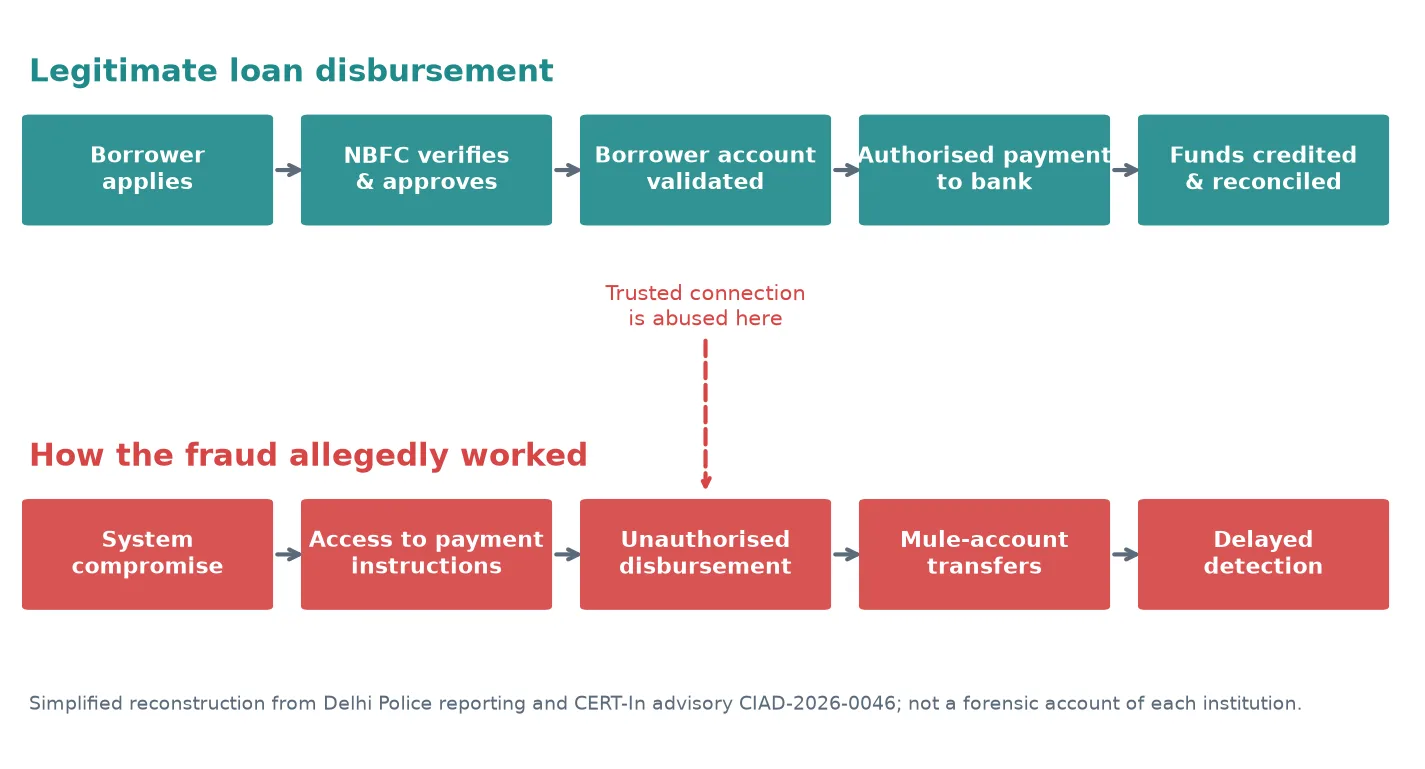
- System compromise — attackers exploit weaknesses in internet-facing applications, exposed APIs or privileged access.
- Access to financial instructions — compromised credentials or systems expose payment functionality and transaction records.
- Unauthorised disbursement — fraudulent instructions exploit trusted integrations and insufficient transaction-level checks.
- Mule-account transfers — funds are credited to accounts controlled or arranged by the criminal network.
- Delayed detection — slow reconciliation gives attackers additional time to move or withdraw funds.
Police reported that some malicious software remained in affected systems for seven to eight days and that certain lenders reconciled transactions only weekly or fortnightly.
A system may be operational, available and processing payments while its financial controls have already been compromised.
4. The numbers behind the fraud
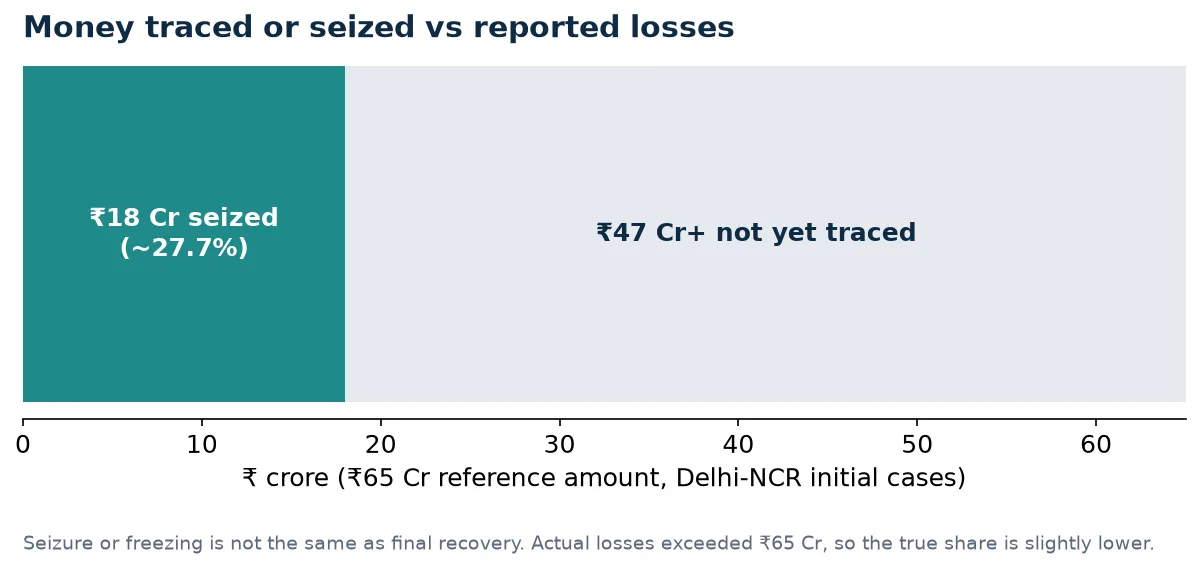
In the initial Delhi-NCR cases, police reported ₹18 crore detected and seized — about 27.7% of the ₹65 crore reference amount. Since reported losses exceeded ₹65 crore, the actual share would be slightly lower, and seizure or freezing is not the same as final recovery or reimbursement.
The faster a fraudulent payment is detected and blocked, the greater the opportunity to preserve funds before they move through multiple accounts.
A new case on 17 November
The Indian Express describes an additional alleged ₹41.27 crore cyber fraud involving a South Delhi NBFC and approximately 96 transfers over about 90 minutes. Investigators reportedly traced some IP addresses to Hong Kong. An IP address associated with Hong Kong does not, by itself, establish the nationality or location of the attacker — nor should the ₹41.27 crore automatically be added to the earlier ₹300 crore figure without confirming whether the case populations overlap.
5. Is AI making financial cybercrime more dangerous?
Potentially yes, but the evidence requires careful interpretation. CERT-In reports possible AI-assisted offensive tooling and a shorter interval between initial compromise and fraudulent transfer. Delhi Police also described an October case involving approximately ₹3 crore in which a tool called CyberStrikeAI was allegedly used.
AI may increase the speed and scale of malicious activity, but the verified concern is broader. Even without AI, weak API authentication, stolen credentials, missing transaction checks and delayed reconciliation can expose institutions to serious losses. The appropriate response is not simply to regulate AI tools — it is to strengthen the underlying financial transaction architecture.
6. Who is responsible when automated finance fails?
The RBI's Digital Lending Directions, 2025 cover borrower protection, disbursement, outsourcing relationships, technology and data governance. An institution cannot treat its use of a fintech vendor or cloud provider as a substitute for its own regulatory responsibilities. Liability for any particular attack, however, depends on the facts, contracts, regulations and investigation findings.
| Control area | Weakness exposed | Appropriate safeguard |
|---|---|---|
| API authentication | Stolen or reusable credentials | Short-lived credentials, strong authentication, secure key management |
| Loan authorisation | Payment instructions bypass business checks | Cryptographic binding to approved loan records |
| Beneficiary verification | Funds reach unauthorised accounts | Independent account and name verification |
| Transaction limits | High-volume unauthorised transfers | Bank-side cumulative limits and velocity controls |
| Maker-checker | Automated payment without independent approval | Risk-based second-level authorisation |
| Reconciliation | Fraud discovered days later | Near-real-time matching against bank records |
| Monitoring | Suspicious behaviour not stopped promptly | Automated alerts, blocking and escalation |
| Third-party governance | Vendor or integration weaknesses | Audits, access reviews, contractual security obligations |
These recommendations are consistent with CERT-In advisory CIAD-2026-0046.
A firewall checks whether traffic is permitted to reach a system. A financial control must also check whether the transaction itself is legitimate.
7. Why this matters beyond NBFCs
| Segment | What needs independent controls |
|---|---|
| Banks and payment institutions | Payment APIs, beneficiary changes, settlement instructions, high-volume automated transfers |
| Wealth and investment platforms | Onboarding, redemption, account changes, mandate creation, transaction authorisation |
| Fintech API and SaaS providers | Multi-tenant architecture, shared infrastructure, privileged credentials, integrations |
| Consumers and investors | Monitoring loan accounts, bank statements and credit reports; challenging unknown liabilities |
The attacks do not establish that mutual fund platforms, stockbrokers or other investment systems have been compromised in the same way — but they show the need to assess similar trust dependencies wherever transactions are automated.
8. Stress test: How quickly could fraud grow?
Consider a hypothetical institution whose controls fail to stop unauthorised transfers averaging ₹2 lakh each. 100 transactions × ₹2 lakh = ₹2.00 crore of gross exposure.
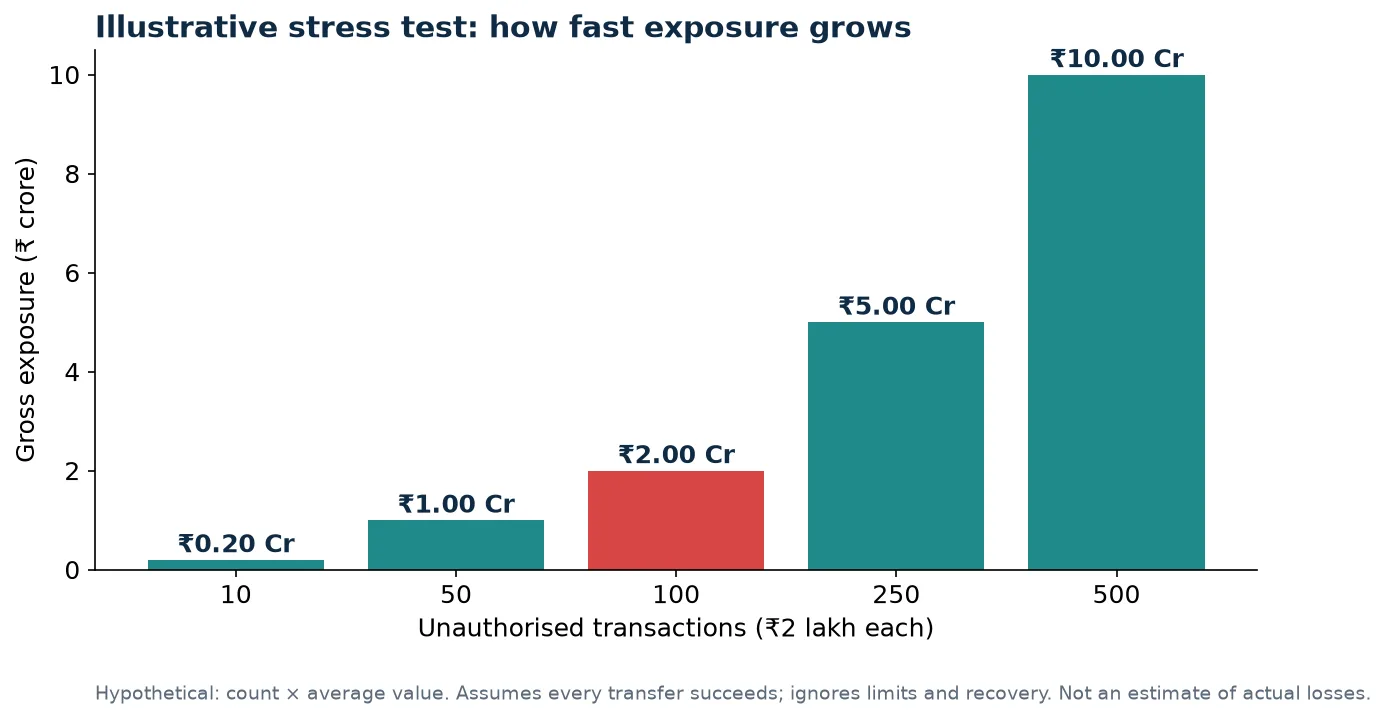
*Illustrative only: assumes every attempted transaction succeeds and ignores limits, recovery and other safeguards. Not an estimate of actual losses.*
When systems process hundreds of transactions automatically, weak controls can let substantial losses accumulate before any human review — which is why preventive controls and real-time reconciliation matter more than retrospective audits.
9. A practical cybersecurity framework
SERNET proposes a five-layer financial transaction security model.
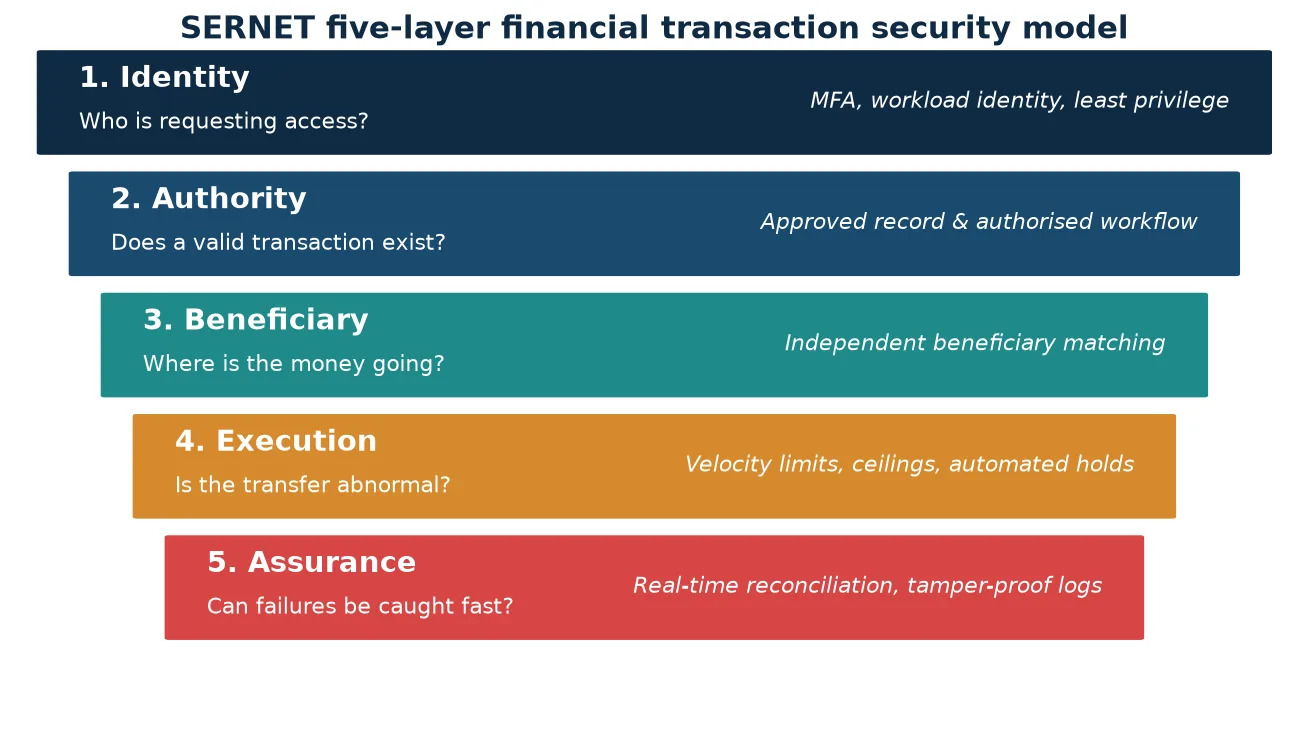
| Layer | Objective | Minimum control |
|---|---|---|
| 1. Identity | Verify who or what is requesting access | MFA, workload identity, least-privilege access |
| 2. Authority | Confirm that a valid business transaction exists | Approved record and authorised workflow |
| 3. Beneficiary | Verify where the money is going | Independent beneficiary matching |
| 4. Execution | Prevent abnormal or excessive transfers | Velocity limits, cumulative ceilings, automated holds |
| 5. Assurance | Detect, contain and investigate failures | Real-time reconciliation, tamper-resistant logs, incident response |
What investors should examine in fintech and NBFC businesses
Cybersecurity is increasingly a valuation issue, not merely an IT expense. Consider:
An apparently profitable lending business may carry significant unrecognised operational risk if its digital transaction controls are weak.
10. What should you do if you suspect loan-related cyber fraud?
Distinguish between a lender suffering an internal cyberattack and a criminal fraudulently obtaining a loan in your name. Both require action, but the evidence and resolution may differ.
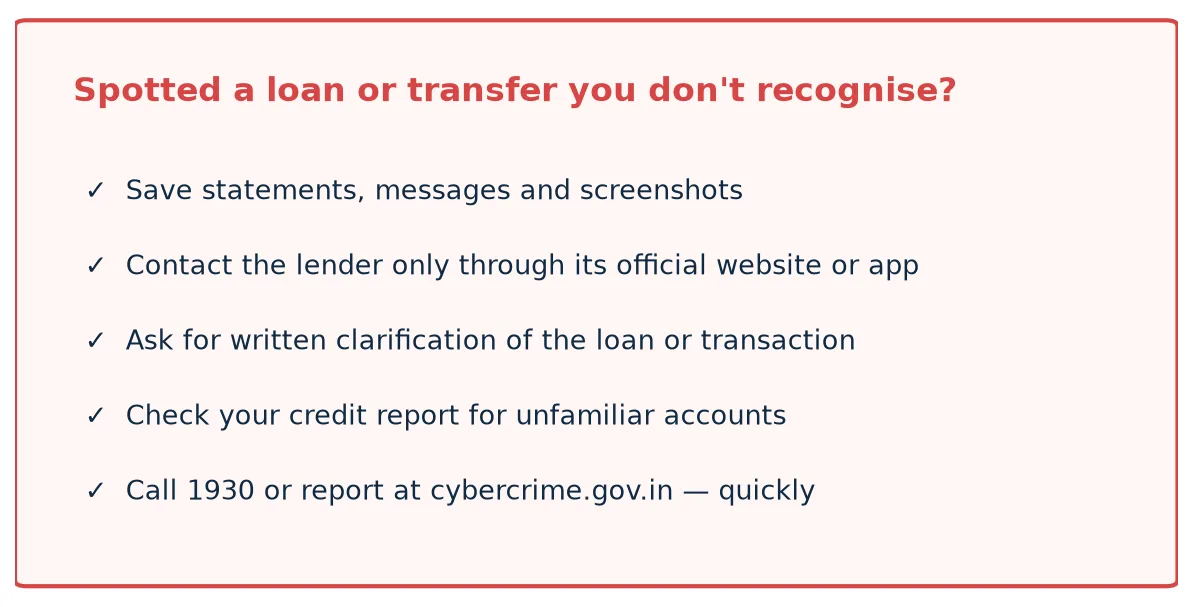
For suspected financial cybercrime in India, call the national helpline 1930 or file a complaint at cybercrime.gov.in. Prompt reporting improves the chance that authorities and banks can act.
Do not assume that an internal lender loss automatically becomes your repayment obligation. Any disputed liability must be assessed against the actual loan agreement, authorisation records and applicable law.
11. The SERNET perspective: A new definition of trust
India has built one of the world's most ambitious digital financial ecosystems. But the faster institutions can move money, the faster criminals may exploit weaknesses if authorisation controls do not keep pace. The reported incidents raise three systemic questions:
- Who verifies the legitimacy of a transaction after the technology has authenticated the request?
- Can the bank or payment partner independently reject a transaction that lacks a genuine underlying business record?
- How quickly can the institution identify and contain unauthorised activity?
A secure platform cannot depend solely on whether a request comes from a familiar server, a trusted vendor or an authenticated application. It must also verify that the requested financial action is legitimate, authorised and consistent with the institution's records.
Final conclusion
The reported ₹300 crore-plus fraud pattern is not evidence of a banking-system collapse. It is, however, a serious warning about weak transaction-level security in an increasingly automated financial sector. AI may accelerate attacks, but it is not the fundamental vulnerability — allowing technical trust to replace financial authorisation is.
In digital finance, a transaction should never be considered safe merely because the system allowed it.
Sources
| Source | Relevance |
|---|---|
| The420.in — original report, 16 November 2026 | Initial reported fraud cases and investigation |
| The Indian Express — detailed investigation | Police accounts, incidents, arrests and methods |
| CERT-In — Critical Advisory CIAD-2026-0046 | Primary technical evidence and recommendations |
| RBI — Digital Lending Directions, 2025 | Regulatory framework for digital lenders |
| Reuters — RBI cybersecurity scrutiny, 30 October 2026 | Broader supervisory response |
| The Indian Express — additional 17 November incident | Newly reported ₹41.27 crore case |
*Disclaimer: This article is for general information, financial education and cybersecurity awareness. Reported incidents and losses are attributed to investigators and news reports; allegations are not findings of criminal guilt. No conclusion is drawn about the security or soundness of any individual institution beyond the cited evidence. SERNET is an AMFI-registered mutual fund distributor and APMI-registered PMS distributor; this material is not investment advice or a recommendation to transact in securities. Questions? Contact SERNET.*
Plan your finances with a SERNET relationship manager.
Schedule a callDisclaimer: This content is for general education and is not personalised advice.
Get SERNET Insights in your inbox
Market updates, IPO notes and money guides.
For preference changes, reactivation or unsubscribe, email support@sernetindia.com from your subscribed address.
Was this article helpful?