
The Ultimate Guide to Investing in Bonds and NCDs in India
How bonds and NCDs work in India: coupon vs YTM, secured vs unsecured debt, credit risk, taxation and a five-pillar due-diligence checklist.
Introduction: Beyond Fixed Deposits and Equities
Indian investors traditionally rely on two major investment avenues: bank fixed deposits for stability and equities for long-term wealth creation.
Between these two lies a substantial investment universe: fixed-income securities, including government bonds, corporate bonds and Non-Convertible Debentures (NCDs).
These instruments allow investors to lend money to governments, financial institutions or companies in exchange for contractual interest payments and repayment obligations.
For investors seeking predictable income, portfolio diversification and alternatives to conventional deposits, bonds can play a meaningful role.
However, there is one distinction every investor must understand:
A fixed coupon does not mean a guaranteed investment.
Unlike eligible bank deposits protected by deposit insurance, corporate bonds expose investors to the issuer’s ability and willingness to repay.
The objective is therefore not simply to find the highest yield. It is to identify an appropriate combination of credit quality, income, liquidity, maturity and taxation.
1. What Is a Bond?
A bond is a debt instrument through which an investor lends capital to an issuer for a defined period or under specified repayment conditions.
The issuer promises to pay interest, known as the coupon, and repay principal according to the terms of the security.
For example, an investor purchases a bond with:
Assuming the issuer fulfils its obligations, the investor receives ₹9,000 annually and ₹1,00,000 at maturity.
The total contractual interest over three years is ₹27,000.
However, this is not necessarily the investor’s effective annualised return, because the actual return also depends on the purchase price, reinvestment of coupons, taxes, transaction costs and repayment performance.
Understanding the essential terminology
Face Value: The principal denomination assigned to a bond.
Coupon Rate: The contractual interest rate calculated according to the security’s terms.
Market Price: The price at which a bond can currently be purchased or sold.
Yield to Maturity (YTM): The annualised discount rate that equates the present value of scheduled future cash flows with the bond’s current price, assuming contractual payments occur.
Maturity: The date or schedule on which the principal becomes repayable.
Credit Rating: An independent agency’s opinion about the relative credit risk of the instrument.
Security Cover: Collateral or other assets pledged to support repayment obligations.
Liquidity: The ability to sell the instrument without substantial delay or price concession.
2. Coupon Rate vs Yield to Maturity: Why the Difference Matters
One of the most common mistakes in bond investing is treating coupon and yield as interchangeable.
Consider three hypothetical bonds with identical face values and coupon rates but different purchase prices.
| Parameter | Bond A | Bond B | Bond C |
|---|---|---|---|
| Face value | ₹1,000 | ₹1,000 | ₹1,000 |
| Annual coupon | 9% | 9% | 9% |
| Purchase price | ₹1,000 | ₹950 | ₹1,050 |
| Annual coupon income | ₹90 | ₹90 | ₹90 |
| Current yield | 9.00% | 9.47% | 8.57% |
Bond B provides a higher current yield because it is purchased below face value.
Bond C provides a lower current yield because it is purchased at a premium.
But current yield excludes the capital gain or loss that may arise when the bond matures or is sold.
YTM incorporates the purchase price, scheduled interest and principal repayment cash flows.
Investor lesson: Never compare bonds using coupon rates alone. Examine YTM, credit quality, cash-flow timing and the price paid.
3. Understanding Non-Convertible Debentures
Non-Convertible Debentures are debt securities that cannot be converted into equity shares under their contractual terms.
Companies and financial institutions issue NCDs to raise funding for lending activities, working capital, refinancing, expansion or other permitted purposes.
NCDs may offer fixed or floating interest rates, different payout schedules and varying levels of security.
Secured NCDs
Secured NCDs are backed by specified assets or collateral under the relevant security arrangements.
Depending on the issue structure, the security may involve receivables, loans, property or other eligible assets.
Security can improve recovery prospects, but it does not eliminate default risk.
Recovery depends on asset quality, enforceability, valuation, competing claims and insolvency proceedings.
Unsecured NCDs
Unsecured NCDs do not have specific collateral backing the relevant debt obligation.
Investors depend on the issuer’s general creditworthiness and contractual ranking.
Unsecured instruments may offer higher yields to compensate for additional risk, although this is not universal.
Subordinated Debt
Subordinated debt ranks below specified senior obligations in the repayment hierarchy.
Such instruments may carry greater loss severity if the issuer experiences financial distress.
Investors must examine the actual contractual ranking rather than assuming all unsecured debt is subordinated.
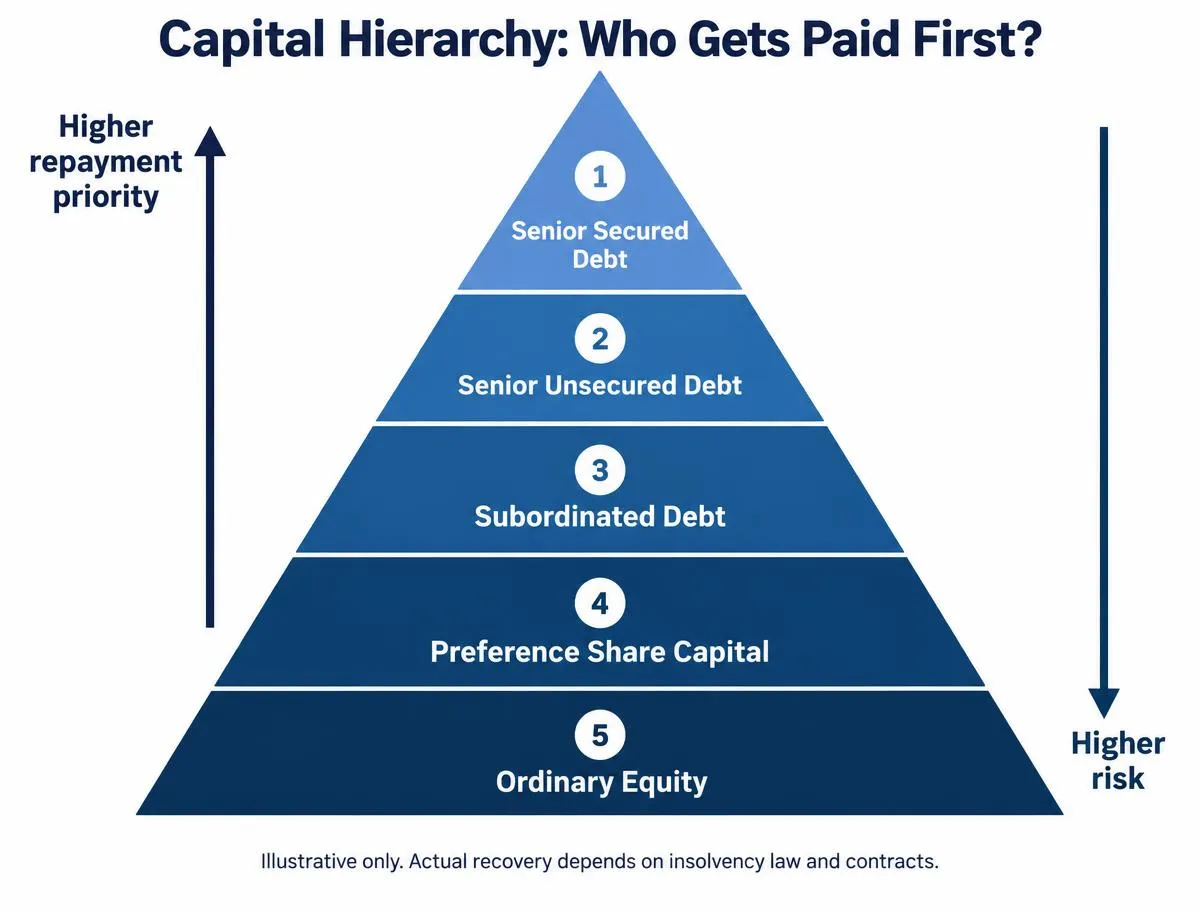
4. Capital Hierarchy: Who Gets Paid First?
When a company enters insolvency or liquidation, different stakeholders may have different repayment priorities.
In a simplified capital structure, senior secured creditors may enjoy stronger contractual claims over specified collateral, while subordinated creditors and shareholders generally face greater recovery risk.
A conceptual hierarchy is:
- Senior secured debt
- Senior unsecured debt
- Subordinated debt
- Preference share capital
- Ordinary equity
Important: This is an illustrative financing hierarchy, not a universal statutory liquidation waterfall. Actual recovery follows applicable insolvency law, security rights and contractual arrangements.
A secured creditor may still suffer losses if collateral is insufficient or difficult to realise.
The central principle is simple: The position of your claim matters as much as the promised yield.
5. Corporate Bonds vs Bank Fixed Deposits
| Feature | Corporate Bonds / NCDs | Bank Fixed Deposits |
|---|---|---|
| Primary risk | Issuer credit and market risk | Bank credit risk, mitigated by applicable deposit insurance |
| Returns | Coupon and market-dependent yield | Contractual deposit interest |
| Liquidity | Exchange or OTC market, subject to buyers | Premature withdrawal subject to product terms |
| Capital protection | No general deposit insurance | Eligible deposits insured up to ₹5 lakh per depositor per bank |
| Price volatility | Market value can fluctuate | Generally not marked to market for depositors |
| Taxation | Interest and applicable capital gains provisions | Interest generally taxable under applicable rules |
Neither instrument is automatically superior.
Bank FDs may be appropriate for investors prioritising simplicity and capital stability within applicable protections.
Corporate bonds may suit investors who can evaluate credit risk, accept liquidity constraints and seek exposure to a wider fixed-income universe.
6. Why Corporate Bonds Are Becoming More Accessible
India’s bond market has historically been dominated by institutions.
Retail accessibility has improved through dematerialised securities, electronic trading infrastructure, online bond platforms and regulatory changes.
Investors can now explore certain bond offerings with smaller investment denominations than those historically associated with institutional transactions.
However, minimum investment amounts differ by security, issuance and platform.
Online access should not be confused with an assurance of investment quality.
Before transacting, investors should verify the platform’s regulatory arrangements, the actual issuer, ISIN, offering documents, credit rating and settlement process.
SEBI’s Bond Central initiative also provides a useful starting point for corporate bond information and comparison.
7. The Five-Pillar Bond Due Diligence Framework
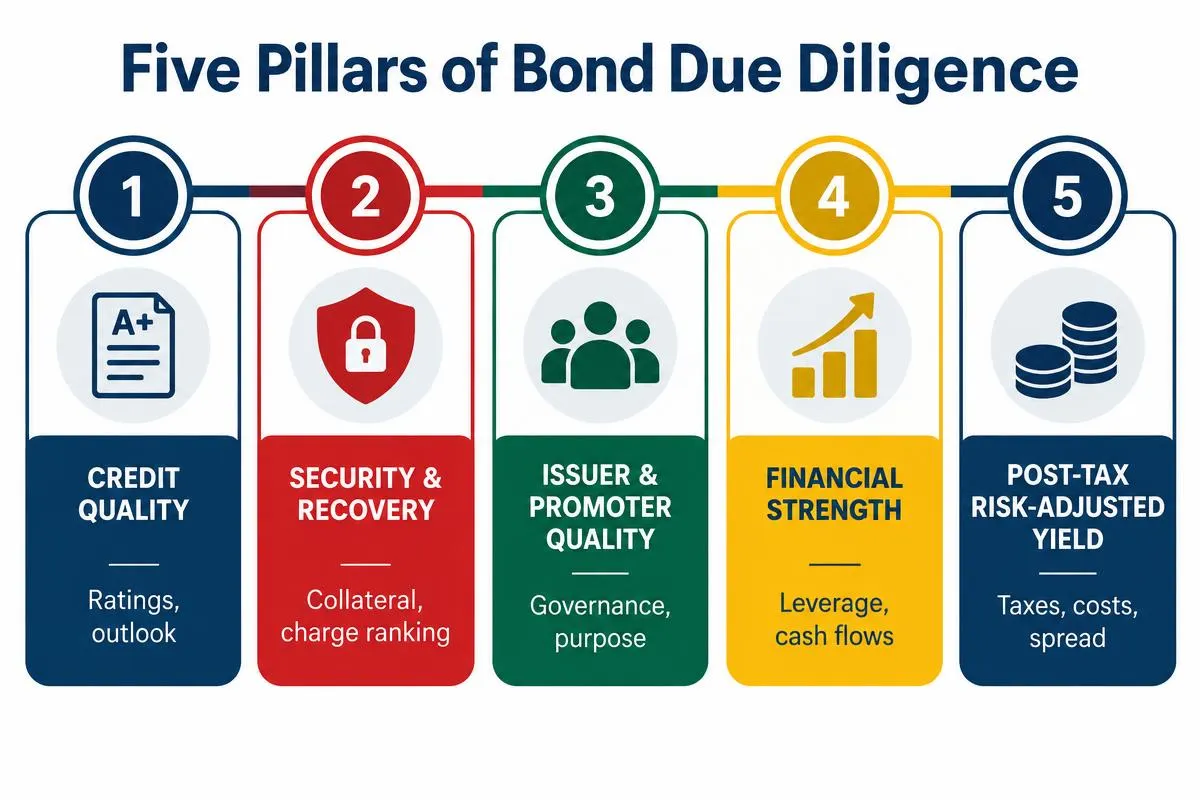
Every bond investment should be evaluated across five interconnected dimensions.
Pillar 1 — Credit Quality
Review the issue-specific credit rating, rating outlook and rating rationale.
Higher-rated securities generally indicate lower assessed credit risk relative to lower-rated securities, but ratings are opinions rather than guarantees.
Examine the issuer’s leverage, profitability, cash flows and repayment history.
Pillar 2 — Security and Recovery
For secured instruments, review the nature of collateral, security cover, charge ranking, trustee arrangements and enforceability.
An advertised security-cover ratio is not sufficient by itself.
Receivable quality, valuation methods and the ability to realise collateral are equally important.
Pillar 3 — Issuer and Promoter Quality
Understand the business model, management, governance, ownership and purpose of borrowing.
Ask whether fresh debt is supporting productive business activity, refinancing existing obligations or covering persistent operating losses.
Refinancing is not inherently negative, but dependence on continuous refinancing can increase vulnerability.
Pillar 4 — Financial Strength
For operating companies, examine leverage, interest coverage, operating cash flows and debt maturity schedules.
For NBFCs, assess capital adequacy, asset quality, liquidity, provisioning, collection performance and asset-liability mismatches.
The relevant regulatory capital requirement must be assessed according to the NBFC’s classification and applicable RBI framework.
Pillar 5 — Post-Tax, Risk-Adjusted Yield
Calculate the expected return after accounting for the purchase price, taxes, costs and cash-flow schedule.
Compare the additional yield against an appropriate government security or high-quality bond of similar maturity.
The incremental yield is compensation for additional risks, not free income.
8. Why Higher Yields Demand Greater Scrutiny
Suppose two bonds of comparable maturity offer:
- Bond A: 7.5% YTM
- Bond B: 11.5% YTM
The four-percentage-point difference may appear attractive.
However, the additional yield could reflect weaker credit quality, limited liquidity, subordination, a complex repayment structure or other risks.
Investors should investigate the reason for the difference rather than assume Bond B is a better investment.
A single default can eliminate several years of additional coupon income.
The goal of fixed-income investing is not to maximise the stated interest rate. It is to improve the probability of achieving the required financial outcome.
9. Taxation of Bonds and NCDs in India
Bond taxation depends on the type of security, listing status, investor category, nature of income and applicable law.
For resident individual investors, coupon interest on ordinary taxable corporate bonds is generally taxable at the applicable income-tax rate.
Capital gains may arise when a bond is sold, redeemed or matures, depending on the security and transaction.
For transfers on or after 23 July 2024, ordinary listed bonds and debentures generally qualify as long-term capital assets after a holding period exceeding 12 months, with qualifying long-term gains taxable at 12.5% without indexation.
Short-term gains are generally taxable at applicable rates.
Unlisted bonds and debentures covered by Section 50AA are subject to deemed short-term capital gains treatment regardless of holding period.
Market-linked debentures have specific tax treatment under Section 50AA.
TDS on interest on securities is generally governed by Section 193 for resident recipients, subject to applicable rates, thresholds and exceptions.
TDS is not necessarily the investor’s final tax liability.
Tax treatment should be verified for the specific instrument and investor before investing or selling.
10. A Practical ₹1 Lakh Investment Illustration
Consider an investor allocating ₹1,00,000 to a hypothetical three-year corporate NCD with a 10% annual coupon and redemption at par.
Assume no default, no fees and no reinvestment of interest.
| Particular | Amount |
|---|---|
| Initial investment | ₹1,00,000 |
| Annual coupon | ₹10,000 |
| Total coupons over 3 years | ₹30,000 |
| Principal repaid at maturity | ₹1,00,000 |
| Total contractual cash receipts | ₹1,30,000 |
For an illustrative 30% marginal income-tax rate, ignoring cess and surcharge:
- Annual coupon income: ₹10,000
- Illustrative tax on coupon: ₹3,000
- Annual income after this assumed tax: ₹7,000
- Three-year coupon income after assumed tax: ₹21,000
This illustration does not include reinvestment, changes in tax law, credit losses or other expenses.
It is not a quotation for an available bond or a guaranteed investment outcome.
11. Portfolio Allocation and Diversification
Corporate bonds should be evaluated as part of the investor’s complete financial portfolio.
An investor seeking regular income may prioritise high-quality instruments, diversified maturity schedules and adequate liquidity.
An investor seeking balanced growth may combine high-quality fixed income with equities and other suitable assets.
A higher-risk investor may consider selectively adding lower-rated corporate credit, but only after assessing potential losses and liquidity constraints.
Diversification should consider:
- Issuer concentration
- Sector concentration
- Credit rating
- Maturity profile
- Security structure
- Interest-rate sensitivity
- Liquidity requirements
A suggested issuer concentration limit, such as 5–10% of the fixed-income portfolio, is a risk-management guideline rather than a universal rule. Appropriate limits depend on portfolio size, issuer quality and investor circumstances.
12. When Should You Buy a Bond?
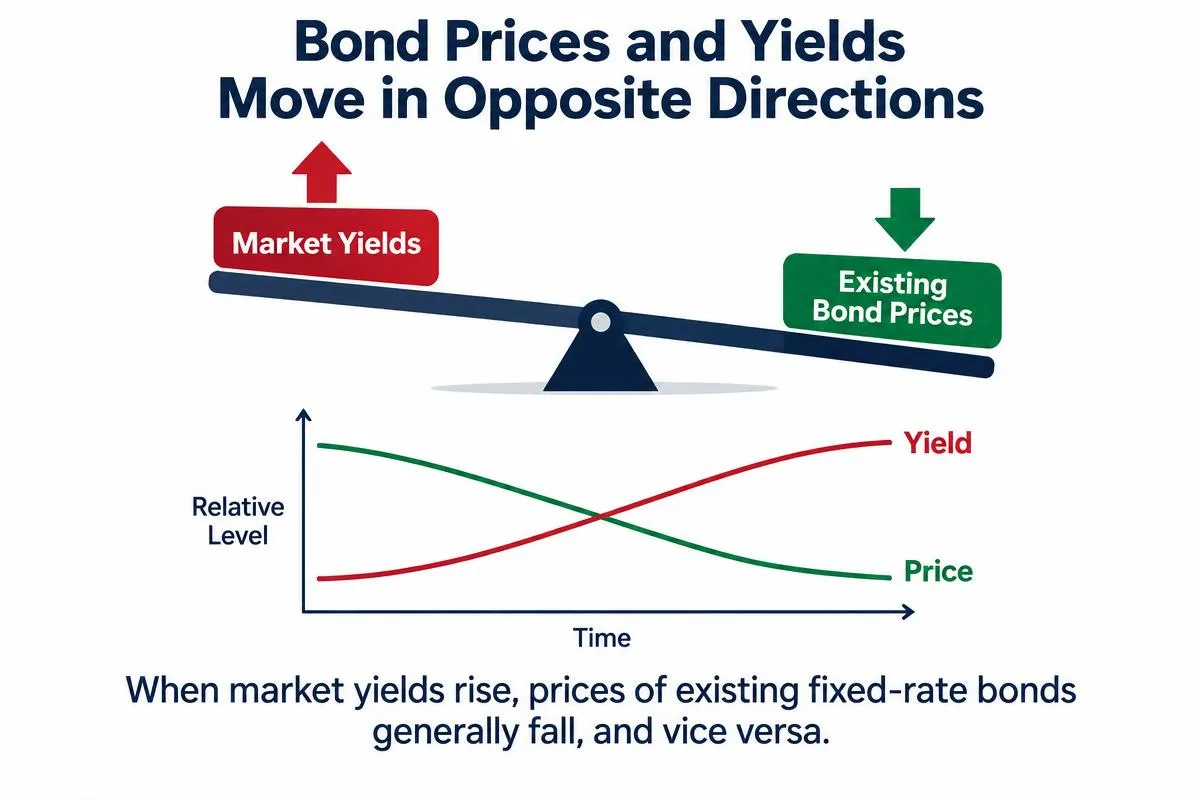
Bond valuations are influenced by interest rates, credit spreads, liquidity and investor demand.
When prevailing market yields rise, prices of existing fixed-rate bonds generally fall.
When yields decline, prices generally rise.
Investors expecting to hold a bond until maturity may focus on contractual cash flows and issuer repayment capacity, while recognising that default and reinvestment risks remain.
Investors who may sell before maturity must pay particular attention to market price sensitivity and liquidity.
A laddered portfolio, with bonds maturing across different dates, may help distribute reinvestment and liquidity requirements.
There is no single ideal entry point for every bond investor.
13. Understanding the Major Risks
Credit Risk: The issuer may delay or fail to make payments.
Interest-Rate Risk: Market value may decline when interest rates rise.
Liquidity Risk: An investor may be unable to sell at a reasonable price.
Reinvestment Risk: Coupons or maturity proceeds may need to be reinvested at lower yields.
Concentration Risk: Excessive exposure to one issuer, sector or group can magnify losses.
Structural Risk: Callable, subordinated, amortising or otherwise complex securities can behave differently from conventional bullet-maturity bonds.
Inflation Risk: Inflation can reduce the purchasing power of nominal interest income.
14. A Pre-Investment Checklist
Before purchasing any corporate bond or NCD, verify:
- The legal identity and financial strength of the issuer.
- The security’s ISIN and offering documentation.
- The current credit rating and latest rationale.
- Whether the instrument is secured, unsecured or subordinated.
- The coupon, YTM, purchase price and maturity.
- The repayment and interest schedule.
- The quality and enforceability of collateral, if applicable.
- Trading liquidity and available exit mechanisms.
- The applicable tax treatment and expected post-tax return.
- Portfolio concentration and suitability for your financial goals.
If an investor cannot clearly understand the repayment structure or principal risks, further due diligence is warranted before investing.
15. Investing Through SERNET and Northern Arc (Altifi)
The source publication identifies SERNET Financial Services and Northern Arc (Altifi) in connection with access to corporate fixed-income opportunities.
The intended proposition is to help eligible investors discover and evaluate suitable bond and NCD offerings through a digital investment journey.
Before using a particular platform or investing in an issue, investors should confirm the authorised service provider, applicable registrations, product availability, onboarding eligibility, transaction charges, settlement arrangements and customer support responsibilities.
Product listings, available yields, minimum denominations and issuer ratings may change.
Any investment decision should be based on the specific security’s official documents and the investor’s financial circumstances.
16. Frequently Asked Questions
Are corporate bonds safer than equities?
Corporate bonds generally have a contractual repayment claim, whereas equity represents residual ownership. However, individual corporate bonds can suffer substantial losses, and safety depends on the issuer, structure and market conditions.
Are secured NCDs guaranteed?
No. Security may support recovery but does not guarantee full or timely repayment.
Can I sell an NCD before maturity?
Certain listed NCDs can be sold through available trading mechanisms, but execution depends on market liquidity and price.
Is an 11% bond better than a 7% bond?
Not necessarily. The higher yield may compensate for additional risk. Investors must compare credit quality, maturity, liquidity and expected after-tax returns.
Are bond coupons paid monthly?
Some bonds pay monthly, while others pay quarterly, semi-annually, annually, cumulatively or according to another contractual schedule.
Do credit ratings guarantee repayment?
No. Ratings are opinions that may change over time.
Are NCDs suitable for senior citizens?
They may be suitable for some investors, but retirement income requirements, capital preservation, liquidity needs and risk tolerance should determine suitability. Higher-yield corporate credit should not automatically replace safer retirement reserves.
Should I invest through a public issue or the secondary market?
Both routes can be appropriate. Investors should compare the effective purchase price, YTM, available information, costs and liquidity rather than assume that a new issue offers better value.
Conclusion: Invest for Outcomes, Not Just Interest Rates
Corporate bonds and NCDs can contribute meaningfully to an Indian investor’s portfolio.
They offer access to contractual income streams, varied maturities and a broader set of investment opportunities beyond conventional deposits.
But sustainable fixed-income investing requires discipline.
A well-constructed portfolio balances income requirements with credit quality, diversification, liquidity and taxation.
The best bond is not necessarily the one offering the highest yield. It is the one whose risks, cash flows and maturity are aligned with the investor’s objectives.
Explore Fixed-Income Opportunities with SERNET
Discover how corporate bonds and NCDs may fit into your financial strategy.
Explore Bonds with Altifi · Connect with SERNET
Sources
- Income Tax Department — Capital gains
- SEBI — Registered online bond platform providers
- SEBI Bond Central
*Investor Disclaimer: This article is intended for educational purposes and does not constitute personalised investment advice, a recommendation, or an offer to purchase securities. Corporate bonds and NCDs involve credit, market, interest-rate and liquidity risks, including potential loss of principal. Indicative yields and illustrations do not represent guaranteed returns. Investors should read all relevant issue documents and consult qualified professionals where appropriate. Platform and distribution arrangements should be independently confirmed before transacting.*
Want help choosing funds that suit your goals?
Start with Tick FundsDisclaimer: Mutual fund investments are subject to market risks; read all scheme-related documents carefully. SERNET is an AMFI-registered mutual fund distributor and receives commission from fund houses.
Get SERNET Insights in your inbox
Market updates, IPO notes and money guides.
For preference changes, reactivation or unsubscribe, email support@sernetindia.com from your subscribed address.
Was this article helpful?