SIF vs SIP: The Better Question Is What You’re Investing In
SIP is a method; SIF is a mutual-fund product category. Understand the ₹10 lakh rule, strategy risks, liquidity and investor suitability.
SIF vs SIP: The Better Question Is What You’re Investing In
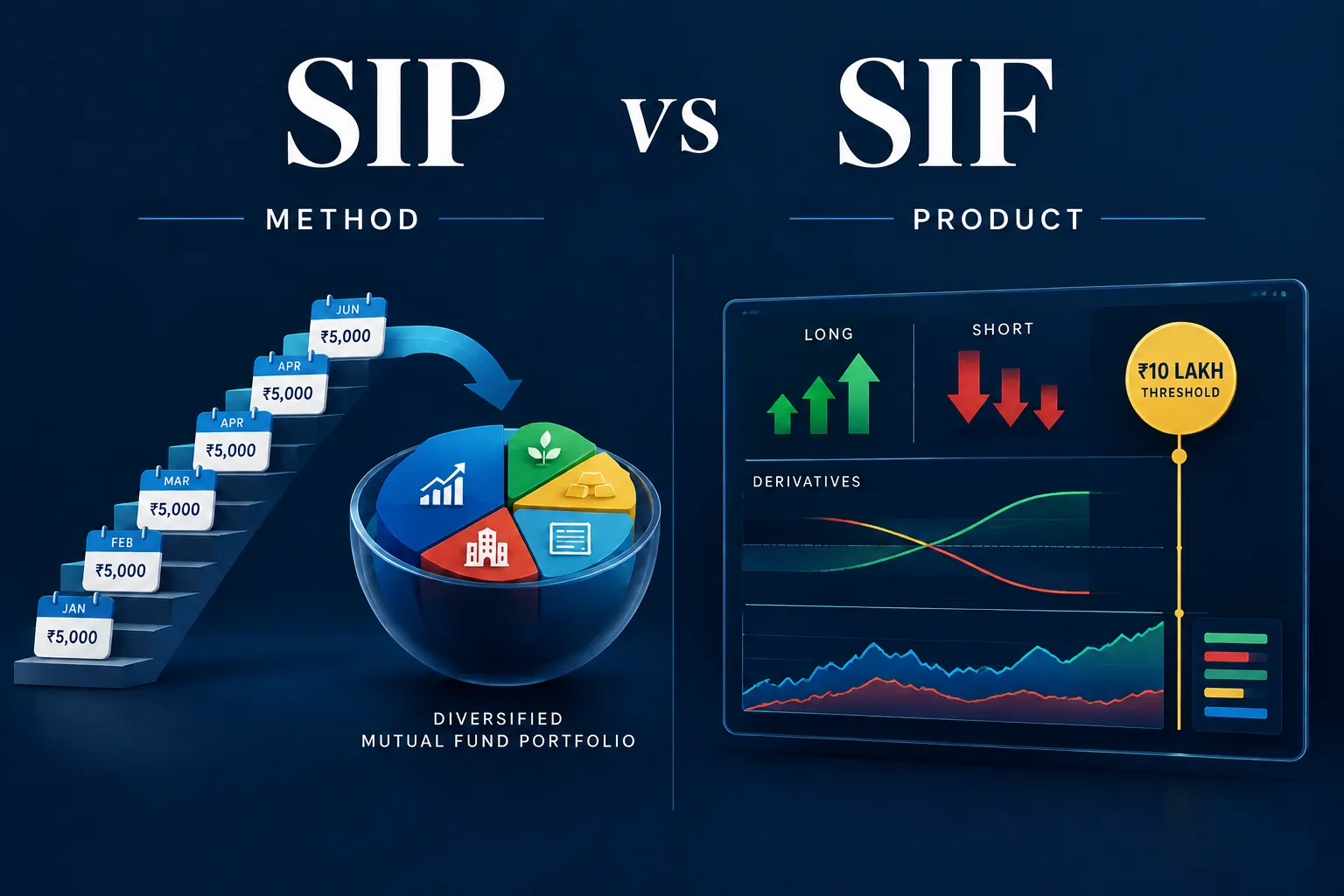
SIP is a method of investing. SIF is a mutual-fund product category. Understanding that difference—and the ₹10 lakh threshold—is more useful than asking which one is “better.”
An investor sees two unfamiliar acronyms: SIF and SIP. They sound like competing choices. They are not.
A Systematic Investment Plan (SIP) is a method of investing a fixed amount at regular intervals. It can be used for eligible mutual-fund schemes, and some Specialized Investment Fund strategies may also offer a SIP facility.
A Specialized Investment Fund (SIF) is a SEBI-regulated mutual-fund product category that permits specified strategies with greater portfolio flexibility, including limited unhedged short exposure through derivatives in certain strategies. It sits between conventional mutual-fund schemes and Portfolio Management Services (PMS) in structure and strategy flexibility. It is not a promise of higher returns, capital protection or lower risk.
First, separate the product from the method
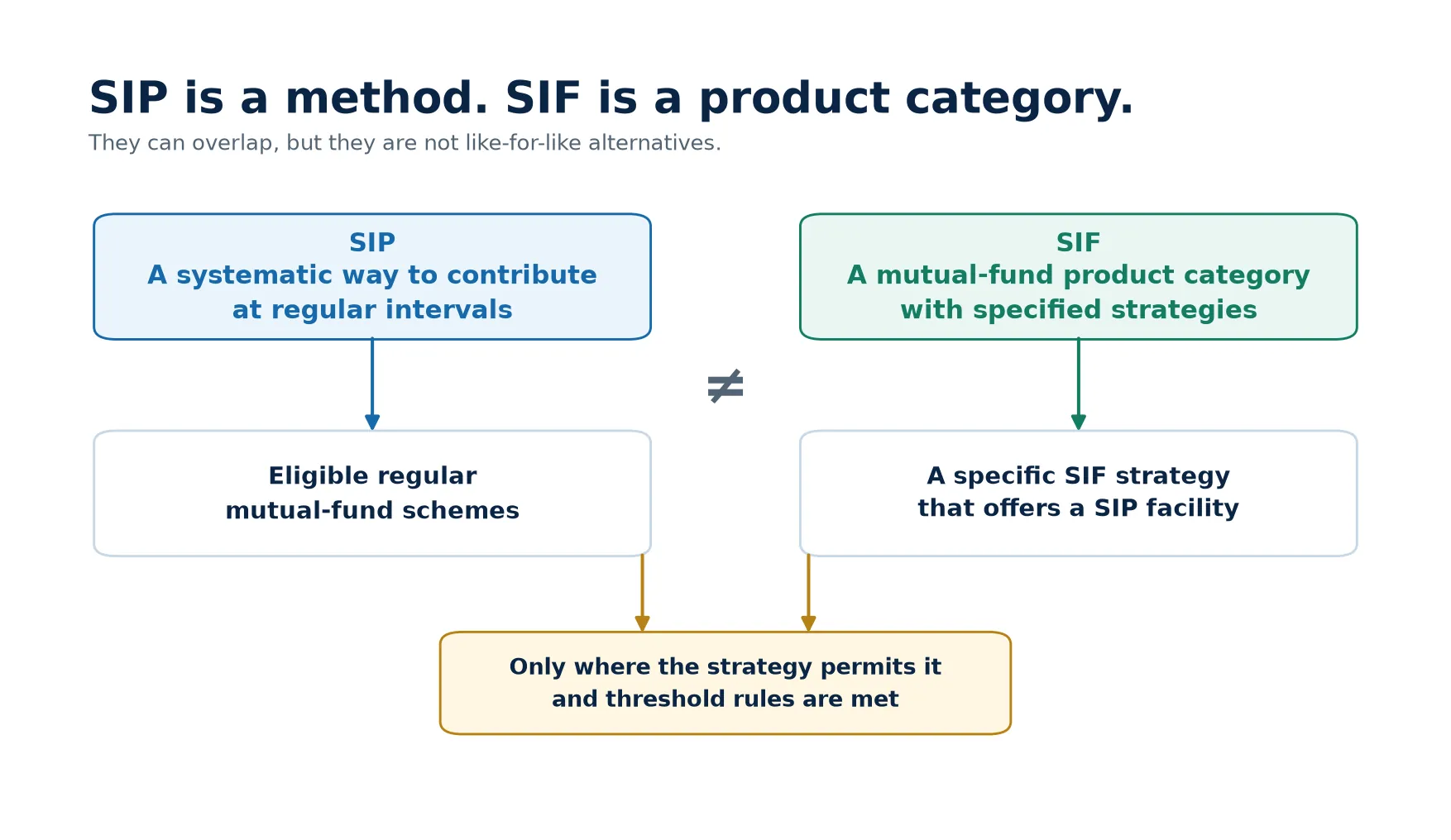
The more useful question is not “SIF or SIP?” It is:
Should this money go into my existing diversified investment plan, or does a specific SIF strategy have a suitable role in my portfolio?
How SIF and SIP differ
| SIP into a regular mutual-fund scheme | SIF strategy | |
|---|---|---|
| What it is | A periodic investment method | A SEBI-regulated mutual-fund product category |
| What it invests in | Depends on the selected scheme | Depends on the chosen SIF strategy |
| Investment threshold | Scheme-specific; many SIPs allow modest regular contributions | ₹10 lakh aggregate investment value across strategies of a particular SIF at PAN level, except for accredited investors |
| Strategy flexibility | Governed by the scheme’s mandate and mutual-fund rules | Some strategies can use limited unhedged short positions through derivatives |
| Liquidity | Depends on the scheme; many open-ended schemes offer frequent redemptions | Depends on the strategy’s redemption schedule, notice period and other terms |
| Main investor task | Choose a suitable scheme and maintain the investment habit | Understand the strategy, derivatives, risks, threshold and redemption terms |
SIPs are commonly used to build wealth gradually through regular investing. They do not guarantee profits, remove market risk or ensure that an investor buys at the lowest point. Their practical value is in creating a repeatable investment habit.
The ₹10 lakh SIF threshold: what it actually means
SEBI’s investor FAQ says an investor must maintain an aggregate investment value of at least ₹10 lakh across the strategies offered by a particular SIF, calculated at PAN level. Holdings in that AMC’s regular mutual-fund schemes are excluded. Accredited investors are exempt from the threshold.
The threshold also affects what happens after investment:
- Market decline: If the value falls below ₹10 lakh only because the NAV has declined, that is a passive breach. The investor is not compulsorily redeemed. While the value remains below the threshold, redemption is permitted only for the entire remaining SIF investment—not a partial withdrawal.
- Investor-initiated transaction: If a transaction takes the SIF holding below the threshold, SEBI’s FAQ describes an active-breach process: units are frozen for debit and the investor receives 30 calendar days to restore the threshold. If it is not restored, the remaining units are automatically redeemed under the stated process.
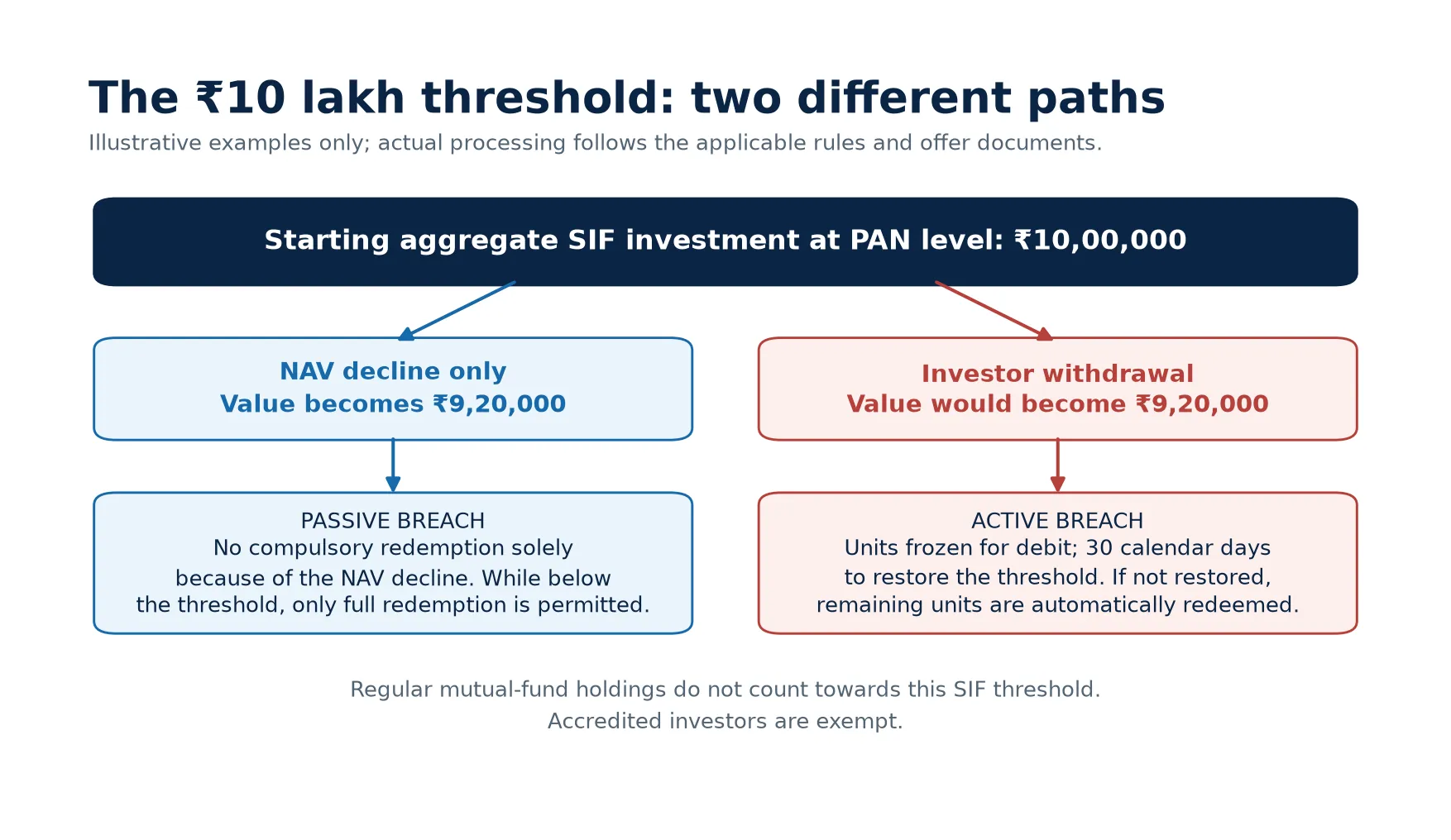
A simple ₹10 lakh example
| Illustrative event | Aggregate SIF value | Why it matters |
|---|---|---|
| Starting investment | ₹10,00,000 | Meets the threshold |
| NAV decline of 8% | ₹9,20,000 | Passive breach; no compulsory redemption solely because of the decline |
| Investor withdrawal that would leave ₹9,20,000 | ₹9,20,000 | Active breach; the restoration and automatic-redemption process applies |
These examples illustrate the threshold mechanics, not any strategy’s expected return. Actual transactions are governed by the applicable rules and offer documents.
Some SIF strategies offer SIP, STP or SWP facilities. Their availability, instalment amounts and terms are strategy-specific. Do not assume that a small SIP can be started independently of the ₹10 lakh threshold. Check the specific Investment Strategy Information Document (ISID) and the AMC’s operating rules before committing.
What makes SIF strategies different?
SIF strategies can use investment approaches that are not available in the same form to ordinary mutual-fund schemes. For example, SEBI permits specified equity long-short strategies to take unhedged short exposure through derivatives up to 25% of net assets. That limit applies to the relevant permitted strategy; it should not be assumed to apply identically to every SIF.
A short position can help a manager express a negative view or manage some portfolio exposures. It can also lose money. Derivatives can magnify losses, behave differently from the underlying security and create basis, liquidity or counterparty risks. A more flexible strategy is not automatically a better strategy.
The SIF label also does not guarantee that a strategy will protect capital during a market decline. SEBI’s investor FAQ specifically identifies the possibility of capital loss and calls attention to liquidity and derivatives-related risks.
Liquidity is a strategy-level question
There is no single redemption schedule that applies to every SIF. The regulatory framework permits:
| Strategy orientation | Maximum redemption frequency | What the investor should check |
|---|---|---|
| Equity-oriented | Daily | Whether the strategy instead uses a less frequent redemption window |
| Hybrid | Twice a week | The specified redemption days and any notice period |
| Debt-oriented | Once a week | The specified redemption day and any notice period |
An AMC may offer less frequent windows. Subscription and redemption frequencies may also differ. A strategy may prescribe a redemption notice period of up to 15 working days, with the applicable NAV determined as stated in the ISID.
Before investing, look for:
SEBI advises investors to read the ISID, Key Information Memorandum and Statement of Additional Information. The strategy documents—not the SIF label alone—provide the relevant details.
Who might consider researching an SIF?
An SIF may be worth researching for an investor who:
- Already has an adequate core portfolio aligned with their goals
- Has genuine surplus capital and can tolerate a loss
- Understands the specific strategy and its use of derivatives
- Can accept the strategy’s liquidity and redemption terms
- Is willing to evaluate a strategy without assuming its early performance will persist
The minimum threshold is an eligibility requirement—not a suitability test. Having ₹10 lakh available does not, by itself, mean that an SIF belongs in someone’s portfolio.
Who may be better served by continuing a regular SIP?
For an investor who is still building an emergency reserve, paying down expensive debt or investing towards long-term goals, a diversified mutual-fund SIP may remain the more straightforward approach.
That is not because SIPs are risk-free. It is because the investor can choose a scheme matched to the goal and risk profile, contribute at a manageable pace and avoid taking on a more complex strategy before understanding its trade-offs.
If an investor is building a future surplus, that should be done in an investment aligned with their own goals and time horizon—not simply to cross an SIF threshold. Returns are uncertain, and the value may be below the original contribution when the money is needed.
You can illustrate regular contributions, transfers and withdrawals with SERNET’s Funds Calculators. These are planning illustrations, not forecasts or recommendations.
Tax treatment: check the strategy, not the acronym
SIFs operate within the mutual-fund framework, but investors should not assume that every SIF has the same tax treatment. Tax treatment depends on the nature and classification of the investment strategy and the tax law in force at the relevant time. Read the strategy’s tax disclosures and seek tax advice for your circumstances.
This is especially important when comparing equity-oriented, debt-oriented and hybrid strategies. A broad label is not enough to determine an individual investor’s final tax treatment.
A simple decision guide
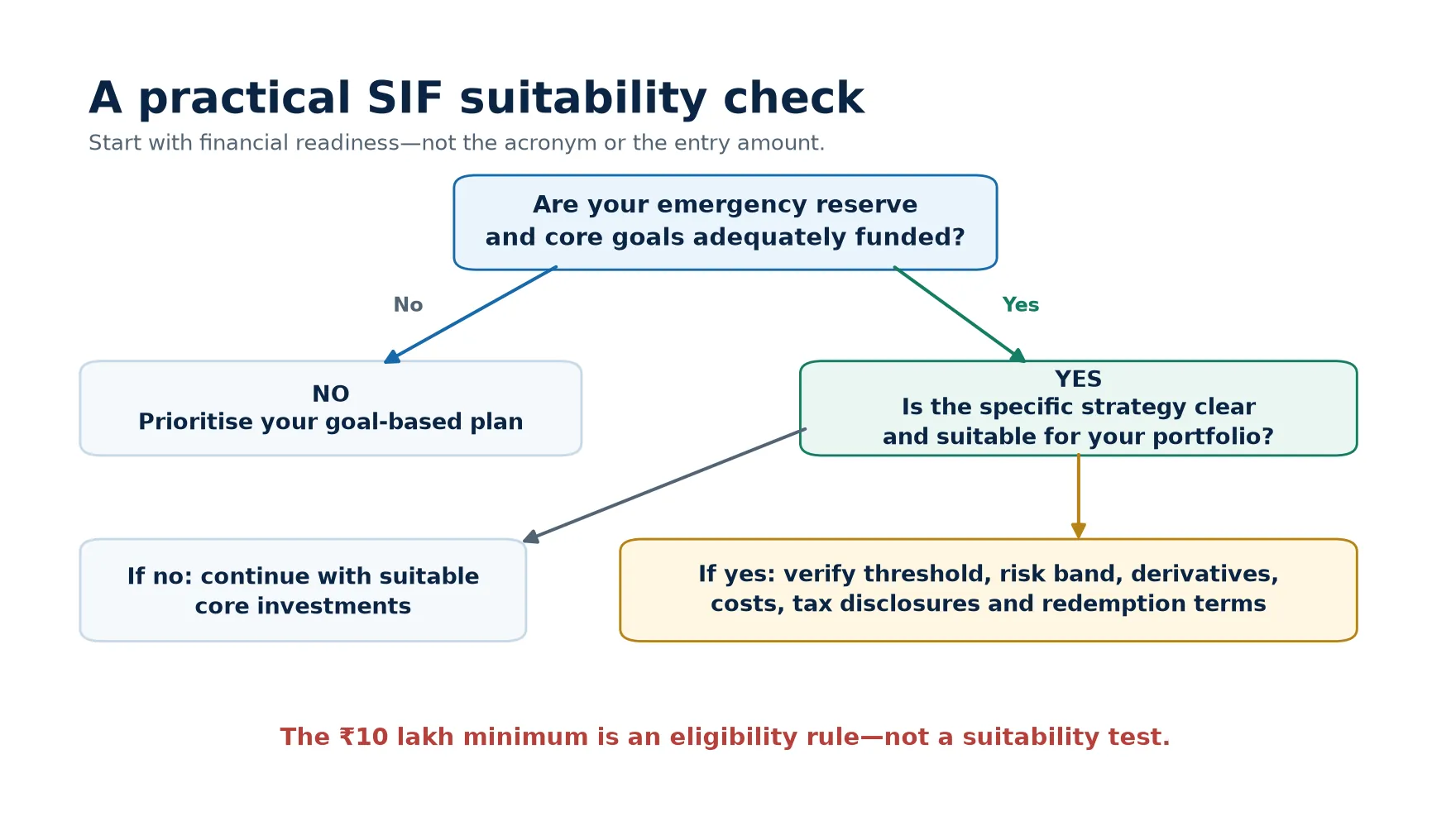
Before investing, answer these questions:
- What role would this strategy play in my portfolio?
- What could cause it to underperform or lose money?
- How much exposure can it take through derivatives or short positions?
- What is the actual redemption frequency and notice period?
- Does the ₹10 lakh threshold apply to me, and what happens if I transact below it?
- What are the strategy’s costs, benchmark and tax disclosures?
- Do I understand the strategy well enough to stay invested through a difficult period?
The takeaway
SIP and SIF are not alternatives. SIP is a contribution method; SIF is a regulated product category with specific investment strategies and a minimum investment threshold.
For many investors, the practical starting point remains a suitable, diversified core portfolio built consistently over time. An SIF should be considered only when a particular strategy has a clear portfolio role, the investor understands its risks and liquidity terms, and the minimum-threshold rules are workable.
The decision should be driven by suitability—not by the acronym, the entry amount or the promise of a more sophisticated strategy.
Regulatory source
*Regulatory rules and offer-document terms may change. Check the latest SEBI material and the specific strategy documents before making a decision.*
Want help choosing funds that suit your goals?
Start with Tick FundsDisclaimer: Mutual fund investments are subject to market risks; read all scheme-related documents carefully. SERNET is an AMFI-registered mutual fund distributor and receives commission from fund houses.
Get SERNET Insights in your inbox
Market updates, IPO notes and money guides.
For preference changes, reactivation or unsubscribe, email support@sernetindia.com from your subscribed address.
Was this article helpful?