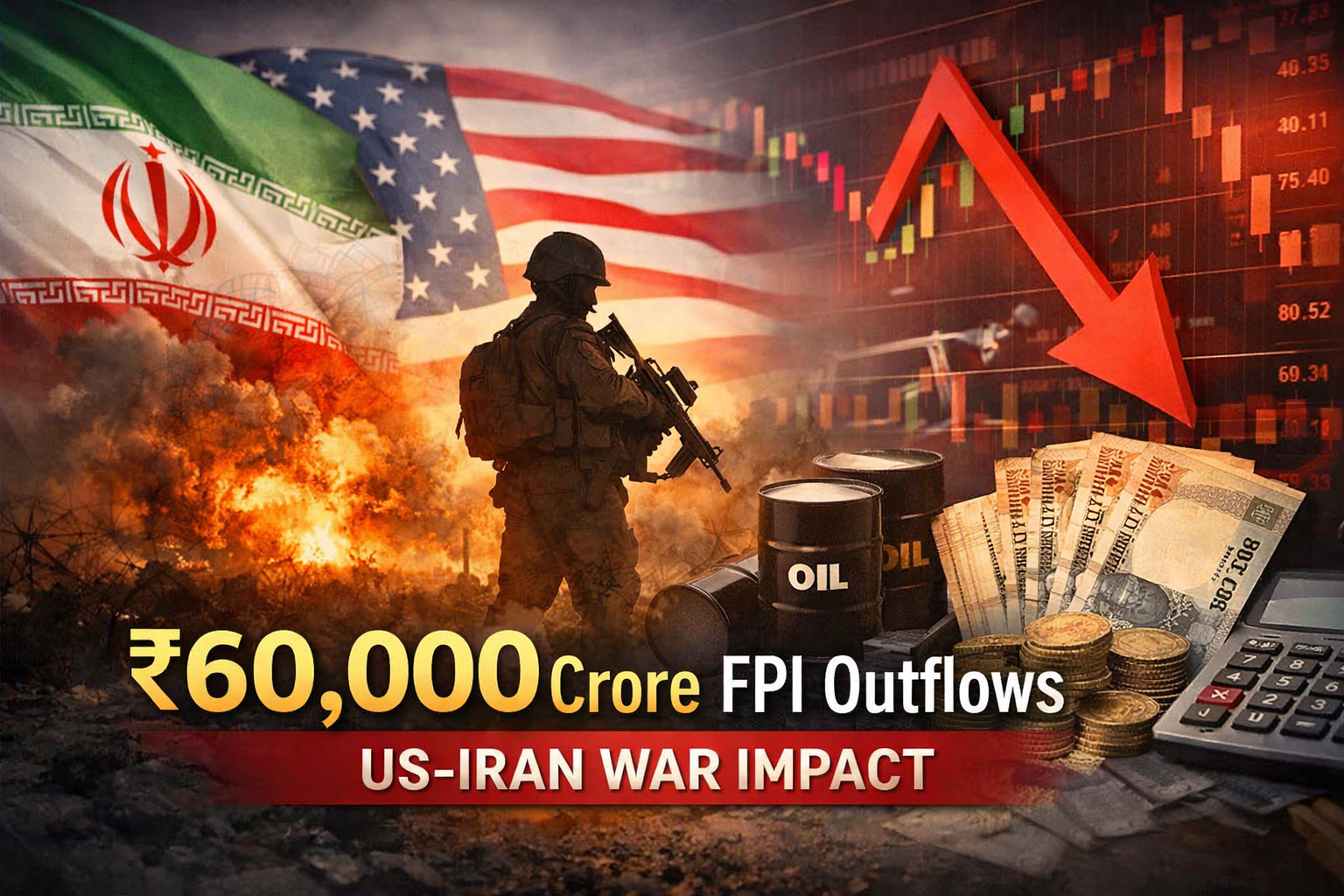
FPIs sell $6.55 billion in the first 9 days of March 2026
US-Iran war sparks ₹60,000 Cr FPI outflows from India as oil surges, rupee weakens, and Hormuz blockade raises market risks. Key scenarios decoded.
WAR AND MARKETS – A BAD COMBINATION
The US-Iran war started in the early hours of 28-February. Since then, the FPIs have been net sellers on all the 9 trading days till last week. In fact, the selling has been quite intense, compared to previous months. Over $5.77 billion of equity selling was largely aggravated by another $820 million of net selling in debt by the FPIs. This resulted in total FPI selling of about $6.55 billion in the first 9 days of March 2026. For now, the war shows no signs of relenting, and neither side wants to give in. The longer the war continues, Iran stands to benefit and the longer the Straits of Hormuz stays blocked, the more economies like India stand to lose. That was the story of March FPI flows.
| Transaction Date | Equity Flows (₹ in Crore) | Primary IPO Flows (₹ Cr) | Overall Equity Flows (₹ Cr) | Debt Flows (₹ Crore) | FPI Flows (₹ Crore) |
|---|---|---|---|---|---|
| 02-Mar-26 | -6,831.95 | 1,364.48 | -5,467.47 | 873.50 | -4,593.97 |
| 04-Mar-26 | -3,070.55 | 81.90 | -2,988.65 | 1,067.76 | -1,920.89 |
| 05-Mar-26 | -9,288.05 | 174.63 | -9,113.42 | -2,028.32 | -11,141.74 |
| 06-Mar-26 | -3,441.05 | 10.80 | -3,430.25 | 268.14 | -3,162.11 |
| 09-Mar-26 | -6,379.65 | 30.55 | -6,349.10 | -1,259.91 | -7,609.01 |
| 10-Mar-26 | -6,577.66 | 9.70 | -6,567.96 | -1,392.41 | -7,960.37 |
| 11-Mar-26 | -5,643.80 | 143.97 | -5,499.83 | -2,484.05 | -7,983.88 |
| 12-Mar-26 | -5,911.90 | 0.00 | -5,911.90 | -2,493.93 | -8,405.83 |
| 13-Mar-26 | -7,311.10 | -63.95 | -7,375.05 | -116.46 | -7,491.51 |
| Total INR (Cr) | -54,455.71 | 1,752.08 | -52,703.63 | -7,565.68 | -60,269.31 |
| Total US$ (Mn) | -5,925.80 | 192.19 | -5,733.61 | -819.89 | -6,553.50 |
WHAT HAS TRIGGERED THE FPI SELLING IN MARCH 2026
The first reason is the uncertainty cause by war. No FPI wants to invest in an emerging market when the overall geopolitical scenario is totally uncertain.
- The big reason for the FPI selling has been the blockade of the Straits of Hormuz. The longer the war continues, the longer the Hormuz Straits remains blocked.
- That has caused the prices of oil to skyrocket to above $100/bbl, up nearly 70% in a little over a month. Hormuz remains key to moving oil from GCC to Asia.
- The weak rupee has added to the FPI concerns, who stand to lose when the rupee is weak as it tends to diminish their dollar denominated returns.
- Finally, industries like autos, power, fertilizers, and ceramics are being starved of gas supplies, which is almost making their existing in business unviable.
WHAT ARE THE LIKELY SCENARIOS ON GEOPOLITICAL RISK?
Broadly, there are 4 possible scenarios as we see and each could have a distinct impact on the FPI flows into Indian equities.
- The first scenario is that the war ends quickly, since both the warring sides would be looking at an honourable exit from the war. If that happens, without too much of collateral damage, then the FPI flows should gravitate back towards India.
- The second scenario is that the war does not worsen, but the status quo continues. This can be a slightly tricky situation. The longer the war continues, the longer the blockade of the Straits of Hormuz and the deeper the pain for Indian companies.
- Rupee impact would largely depend on how long the Straits of Hormuz stays under block. Even if the war continues, but safe passage through the Straits of Hormuz is made possible, then the FPI flows could come back towards India.
- The last scenario is a situation wherein both sides are unrelenting and the war takes a new shape. We could see Iran start to use its long-range ballistic missiles, which could have larger repercussions. That would be a spike in geopolitical risk.
FPI selling of $6.55 billion in Indian stocks and bonds in the first 9 days of March clearly underline that the fear factor among the FPIs is quite high. The weak rupee has induced selling in equities and debt. A lot will depend on how the geopolitical risk pans out!
Want help choosing funds that suit your goals?
Start with Tick FundsDisclaimer: Mutual fund investments are subject to market risks; read all scheme-related documents carefully. SERNET is an AMFI-registered mutual fund distributor and receives commission from fund houses.
Was this article helpful?