
The Complete Portfolio Health Check: When to Review, When to Rebalance and When to Do Nothing
A practical Indian investor guide to reviewing goals, risk, returns, diversification and tax before you rebalance.
*An Indian investor's practical guide to measuring portfolio performance, managing risk, reducing unnecessary taxes and keeping investments aligned with financial goals.*
Executive summary
A portfolio can be profitable and still be poorly managed.
Your mutual funds may be generating attractive returns, your stocks may be reaching new highs, and your overall wealth may be increasing. Yet beneath those numbers, your portfolio could be carrying excessive risk, duplicating the same investments, falling behind your financial goals or accumulating avoidable tax liabilities.
Conversely, a portfolio that has temporarily underperformed may still be doing precisely what it was designed to do.
This is why successful investing requires more than tracking returns.
It requires a structured process for evaluating whether your investments remain suitable for your goals, financial circumstances and capacity to withstand losses.
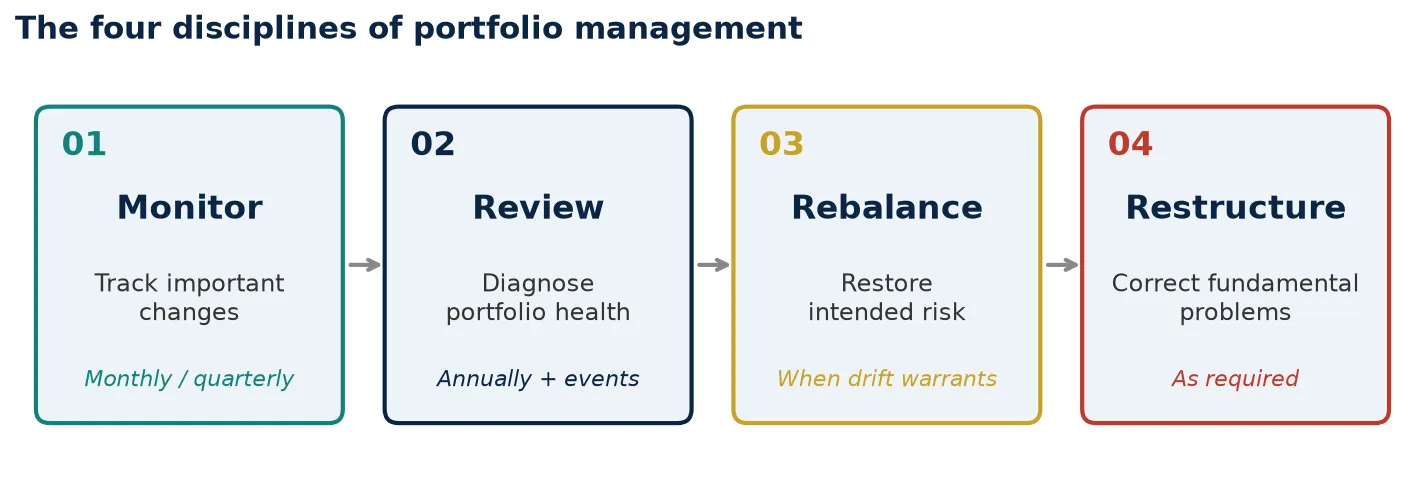
*The four disciplines of portfolio management: monitor, review, rebalance, restructure*
The most important principle is simple:
A portfolio review is a decision-making exercise, not a compulsory buying-and-selling exercise.
A successful review may conclude that no changes are necessary.
1. Review, rebalance and restructure: Understanding the difference
| Activity | Purpose | Typical frequency | Does it require transactions? |
|---|---|---|---|
| Monitoring | Identify unusual changes | Monthly or quarterly | No |
| Portfolio review | Evaluate suitability, progress and risk | Annually; event-driven when needed | No |
| Rebalancing | Restore target asset allocation | When drift warrants action | Sometimes |
| Restructuring | Correct unsuitable investments or changed objectives | As required | Often |
Think of a portfolio as a vehicle on a long journey.
Monitoring is checking the dashboard. Reviewing is assessing whether the vehicle is on the correct route and remains fit for the journey. Rebalancing is correcting its direction. Restructuring is changing the vehicle or the route because your needs have fundamentally changed.
Constantly changing investments simply because markets move can create costs without improving outcomes.
2. When should you review your portfolio?
An annual comprehensive review is a practical starting point for many long-term investors. It is not a regulatory requirement or a universal rule.
Different portfolio components need different monitoring frequencies.
| Review trigger | Recommended action |
|---|---|
| Monthly | Track contributions, cash flows, upcoming obligations and unusual transactions |
| Quarterly | Check allocation drift, major fund changes and concentration |
| Annually | Conduct a comprehensive goals, risk, performance and tax review |
| Major life event | Reassess financial goals, liabilities and protection |
| Goal approaching within 2–3 years | Reconsider the amount exposed to market volatility |
| Material portfolio drift | Evaluate whether rebalancing is justified |
| Major regulatory or tax change | Reassess implementation and post-tax outcomes |
Life-stage differences
A 28-year-old professional investing for retirement may reasonably tolerate significant interim volatility.
A 55-year-old preparing to retire in five years needs to evaluate sequence-of-returns risk, liquidity and withdrawal planning.
A business owner with irregular income may require larger liquidity reserves than a salaried employee.
An HNI with concentrated business ownership, property and unlisted investments must examine risks across the entire household balance sheet, not merely the mutual fund statement.
The review process should be consistent, but its conclusions must be investor-specific.
3. The seven pillars of a portfolio health check
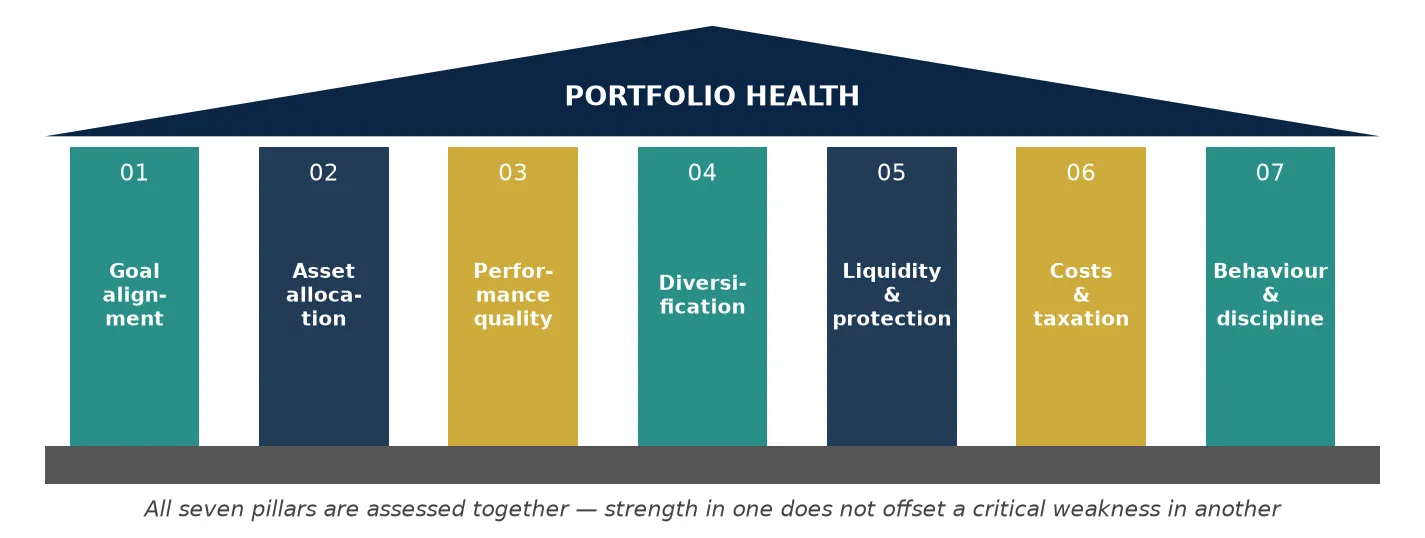
*The seven pillars of a portfolio health check*
| # | Pillar | Key question |
|---|---|---|
| 01 | Goal alignment | Are investments sufficient and appropriately timed for future financial needs? |
| 02 | Asset allocation | Does the balance of equity, debt, gold, property and cash match the intended risk profile? |
| 03 | Performance quality | Are returns appropriate relative to benchmarks, risks and investment objectives? |
| 04 | Diversification | Is wealth genuinely diversified, or concentrated in overlapping exposures? |
| 05 | Liquidity and protection | Can the investor meet emergencies and liabilities without distressed selling? |
| 06 | Costs and taxation | Are expense ratios, exit loads, taxes and turnover reducing wealth unnecessarily? |
| 07 | Behaviour and discipline | Are investment decisions consistent, documented and free from repeated emotional reactions? |
A portfolio health review should consider all seven pillars together.
For example, a fund may have excellent historical returns but be unsuitable for a goal that must be funded in six months.
Likewise, a portfolio may be diversified across ten funds but still hold the same large-cap stocks repeatedly.
4. Are your investments actually meeting your goals?
Consider an investor planning to accumulate ₹1 crore over the next 15 years.
Assume the investor has ₹10 lakh already invested and expects an illustrative annual return of 10%.
Worked example: goal funding
| Particular | Value |
|---|---|
| Target corpus | ₹1,00,00,000 |
| Years remaining | 15 |
| Assumed annual return | 10% |
| Existing investment | ₹10,00,000 |
| Existing investment's illustrative value after 15 years | ≈ ₹41.8 lakh |
| Shortfall to be funded by monthly SIP | ≈ ₹58.2 lakh |
| Estimated required monthly investment | ≈ ₹14,614 |
*Illustrative end-of-month contributions using an effective monthly rate derived from the annual return assumption. Excludes taxes, costs and inflation adjustments. Returns are not guaranteed. Try your own numbers with the SERNET SIP calculator.*
A review should determine whether the investor's current contribution is adequate, whether the target remains realistic and whether the risk required to pursue it is acceptable.
Importantly, the assumed return should not be increased merely to make the required SIP appear affordable.
5. Asset allocation: The foundation of portfolio risk
Asset allocation determines how capital is distributed across different investment categories.
A common mistake is allowing market movements to change the portfolio's risk without consciously deciding to do so.
Consider a ₹20 lakh portfolio initially allocated 70% to equity and 30% to debt.
If equity rises by 30% while debt earns 6%, the allocation changes substantially.
| Particular | Equity | Debt | Total |
|---|---|---|---|
| Original value (70:30) | ₹14,00,000 | ₹6,00,000 | ₹20,00,000 |
| Return | +30% | +6% | — |
| Current value | ₹18,20,000 | ₹6,36,000 | ₹24,56,000 |
| Current allocation | 74.1% | 25.9% | 100% |
| Value at 70:30 target | ₹17,19,200 | ₹7,36,800 | ₹24,56,000 |
| Excess / (shortfall) | ₹1,00,800 | (₹1,00,800) | — |
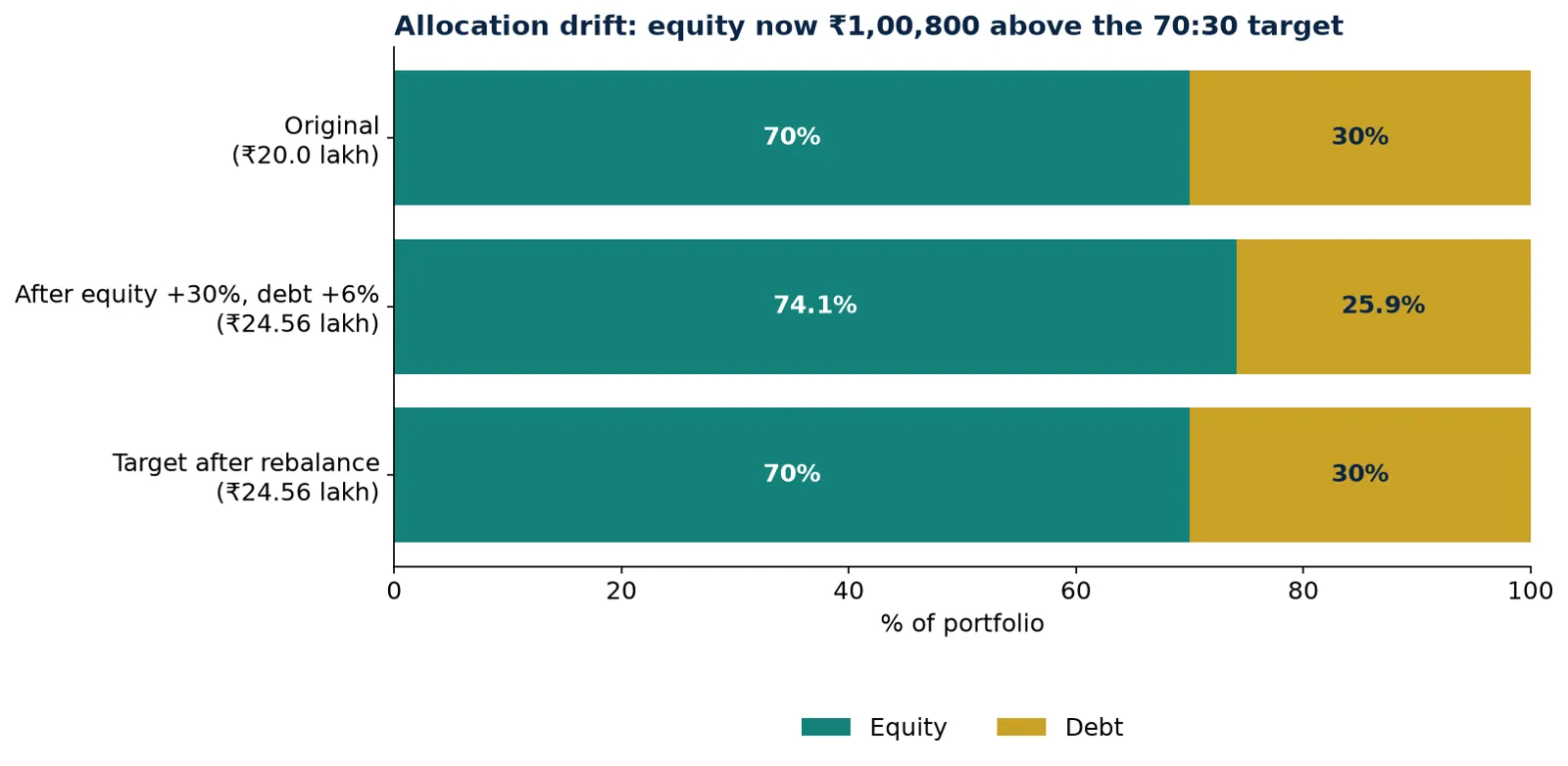
*Allocation drift after equity rises 30% and debt earns 6%*
*Assumes no cash flows, no transaction costs or taxes. A negative excess would mean equity is below target and may require additions instead.*
Selling is not always the best response.
If the deviation is modest, fresh SIPs or new investments can be directed towards the underweighted asset class. This may reduce transaction costs and defer taxable gains.
Three ways to rebalance
| Method | How it works | Main advantage |
|---|---|---|
| Calendar-based | Review allocation at predetermined intervals | Simple and disciplined |
| Threshold-based | Rebalance when allocation exceeds a defined band | Responds to meaningful drift |
| Cash-flow-based | Use new contributions or withdrawals to correct allocation | Can minimise selling and taxes |
A five-percentage-point deviation is a possible policy trigger, not a universal standard. Appropriate thresholds depend on asset volatility, portfolio size, transaction costs and investor circumstances.
6. Measuring returns correctly: CAGR, XIRR and rolling returns
One of the most common portfolio review mistakes is comparing investment returns calculated using different methods.
A mutual fund SIP, a lump-sum investment and a stock portfolio with frequent deposits cannot always be evaluated using the same return measure.
Understanding the important metrics
| Metric | What it measures | Most appropriate use |
|---|---|---|
| Absolute return | Total percentage gain or loss | Simple, short-period comparisons |
| CAGR | Annualised growth between starting and ending values | Lump-sum investments |
| XIRR | Annualised return considering dated cash flows | SIPs and portfolios with irregular transactions |
| Rolling returns | Returns across multiple overlapping holding periods | Evaluating consistency |
| Benchmark-relative return | Performance against an appropriate index | Assessing investment results |
| Maximum drawdown | Largest peak-to-trough decline | Understanding downside risk |
| Volatility | Variability of returns | Assessing market fluctuation |
| Sharpe ratio | Excess return per unit of volatility | Risk-adjusted comparisons, with limitations |
Example: Two investments with the same total return
Assume two investments each generate a 40% absolute return.
| Holding period | Total return | CAGR |
|---|---|---|
| 3 years | 40% | 11.9% |
| 5 years | 40% | 7.0% |
| 7 years | 40% | 4.9% |
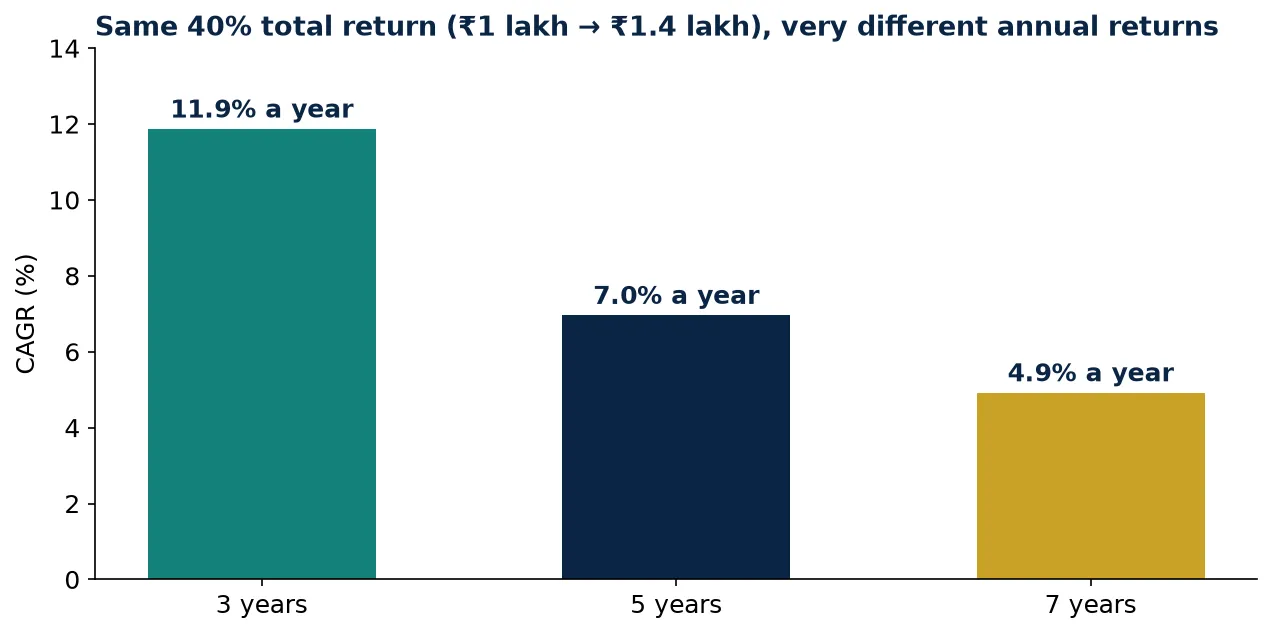
*Same 40% total return over 3, 5 and 7 years produces very different CAGRs*
The total return is identical, but the investment experience is very different.
This is why investors should not compare a fund's three-year CAGR with another fund's five-year absolute return.
Why XIRR matters for SIP investors
Suppose an investor makes monthly contributions for several years.
The investment made in the first month has been exposed to market movements much longer than the most recent contribution.
XIRR accounts for the actual dates and amounts of contributions and withdrawals.
However, XIRR can be misleading for very short periods or portfolios with unusual cash-flow patterns. For evaluating the investment manager's performance independently of investor cash-flow timing, time-weighted returns may be more suitable.
Why rolling returns are valuable
A five-year trailing return tells investors what happened during one particular five-year period.
Five-year rolling returns examine many different five-year windows.
That helps answer a more useful question:
Was the fund consistently competitive, or did its apparent success depend on one unusually favourable market period?
A comprehensive review should therefore assess performance over comparable periods and against appropriate benchmarks, not simply rank funds by recent returns.
7. Diversification: Are your ten funds really ten different investments?
Holding more schemes does not automatically improve diversification.
Consider an investor owning five large-cap mutual funds. Each fund may hold substantial positions in the same leading banks, technology companies and industrial businesses.
The investor owns five products but may still have a highly concentrated economic exposure.
Illustrative portfolio overlap
| Fund | Hypothetical overlap with Fund A |
|---|---|
| Large-cap Fund A | Reference |
| Large-cap Fund B | 72% |
| Flexi-cap Fund C | 48% |
| Large & mid-cap Fund D | 35% |
| Small-cap Fund E | 8% |
Hypothetical percentages, included to demonstrate the concept. These are not measurements of actual mutual fund portfolios.
Overlap should be calculated from the underlying holdings using a consistent methodology and reporting date. Different overlap measures can produce different results.
The objective is not necessarily to eliminate every repeated stock.
It is to ensure that each investment serves a clear purpose.
A useful review asks whether each fund contributes a genuinely different exposure, investment strategy, risk characteristic or financial objective.
Look beyond mutual funds
True household diversification should also consider:
For example, an investor working in the IT industry, holding employer shares and investing heavily in technology mutual funds may have more technology-sector exposure than their investment statement suggests.
8. Portfolio review and Indian taxation: What investors must understand
Tax efficiency is an important part of portfolio management because investors ultimately spend or reinvest post-tax wealth, not reported pre-tax returns.
But tax considerations should support sound investment decisions, not override them.
Equity taxation: Key rules for FY2026–27
For eligible listed equity shares and equity-oriented mutual funds subject to the relevant securities transaction tax conditions:
| Holding period | Capital gain classification | Applicable base tax rate |
|---|---|---|
| Up to 12 months | Short-term capital gain | 20% |
| More than 12 months | Long-term capital gain | 12.5% on aggregate eligible LTCG exceeding ₹1.25 lakh in the tax year |
Applicable surcharge and cess may increase the final liability. The ₹1.25 lakh threshold applies to aggregate eligible gains under the relevant provision, not separately to each mutual fund.
These rates are reflected in the Income Tax Department's guidance and NISM's 2026–27 investor education material.
Example: Tax-aware equity redemption
Suppose an investor has ₹2 lakh of eligible realised long-term equity gains during a tax year, with no other gains using the annual threshold.
| Particular | Amount |
|---|---|
| Eligible LTCG | ₹2,00,000 |
| Annual threshold | ₹1,25,000 |
| Taxable gain | ₹75,000 |
| Tax at 12.5% | ₹9,375 |
| Health and education cess at 4% | ₹375 |
| Illustrative total | ₹9,750 |
This assumes no applicable surcharge, adjustments or special circumstances.
A review conducted before the tax year ends can help investors evaluate whether a planned redemption should occur immediately or after an applicable holding-period milestone.
But delaying a necessary sale merely to save tax can be counterproductive if market risk is substantial.
Debt mutual funds require special attention
Not all mutual funds receive the same capital gains treatment.
For specified debt-oriented mutual funds, the special taxation rules generally deem gains on units acquired on or after April 1, 2023 to be short-term, regardless of holding period.
The definition of specified mutual funds was revised for FY2025–26 onwards, focusing on funds with more than 65% in debt and money-market instruments, or qualifying fund-of-funds structures.
Investors must therefore verify the actual scheme classification, acquisition date and applicable tax provisions rather than assuming that every fund becomes eligible for long-term capital gains treatment after two years.
The tax checklist before switching
| Question | Why it matters |
|---|---|
| Is the gain short-term or long-term? | Determines tax classification |
| What is the original purchase date? | SIP instalments may have different holding periods |
| Are there exit loads? | Can reduce realised proceeds |
| Are there existing realised gains or losses? | Affects aggregate tax computation |
| Can fresh contributions correct the allocation? | May avoid an immediate taxable sale |
| Is the switch between schemes or plans? | Mutual fund switches generally constitute taxable redemptions |
| Is the investment held by an NRI or another entity? | TDS, treaty and entity-specific rules may apply |
Tax-loss harvesting
Capital losses can sometimes be used to offset eligible capital gains, subject to the applicable set-off rules.
Broadly, short-term capital losses can be set off against eligible short-term or long-term capital gains, while long-term capital losses can generally be set off only against long-term capital gains.
Carry-forward of eligible losses normally requires compliance with return-filing requirements and applicable timelines.
Tax-loss harvesting should never be treated as an automatic recommendation to sell underperforming investments.
The decision should consider the investor's future investment thesis, transaction costs, tax rules and the economic substance of any repurchase.
Tax efficiency means maximising suitable post-tax outcomes, not minimising tax at any cost.
9. What should a portfolio review recommend?
A review should produce an understandable decision for each material investment.
| Decision | When it applies |
|---|---|
| Hold | Investment remains suitable, and no material corrective action is justified. |
| Monitor | There is a concern, but insufficient evidence for immediate action. |
| Redirect | Adjust future SIPs or contributions to improve portfolio balance. |
| Rebalance | Correct a meaningful allocation deviation after evaluating costs and taxes. |
| Replace / Exit | A material suitability, quality, liquidity or investment-thesis problem justifies action. |
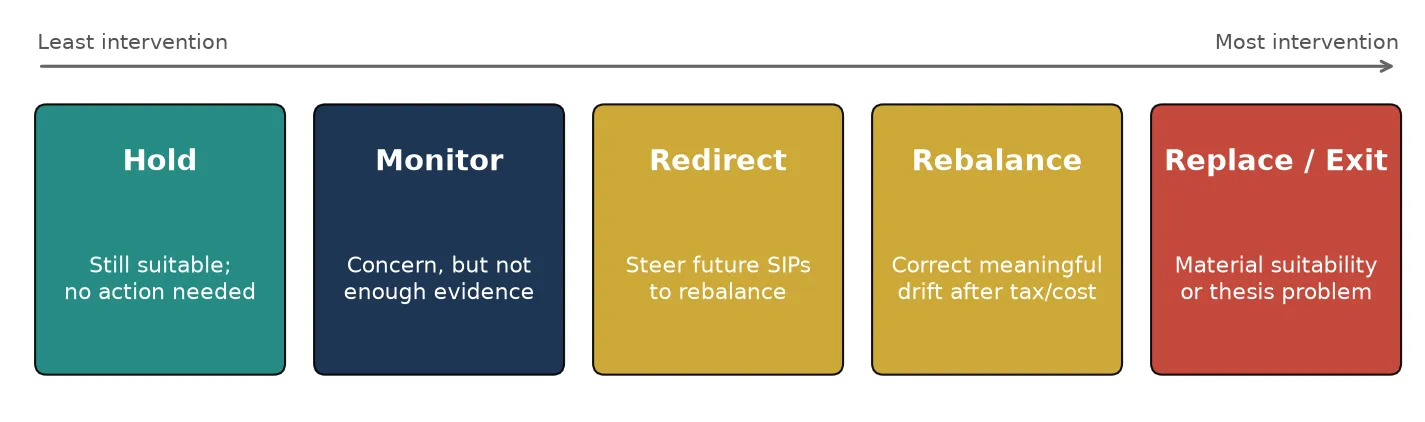
*The portfolio review decision ladder: from least to most intervention*
An underperforming investment does not automatically deserve replacement.
Before exiting, examine whether its underperformance is temporary, whether the benchmark is appropriate, whether the original investment thesis remains valid and whether the expected improvement justifies the tax and transaction costs.
Similarly, a strong-performing investment should not automatically receive additional capital if it has become excessively concentrated or overvalued.
10. The SERNET Portfolio Health Score
A structured scorecard can make portfolio reviews more consistent and easier for investors to understand.
The following is a proposed educational framework. It is not a SEBI-prescribed score or a statistically validated predictor of future returns.
Illustrative example: 65 / 100 — generally sound; improvements needed
| Pillar | Weight | Sample score (1–5) | Weighted points |
|---|---|---|---|
| Goal alignment | 20% | 4 | 16 |
| Asset allocation and risk | 20% | 3 | 12 |
| Performance quality | 15% | 3 | 9 |
| Diversification | 15% | 2 | 6 |
| Liquidity and protection | 15% | 4 | 12 |
| Cost and tax efficiency | 10% | 3 | 6 |
| Investment discipline | 5% | 4 | 4 |
| Total | 100% | — | 65 |
*Weighted points = weight × (score ÷ 5). A higher score does not guarantee investment safety or performance. The framework requires documented evidence, assessment criteria and validation before operational use.*
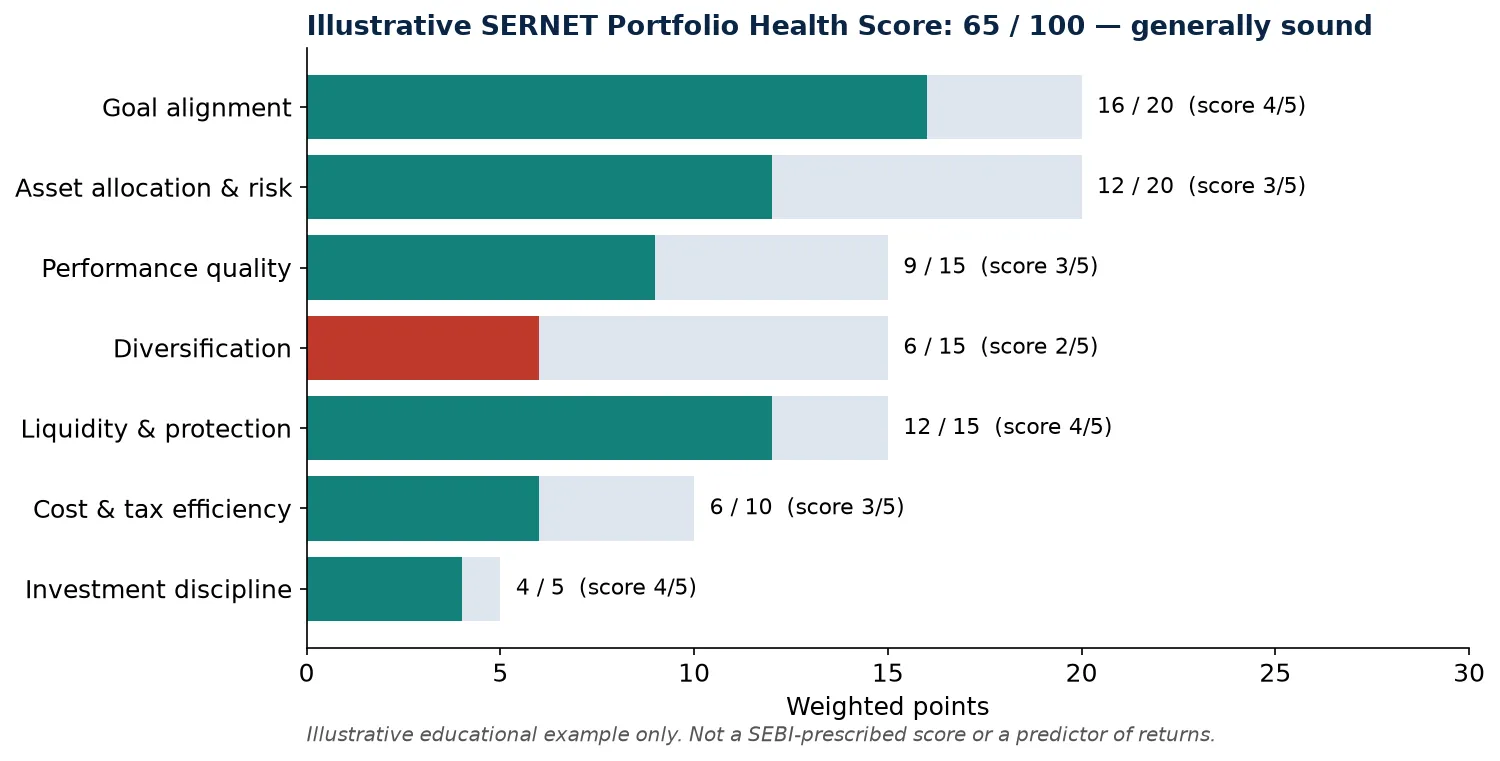
*Illustrative SERNET Portfolio Health Score breakdown*
How the score should be interpreted
| Score | Interpretation | Suggested response |
|---|---|---|
| 80–100 | Strong portfolio alignment | Maintain discipline and monitor |
| 60–79 | Generally sound | Address identified weaknesses |
| 40–59 | Material improvements needed | Conduct a detailed review |
| Below 40 | Priority attention warranted | Reassess goals, liquidity and risk promptly |
These bands are proposed educational thresholds, not empirically derived risk probabilities.
A portfolio should never receive a favourable overall assessment merely because strong performance compensates numerically for inadequate liquidity or an unsuitable risk profile. Critical deficiencies must be flagged separately.
11. What documents should you prepare for a review?
A complete review is only as reliable as the information supplied.
Portfolio review checklist
- [ ] Latest consolidated mutual fund account statement (CAS)
- [ ] Demat and direct equity holdings
- [ ] Bank deposits, bonds and other financial assets
- [ ] Insurance policies and coverage details
- [ ] Outstanding loans and repayment obligations
- [ ] Financial goals and expected withdrawal dates
- [ ] Income, expenditure and emergency fund details
- [ ] Capital gains statement and relevant tax records
For HNIs, business owners, NRIs and family portfolios, additional documentation may be needed for unlisted investments, property, overseas assets, trusts, business liabilities and succession arrangements.
12. What should investors receive after a portfolio review?
A meaningful portfolio review should result in a clear, documented summary.
Ideally, the investor should understand:
- Where they stand: Current net worth, asset allocation and progress towards goals.
- What is working: Investments and strategies that remain aligned with objectives.
- What needs attention: Concentration, unsuitable risk, weak performance, liquidity gaps or tax inefficiencies.
- What action is appropriate: Hold, monitor, redirect contributions, rebalance or restructure.
- What happens next: Implementation priorities, responsibilities and the next review date.
A review should also distinguish urgent issues from optional improvements.
For example, an inadequate emergency reserve may deserve more immediate attention than replacing a mutual fund that has modestly underperformed its benchmark.
13. Frequently asked questions
Should I review my mutual funds every month?
Monthly monitoring can be useful, but comprehensive monthly reviews are usually unnecessary for long-term investors. An annual structured review, supplemented by periodic monitoring and event-driven checks, is often more practical.
Should I sell a fund that has underperformed for one year?
Not automatically. Compare it with an appropriate benchmark and peers over relevant periods, and assess whether its strategy, risk and investment thesis remain suitable.
Is rebalancing compulsory every year?
No. Rebalancing should depend on the investment policy, asset allocation drift, cash flows, transaction costs and tax consequences.
Can I rebalance without selling investments?
Often, yes. Fresh SIPs, lump-sum contributions and planned withdrawals may help restore the desired allocation without immediately realising capital gains.
Should I wait until March to review my investments?
No. March is relevant for Indian tax-year planning, but portfolio suitability and risk should be evaluated whenever necessary. A tax-focused review during January–March can complement the annual comprehensive review.
What if my portfolio is profitable but not meeting my goals?
Positive returns are not sufficient. You may need to reassess contribution amounts, inflation assumptions, goal timelines and the suitability of your asset allocation.
Does a high portfolio health score mean my money is safe?
No. A scorecard can identify areas for review, but it cannot eliminate market, credit, liquidity, inflation or operational risks.
14. Final perspective: Review with purpose, rebalance with discipline
A healthy portfolio is not the one that changes most often.
It is the one that remains aligned with its owner's goals, financial capacity and tolerance for uncertainty.
The purpose of a portfolio review is not to identify something to sell every year.
It is to identify what deserves attention, what requires action and what should be left undisturbed.
Review to understand. Rebalance when necessary. Restructure when justified. And always evaluate the consequences after taxes, costs and risks.
That is how portfolio management becomes a disciplined wealth-building process rather than a reaction to market headlines.
Sources and further reading
| Institution | Reference |
|---|---|
| SEBI Investor Education | Understanding the Mutual Fund Riskometer |
| Income Tax Department | Capital Gains: Rules and Tax Rates |
| Association of Mutual Funds in India | Tax Regime for Mutual Funds |
| National Institute of Securities Markets | Capital Gains Tax: 2026–27 Investor Guide |
*Disclaimer: This article is for investor education and general information. It does not constitute personalised investment advice, a portfolio management service or a recommendation to buy, sell or switch securities. Tax treatment depends on the investor's status, acquisition date, asset classification and applicable law; rates mentioned reflect the position for FY2026–27 as described in the cited sources. Consult a qualified tax professional for individual tax decisions. Mutual fund investments are subject to market risks; read all scheme-related documents carefully. The SERNET Portfolio Health Score is an illustrative educational framework, not a SEBI-prescribed or validated rating. SERNET is an AMFI-registered mutual fund distributor and APMI-registered PMS distributor, not a SEBI-registered investment adviser. Want help organising your documents for a review? Contact SERNET.*
Plan your finances with a SERNET relationship manager.
Schedule a callDisclaimer: This content is for general education and is not personalised advice.
Get SERNET Insights in your inbox
Market updates, IPO notes and money guides.
For preference changes, reactivation or unsubscribe, email support@sernetindia.com from your subscribed address.
Was this article helpful?