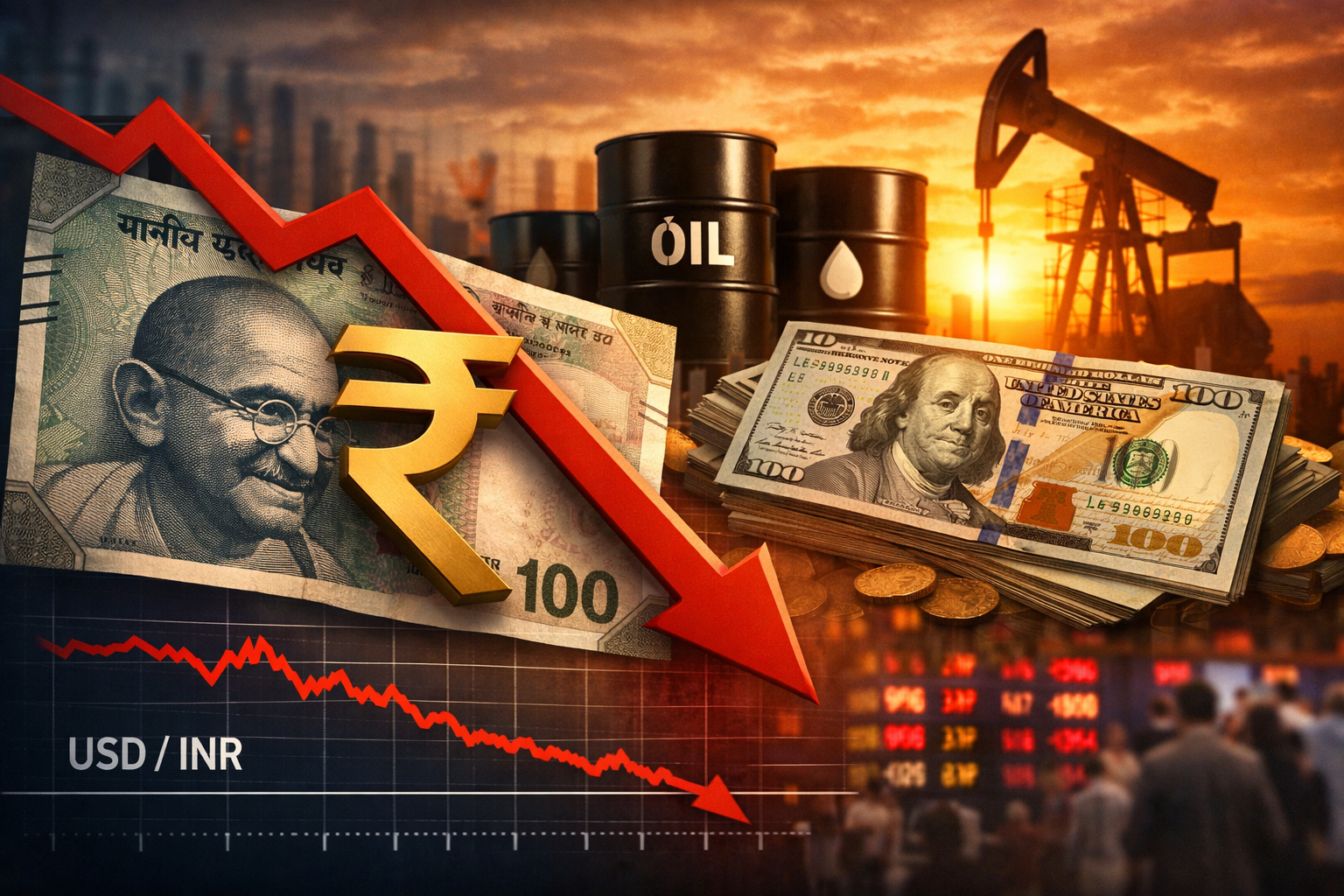
Indian Rupee – This is a currency crisis; and needs urgent remedies
During the week, the rupee fell rapidly to ₹93.7/$. The fall has been rapid in the last few months and the Indian rupee has been one of the worst performing currencies in emerging markets. But the real issue is much bigger!
Why is the Rupee falling so sharply?
There have been several reasons proffered for the rapid fall in the Indian Rupee; and each of them is true to some extent. Firstly, geopolitical risk has made the rupee vulnerable, but the rupee weakness started long before that. Secondly, FPI selling has been the other issue, as they have sold equities worth ₹1 trillion so far in 2026. There has been a distinct shift out of Indian equities into Asian semiconductor stocks. Thirdly, the sharp spike in Brent Crude prices from $60/bbl to $110/bbl in just 35 days has also caused the rupee to weaken. The bigger question is whether the central bank and the government could have prevented a vertical fall in the rupee with their $700 billion forex reserves?
What is the official stand on the Rupee?
That is not too clear at this point of time. However, the repeated RBI interventions show that the central bank is not happy with the vertical fall in the rupee. Today, if you look at the central bank positions, the net short on the dollar (across onshore and offshore), has gone up from $64 billion in January to $88 billion in February and further to $102 billion in March 2026. However, these shorts are not able to make much of an impact in defending the rupee. One strategy that has worked in India, as we saw in the 2013 currency crisis, was when multiple levers are applied aggressively. That is possibly not happening in the Indian context today, and that is clearly the need of the hour.
How Asian currencies were defended in 1997?
An interesting analogy that India can look at is how the Asian crisis developed in 1997 and how the central banks defended these currencies. The responses were varied. In case of South Korea, they accepted the $58 billion IMF bailout package and even agreed to restructure their Chaebols. Malaysia, on the other hand, refused to accept the IMF package and put capital controls. Hong Kong Monetary Authority used the funds at its disposal to buy up Hong Kong dollars and also to buy beaten down stocks. Taiwan shifted to a free float, which eventually made the NT$ stronger. In each of these cases, the strategy was different, but it eventually worked in their specific case.
India has to accept this is a currency crisis
The pace at which the rupee has fallen shows this is a crisis. Most of the FPI flows are not coming back, unless India has a story as compelling as the semiconductor story to tell. India has to decide whether it wants to make the rupee a free float or whether it wants to ban any rupee trading in the offshore markets. These may have short-term implications. The big message is that it is essential for the government and the central bank to evolve a strategy to defend the rupee. The services surplus has offset the goods deficit. However, AI could change that equation. This is a rupee crisis; and unless India has a credible Plan-B in place, it will get tougher to defend the rupee.
Turn market insight into a plan for your money.
Talk to usDisclaimer: This content is for general information and education only and is not a recommendation to buy or sell any security.
Was this article helpful?