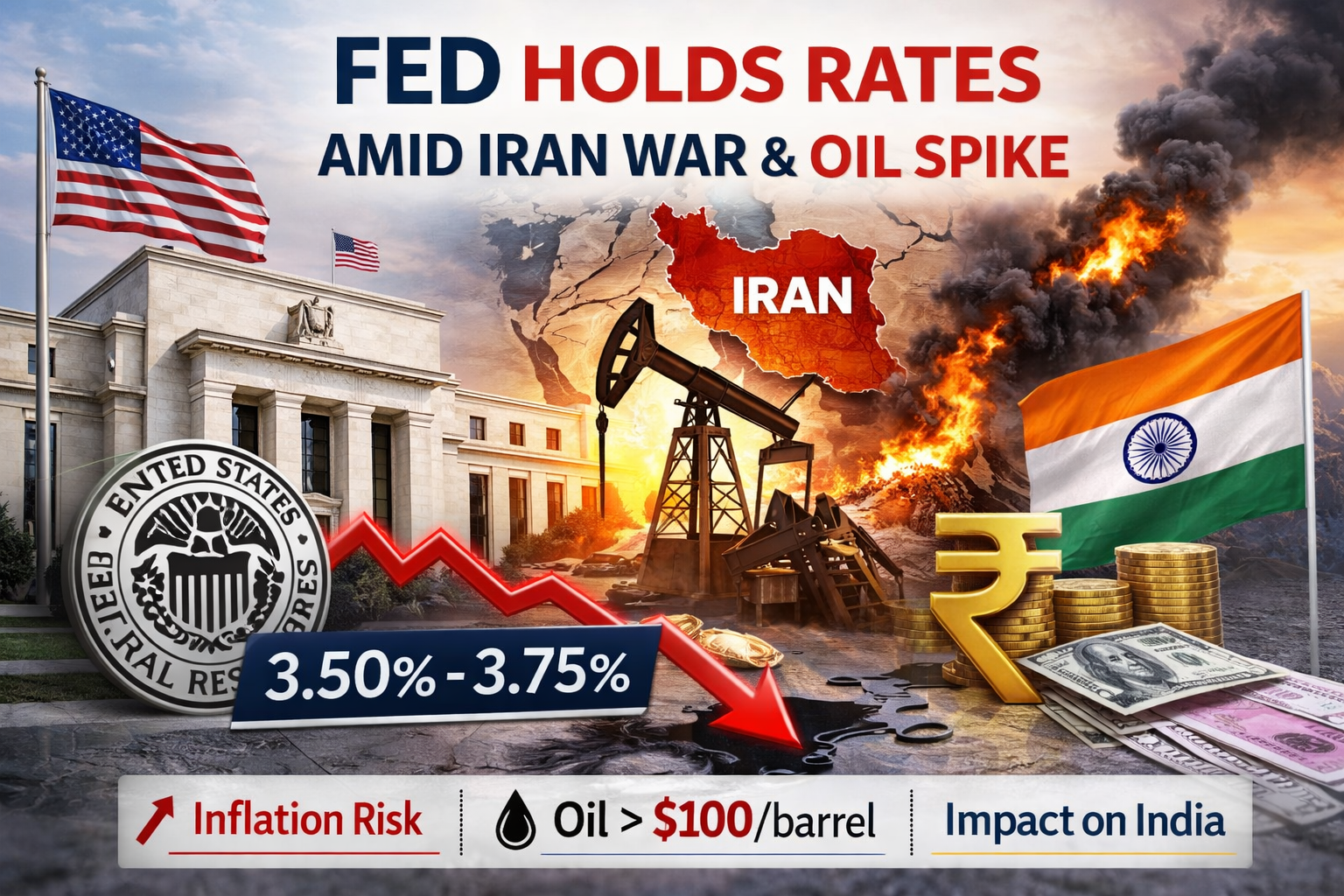
Fed Holds Rates Amid Iran War: Impact on India & Markets
Fed keeps rates unchanged amid Iran war uncertainty. Oil spike, inflation risks, and Fed outlook—what it means for India, rupee, and markets.
FED UNDERLINES UNCERTAINY CAUSED BY IRAN WAR
The US Federal Reserve, largely along expected lines, kept the rates static in the range of 3.50% to 3.75%. Since September 2024, Fed rates are already down a full 175 bps.
Fed rates peaked at 5.50% in early 2023 and stayed at that level till August 2024. In September 2024, concerns over the unemployment figure led to a series of cuts in the Fed rate. In fact, between September 2024 and December 2024, Fed cut rates by 100 basis points. Then again, between September 2025 and December 2025, the Fed cut rates by 75 bps. When the Fed had cut rates by 25 basis points in January 2026, it was clear that the Fed lacked conviction. In the last few couple of months, while there are concerns over GDP growth and unemployment; the bigger risk appears to be the likely inflation impact on account of the ongoing war in West Asia. Oil has already spiked to above $100/bbl (WTI).
READING BETWEEN THE LINES OF THE FED STATEMENT
Jerome Powell has underlined that projections were very difficult amid the war situation, and the lack of certainty over how long it will continue. Here is a gist of our readings.
- While holding rates in the range of 3.50%-3.75%, the Fed underlined that the blockade of the Straits of Hormuz and the damage to oil facilities in the Middle East were likely to create a supply shock. The price impact would be sharp, and structural.
- The Fed has given an indication that there could be possibly one more rate cut in 2026 and another one in 2027. However, due to the war uncertainty, the Fed has been unable to commit to any timelines for the rate cut. They remain ambiguous, at best.
- On questions of “stagflation” (low growth with high inflation), Powell was emphatic that was not likely at this juncture. After all, the slowdown in growth and jobs appear to be temporary and restricted only to the fourth quarter of 2025.
- There have been some subtle changes in the language of the Fed. The statement on jobs situation stabilizing has been removed. Also, there have been repeated references to the uncertainty caused by the war in the Middle East and West Asia.
- The vote for status quo on rates was almost unanimous, with only Trump nominee, Stephen Miran, still calling for rate cuts. Interestingly, even Christopher Waller appears to have switched his vote in favour of a status quo on rates.
- An interesting statement made by Powell was that inflation was not coming down as much as hoped. Also, it looks like Powell is staying in the chair till the investigations are wrapped up, so Kevin Warsh may have some more waiting to do.
The situation was best summed up by Powell in the post-policy conference. “We are balancing two goals; containing the risk of jobs on the downside and inflation on the upside.” Stock market reaction showed that markets were disappointed.
CHARTING THE ROAD AHEAD FOR FED RATES?
Here are the CME Fedwatch probabilities of rate moves at each upcoming Fed meet.
| Fed Meet | 175-200 | 200-225 | 225-250 | 250-275 | 275-300 | 300-325 | 325-350 | 350-375 | 375-400 |
|---|---|---|---|---|---|---|---|---|---|
| Jun-26 | Nil | Nil | Nil | Nil | Nil | Nil | 5.2%% | 90.9% | 3.9% |
| Dec-26 | Nil | Nil | Nil | Nil | 0.8% | 7.8% | 33.8% | 55.2% | 2.3% |
| Jun-27 | Nil | Nil | Nil | 0.3% | 2.4% | 12.8% | 37.2% | 45.3% | 1.9% |
| Dec-27 | 0.3% | 1.8% | 7.9% | 21.3% | 32.6% | 25.4% | 9.3% | 1.4% | Nil |
Data source: CME Fedwatch
The CME Fedwatch probability chart focuses on 2026 and 2027 calendar years.
- Rate cuts look unlikely till June 2026. Even by December 2026, CME Fedwatch is only assigning a probability of just 42.4% to a rate cut, which is low on conviction.
- As of June 2027, The probability of the first rate-cut is just about 52.8%, which is positive, but not a number that speaks of dovish conviction.
- Markets are expecting two rate cuts to back-ended to the second half of 2027. There is 98.6% probability of 1 rate cut and 89.3% probability of 2 rate cuts of 25 bps each.
For now, the most likely scenario is that the Fed may just wait and watch till the end of the first half of 2027. Based on the macros, the Fed would take a call on rate cuts. That is hoping that the war impact would be offset by that time!
MARCH 2026 FOMC PROJECTIONS (VERSUS LAST 2 QUARTERS)
Fed provides a quarterly update to its long-term macro projections on a quarterly basis. The table below shows the updated projections of March 2026; compared to the last 2 quarters.
| Variable | CY-2026 | CY-2027 | CY-2028 | Longer run |
|---|---|---|---|---|
| Change in real GDP (Mar-26) | 2.4 | 2.3 | 2.1 | 2.0 |
| Dec-2025 projection | 2.3 | 2.0 | 2.0 | 1.8 |
| Sep-2025 projection | 1.8 | 1.9 | 1.9 | 1.8 |
| Unemployment rate (Mar-26) | 4.4 | 4.3 | 4.2 | 4.2 |
| Dec-2025 projection | 4.4 | 4.2 | 4.2 | 4.2 |
| Sep-2025 projection | 4.4 | 4.3 | 4.3 | 4.2 |
| PCE inflation (Mar-26) | 2.7 | 2.2 | 2.0 | 2.0 |
| Dec-2025 projection | 2.4 | 2.1 | 2.1 | 2.0 |
| Sep-2025 projection | 2.6 | 2.1 | 2.1 | 2.0 |
| Core PCE inflation (Mar-26) | 2.7 | 2.2 | 2.0 | |
| Dec-2025 projection | 2.5 | 2.1 | 2.1 | |
| Sep-2025 projection | 2.6 | 2.1 | 2.1 | |
| Federal funds rate (Mar-26) | 3.4 | 3.1 | 3.1 | 3.0 |
| Dec-2025 projection | 3.4 | 3.1 | 3.1 | 3.0 |
| Sep-2025 projection | 3.4 | 3.1 | 3.1 | 3.0 |
| Data Source: US Federal Reserve (CY refers to calendar year) |
Here are 3 key takeaways from the table above
- US GDP growth for 2025 has been upgraded by 10 bps for 2026 and by 30 bps for 2027. Clearly, the US economy appears to be benefiting from tariff-driven lower imports.
- PCE inflation is expected to be sharply higher, and the pressure is likely to come largely from core inflation due to the war-related supply chain disruptions.
- While non-farm payrolls contracted in February, the overall unemployment projections have not changed compared to December. That shows overall stability.
Let us take a quick look at what these Fed statement and projections mean for India?
WHAT DOES THIS FED RATE CUT MEAN FOR INDIA?
Let us first focus on the Fed statement. The statement has highlighted that inflation is likely to remain higher and also will be driven by supply chain bottlenecks. That is not great news. Since India still buys a lot of oil in dollars, this could lead to imported inflation. However, the Fed status quo on rates does give breathing space to RBI in managing the rupee.
On the projections, we will not get into the higher inflation projections, as that is already discussed. However, the robust growth assumption in the coming years is going to be a positive for India, which is planning to ride on US growth, especially once the Indo-US trade deal is finalized. For now, the focus is entirely on the repercussions of the war in West Asia!
Turn market insight into a plan for your money.
Talk to usDisclaimer: This content is for general information and education only and is not a recommendation to buy or sell any security.
Was this article helpful?