
India's ₹1.53 Lakh Crore Margin Trading Boom: Why SEBI May Be Right to Apply the Brakes
MTF exposure hit ₹1.53 lakh crore as SEBI weighs curbs. How leverage, free-float concentration and forced selling can deepen market falls.
*When borrowed money drives stock prices higher, who absorbs the shock when markets reverse?*
India's equity markets have undergone a remarkable transformation. More retail investors, easier trading access, digital broking platforms and expanding credit facilities have made stock-market participation increasingly convenient.
But another trend deserves attention: investors are borrowing increasingly large amounts to purchase shares.
On 17 November 2026, Reuters reported that the Securities and Exchange Board of India (SEBI) is considering restrictions on fresh margin-funded stock purchases in companies where leveraged holdings have become unusually concentrated.
The reported outstanding margin-funded exposure has reached ₹1.53 lakh crore, rising 29% year-on-year and nearly doubling from late-2024 levels. Approximately two-thirds is associated with small- and mid-cap stocks.
This is not simply a story about borrowing. It raises a larger question:
Can excessive leverage turn an ordinary market correction into a chain reaction of forced selling?
| Reported MTF exposure | Annual growth | Small/mid-cap share |
|---|---|---|
| ₹1.53 lakh Cr | +29% | ~67% |
Figures reported by Reuters, 17 November 2026. The exposure estimate should not be confused with the NSE's separately reported month-end MTF book.
1. Understanding Margin Trading Facility (MTF)
Margin Trading Facility allows an investor to purchase shares by contributing part of the money while a broker finances the balance.
Consider a simple example:
Example: buying ₹4 lakh of shares with ₹1 lakh of your own money (₹3 lakh borrowed)
| Scenario | Return on own capital, before costs |
|---|---|
| Stock rises 10% | +40% |
| Stock falls 10% | −40% |
The problem is straightforward: leverage magnifies losses just as it magnifies gains.
At an illustrative 12% annual borrowing rate, a ₹3 lakh loan costs ₹36,000 a year in simple interest, before other charges. A flat stock price does not mean a cost-free investment.
2. How India's margin trading book has grown
Historical data show that leveraged equity participation has expanded dramatically over the past several years.
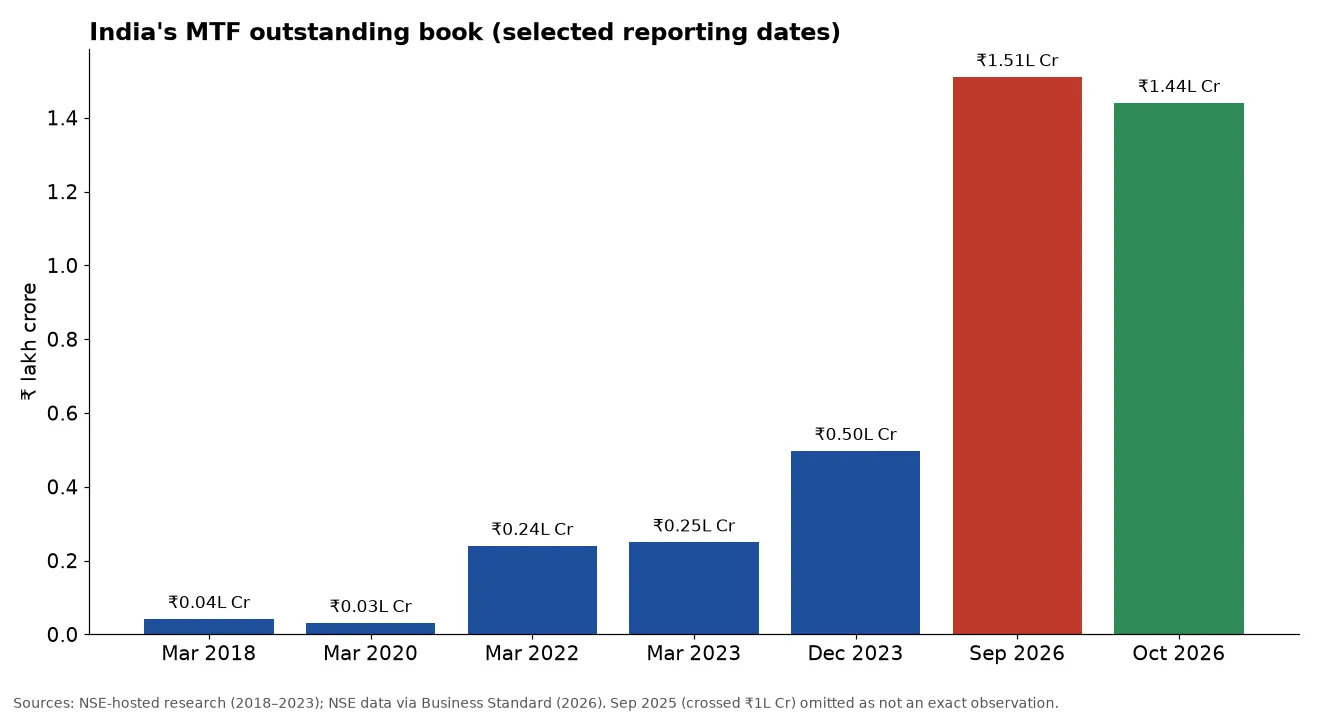
*Historical 2018–2023 figures from an NSE-hosted research document; September 2025 is a crossed-threshold reference, not an exact observation; 2026 figures from NSE data reported by Business Standard.*
| Period | MTF outstanding | Significance |
|---|---|---|
| March 2018 | ₹4,140 Cr | Early-stage market |
| March 2020 | ₹3,060 Cr | Lower leverage base |
| March 2022 | ₹23,970 Cr | Strong expansion |
| March 2023 | ₹24,920 Cr | Elevated participation |
| December 2023 | ₹49,690 Cr | Nearly ₹50,000 Cr |
| September 2025 | Crossed ₹1 lakh Cr | New milestone |
| September 2026 | ₹1.51 lakh Cr | NSE month-end high |
| October 2026 | ₹1.44 lakh Cr | 4.65% monthly decline |
The growth from March 2018 to October 2026 represents roughly 35 times the starting outstanding amount. This is a comparison of reported book sizes, not a measure of the growth in individual investor borrowing or a constant-definition credit series.
There is also a useful qualification: NSE's October month-end figure was ₹1.44 lakh crore, whereas the Reuters report cites ₹1.53 lakh crore. These are not the same observation date or necessarily identical reporting scopes, and should not be presented as interchangeable.
3. Why SEBI is concerned: The concentration problem
The most worrying statistic is not the ₹1.53 lakh crore headline. It is how much leveraged buying may be concentrated in particular stocks.
Reuters reports that:
- More than 220 stocks have MTF-funded holdings exceeding 5% of their free float.
- At least 36 stocks exceed 10% of their free float.
- SEBI is considering restricting fresh MTF positions once a stock crosses a threshold somewhere between 5% and 10%.
These are proposals under discussion, not notified rules.
What does free float mean?
Free float is the portion of a company's shares generally available for public trading, excluding strategic or otherwise non-free-floating holdings.
Imagine a company with 10 crore free-floating shares. If 80 lakh shares are held through MTF-funded positions, the MTF concentration is 8%.
*Illustration: 8% of free float financed through MTF; 92% other holdings.*
Under a hypothetical 5% threshold, this stock could be restricted for fresh MTF buying. Under a 10% threshold, it would remain below the proposed ceiling.
Why does this matter? Because shares financed through borrowed money can become more vulnerable to forced selling when prices fall and investors cannot meet margin requirements.
A stock with a limited free float, relatively thin trading volumes and concentrated leverage may experience disproportionate selling pressure.
Importantly, MTF concentration is not the same as the percentage of shares that will be forcibly sold. That depends on financing terms, collateral buffers, investor resources and market conditions.
4. The dangerous chain reaction: How a correction can become a crash
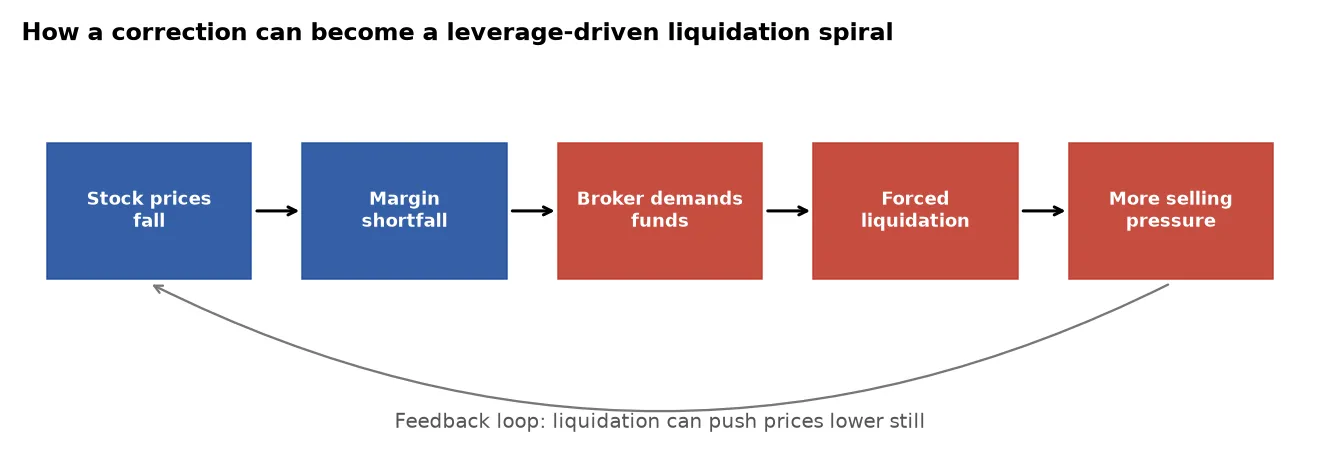
- Stock prices fall — a correction reduces collateral value.
- Margin shortfall — the investor's equity cushion shrinks.
- Broker demands funds — additional cash or collateral is required.
- Forced liquidation — positions may be sold if requirements are not met.
- More selling pressure — liquidation may accelerate the decline, feeding back into further price falls.
This mechanism is sometimes called a leverage-driven liquidation spiral. It does not mean every correction produces one. The risk increases when leverage is concentrated in stocks with insufficient liquidity to absorb selling.
What happens to the investor's capital?
The following illustration assumes ₹1 lakh of investor capital, ₹3 lakh of borrowing and 4× initial exposure, with interest and charges excluded.
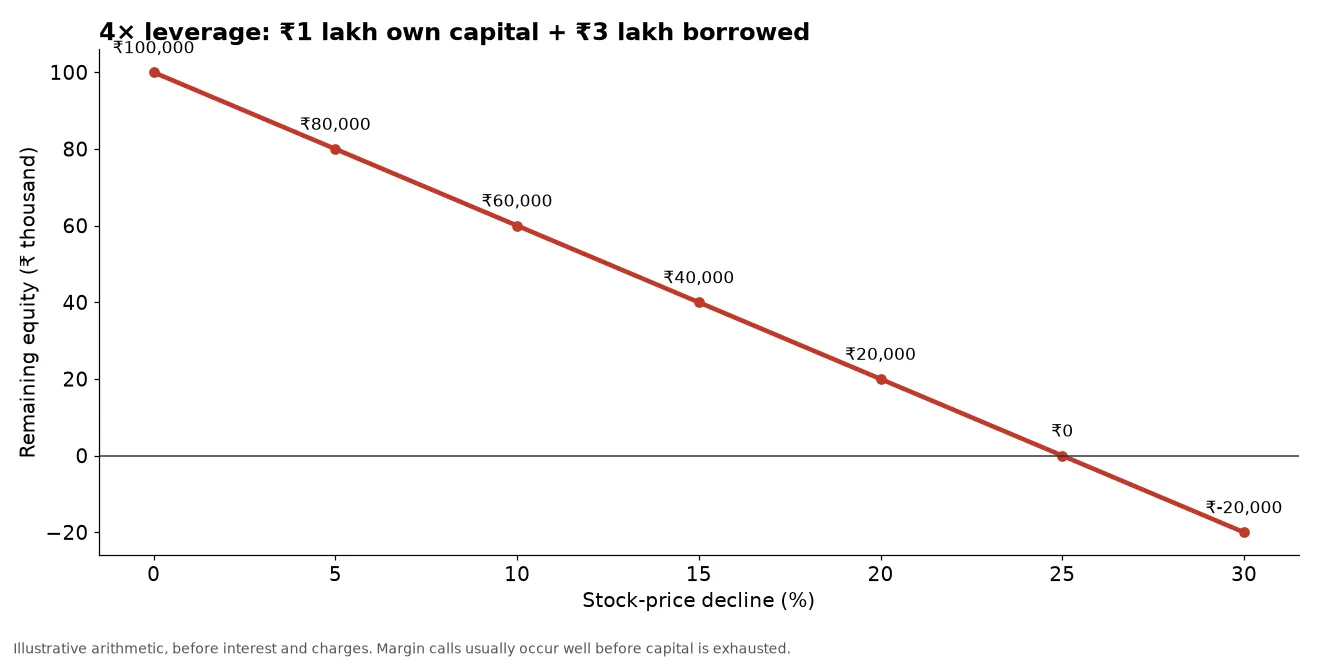
| Price decline | Remaining equity | Return on own capital |
|---|---|---|
| 5% | ₹80,000 | −20% |
| 10% | ₹60,000 | −40% |
| 15% | ₹40,000 | −60% |
| 20% | ₹20,000 | −80% |
| 25% | ₹0 | −100% |
*Illustrative arithmetic only. At a 25% price decline, initial capital is exhausted before costs. In practice, margin calls and liquidation can occur substantially earlier under broker-specific maintenance requirements.*
The lesson is that a stock need not fall 25% for a leveraged investor to face serious financial pressure.
5. How does India compare with the rest of the world?
International comparisons require care. Countries use different definitions of margin debt, collateral rules and eligible securities. Therefore, absolute balances cannot be treated as directly comparable measures of market risk.
| Market | Latest identified reference | Regulatory approach |
|---|---|---|
| India | ₹1.53 lakh Cr reported, Nov 2026 | Considering stock-level MTF concentration limits |
| United States | $1.48 trillion margin debt, Sep 2026 | Initial and maintenance margin requirements |
| South Korea | ₩36.7 trillion margin loans, Jun 2026 | Stronger oversight of leveraged retail products |
| European Union | No comparable single MTF balance established here | Retail leverage controls for CFDs, a different product |
*Derived from the Korea Capital Market Institute's reported US and Korean margin balances for end-2016 and June 2026. Indexed growth is more meaningful here than comparing balances in different currencies and market structures.*
United States: Leverage is permitted, but controlled
The US Federal Reserve's Regulation T generally allows borrowing up to 50% of the purchase price of eligible margin securities. FINRA rules generally require at least 25% maintenance equity, with brokers often imposing higher requirements.
US margin debt reached approximately $1.48 trillion in September 2026, up 31.4% year-on-year. That is substantial, but the US market is also much larger, so the absolute debt figure alone does not establish whether US investors are more leveraged than Indian investors.
South Korea: A warning about late intervention
South Korea offers a particularly relevant cautionary example.
Its margin-loan balances reached ₩36.7 trillion by June 2026, approximately 5.5 times the end-2016 level. The Korea Capital Market Institute warned that forced liquidations and leveraged-product trading could amplify market volatility.
During the sharp July 2026 selloff, Korean regulators tightened restrictions on certain single-stock leveraged products. Later, in November, authorities reportedly relaxed some collateral requirements temporarily to reduce the risk of forced selling.
This illustrates a difficult regulatory dilemma: prevent excessive leverage before stress develops, rather than relying only on emergency measures once forced selling begins.
Europe: Investor protection through product-specific controls
European regulators have used leverage limits, margin close-out requirements and negative-balance protection for retail contracts for difference (CFDs).
These are not equivalent to India's cash-equity MTF arrangements, but they demonstrate the wider principle that leverage may require additional safeguards for retail investors.
6. Is SEBI justified in considering tighter restrictions?
Yes — a carefully designed, proportionate intervention is justified by the evidence of rapid leverage growth and stock-level concentration.
However, that does not mean every proposed restriction will necessarily improve market stability.
Protecting investors from excessive leverage
Retail investors may underestimate borrowing costs, collateral requirements and the speed at which losses can multiply. Preventive controls can reduce avoidable harm.
Reducing concentration-driven volatility
Restricting new MTF exposure in already heavily leveraged stocks could reduce the accumulation of positions vulnerable to simultaneous liquidation.
Maintaining orderly price discovery
A stock's price should principally reflect business fundamentals, expected earnings and investor demand — not an unsustainable cycle of debt-financed buying.
Protecting the broader market ecosystem
Concentrated leverage can create interconnected risks for investors, brokers and market liquidity providers, even when individual accounts initially appear adequately collateralised.
But SEBI should avoid unintended consequences
A rigid 5% cap could create difficulties for some otherwise liquid and fundamentally strong companies. A sudden restriction could also reduce buying liquidity precisely when markets are weak.
A better framework would consider multiple indicators together.
| Risk indicator | Why it matters |
|---|---|
| MTF holdings / free float | Measures concentration |
| MTF holdings / average daily trading volume | Indicates potential liquidation pressure |
| Stock-price volatility | Estimates the speed of collateral erosion |
| Market depth and liquidity | Measures the market's ability to absorb selling |
| Broker-level exposure concentration | Identifies interconnected risks |
| Growth rate of MTF positions | Flags unusually rapid leverage accumulation |
These are SERNET's proposed analytical indicators, not confirmed components of SEBI's contemplated framework.
A phased implementation, transparent thresholds, periodic disclosures and a distinction between new and existing positions would make the rules more predictable.
7. What should investors do now?
Investors should not interpret the news as a reason to panic or automatically liquidate their portfolios. SEBI has not announced final rules.
Instead, the report is an opportunity to reassess leverage.
An investor using MTF should understand the effective borrowing rate, maintenance margin, collateral requirements, maximum tolerable loss and the possibility that a broker may liquidate positions when margin requirements are breached.
Long-term investors should be especially cautious about using short-term borrowing to finance positions whose investment thesis may require several years to mature.
SERNET's MTF Riskometer
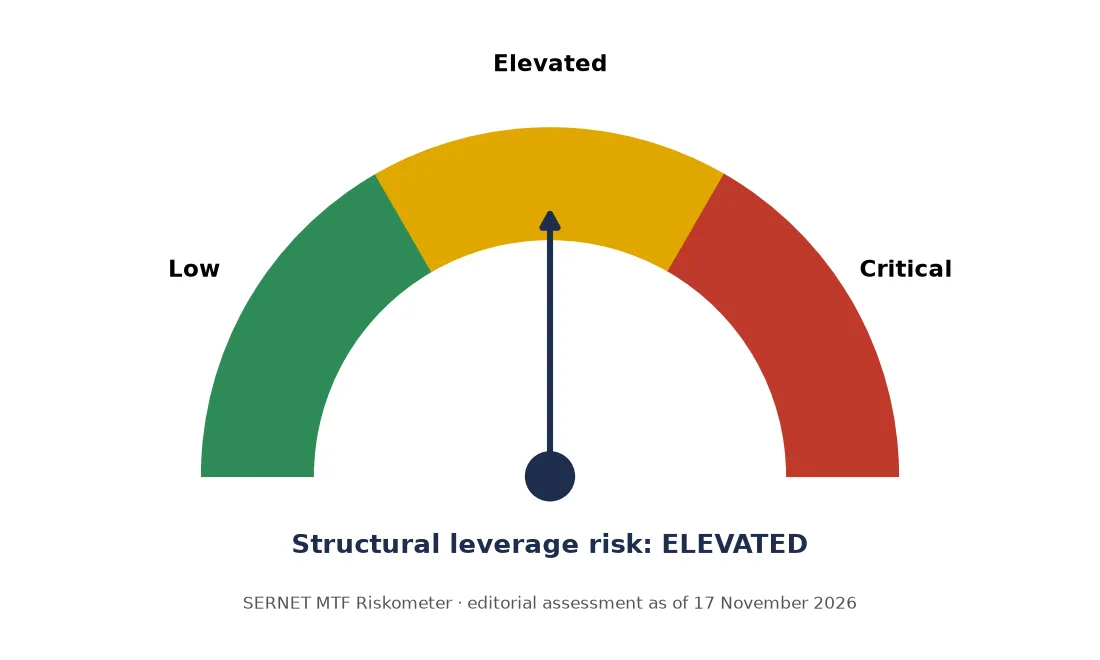
Structural leverage risk: Elevated (scale: Low · Elevated · Critical)
Key drivers: Rapid multi-year MTF growth, significant small/mid-cap exposure and more than 220 stocks exceeding 5% MTF-to-free-float concentration.
*Qualitative SERNET editorial assessment as of 17 November 2026, not a statistically calibrated score or prediction of an imminent market crash.*
8. SERNET's conclusion: The objective should be safer participation, not less participation
India's equity markets have benefited enormously from wider retail participation. Margin financing is a legitimate financial facility that can improve capital efficiency for investors who understand and can withstand its risks.
But when leverage grows faster than investors' capacity to absorb losses, it can become a source of market instability.
The proposed SEBI intervention is therefore directionally justified — particularly if it targets concentrated, illiquid and rapidly growing leveraged positions rather than restricting MTF indiscriminately.
The real test will be whether the eventual rules reduce systemic vulnerability without unnecessarily disrupting market liquidity or legitimate investment activity.
The most important distinction is between a market correction and a leverage crisis. A correction is a normal feature of equity investing. Excessive borrowing can turn that correction into forced selling, accelerating losses for investors who may otherwise have been willing to hold.
Borrowing can multiply your buying power. It cannot multiply your ability to bear losses.
That is the principle investors — and regulators — should keep at the centre of every discussion about margin trading.
Sources and publication notes
Primary reporting: Reuters, 17 November 2026 and Moneycontrol's Reuters report.
Historical and international context: NSE MTF figures reported by Business Standard, Korea Capital Market Institute, US SEC margin investor guidance and ESMA leverage safeguards.
Editorial disclosure: Information is current to 17 November 2026. The proposed SEBI restrictions remain unconfirmed and subject to consultation. Numerical simulations are illustrative, not forecasts. International comparisons involve different products, dates and reporting methodologies. This article is for investor education and does not constitute a recommendation to buy, sell or finance any security.
*SERNET Financial Services Private Limited is an AMFI-registered mutual fund distributor and APMI-registered PMS distributor. It is not a stock broker and does not provide margin trading facilities. Margin trading is offered by SEBI-registered stock brokers; review your broker's terms, interest rates and maintenance margins before using leverage. Talk to us about long-term, unlevered investing options.*
Turn market insight into a plan for your money.
Talk to usDisclaimer: This content is for general information and education only and is not a recommendation to buy or sell any security.
Get SERNET Insights in your inbox
Market updates, IPO notes and money guides.
For preference changes, reactivation or unsubscribe, email support@sernetindia.com from your subscribed address.
Was this article helpful?