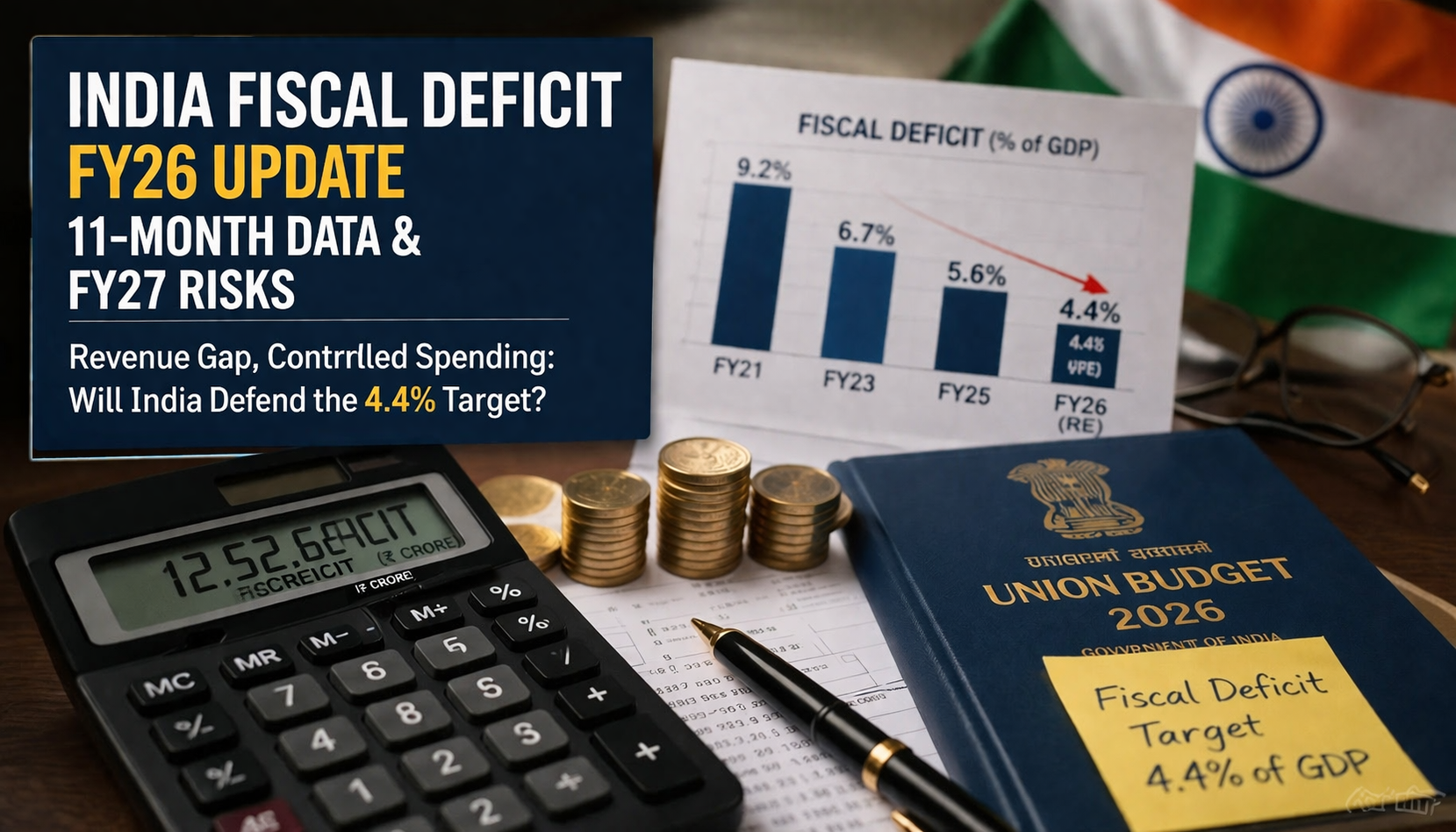
India Fiscal Deficit FY26: 11-Month Data & FY27 Risks
India’s FY26 fiscal deficit after 11 months shows revenue gaps but controlled spending. Can the government meet the 4.4% target amid global risks?
QUICK WORD ON 11 MONTHS FISCAL DEFICIT FOR FY26
Fiscal deficit shows the budget deficit or the extent to which the government has to borrow to bridge the gap between its revenues and expenses. For February 2026, the cumulative fiscal deficit for FY26 increased by ₹2.71 Trillion. The government had booked its entire advance tax revenues in December, so slowing in tax revenues and a spike in fiscal deficit was expected. However, government still expects to defend 4.4% fiscal deficit for FY26.
High fiscal deficit has negative implications as rating agencies and FPIs tend to be wary if the fiscal deficit as a share of GDP is above 5%. In India, fiscal deficit touched a level of 9.2% of GDP after COVID. Since then, the government has systematically brought it down to 4.4% (estimated) in FY26. For FY27, budget estimates pegged fiscal deficit still lower at 4.3% of GDP. The February Union Budget actually lowered the rupee fiscal deficit target for FY26.
FISCAL DEFICIT STORY FOR FIRST 11 MONTHS OF FY26
Here are government receipts, expenditures, and fiscal deficit for 11 months of FY26 ending February 2026. The table also shows the percentage of target reached for each item.
| Item Heads | FY26 (BE) (₹ in Crore) | FY26 (RE) (₹ in Crore) | Actuals (Apr-Jan) (₹ in Crore) # | Actual to Target (% achieved) |
|---|---|---|---|---|
| Revenue Receipts | 34,20,409 | 33,42,323 | 27,26,396 | 81.6% |
| Tax Revenue (Net) | 28,37,409 | 26,74,661 | 21,45,223 | 80.2% |
| Non-Tax Revenue | 5,83,000 | 6,67,662 | 5,81,173 | 87.0% |
| Non-Debt Capital Receipts | 76,000 | 64,027 | 65,547 | 102.4% |
| Total Receipts | 34,96,409 | 34,06,350 | 27,91,943 | 82.0% |
| Revenue Expenditure | 39,44,255 | 38,69,087 | 31,15,270 | 80.5% |
| Capital Expenditure | 11,21,090 | 10,95,755 | 9,29,322 | 84.8% |
| Total Expenditure | 50,65,345 | 49,64,842 | 40,44,592 | 81.5% |
| Fiscal Deficit | 15,68,936 | 15,58,492 | 12,52,649 | 80.4% |
| Revenue Deficit | 5,23,846 | 5,26,764 | 3,88,874 | 73.8% |
| Primary Deficit | 2,92,598 | 2,84,154 | 1,87,344 | 65.9% |
Data Source: Controller General of Accounts (# - 11 months data)
Here are key takeaways from the updated fiscal deficit story for FY26.
- As of the end of 11 months, it does look like the government could face a major challenge on meeting its revenue targets. Total receipts are still about 18% short of target with just one month to go. Of course, there will be the advance tax collections up to March 15, which will be recorded in March, so that should give some relief.
- The good news is that even the total expenditure is about 19% short of target. If the revenues fall short of target, the government can always tighten the screws on spending, or they can just put off the spending to the next fiscal. However, with fiscal deficit still about 20% short of target, it looks like 4.4% of GDP will be defended.
- One risk is the impact of the ongoing war in the Middle East on the Indian economy. However, that is unlikely to change the budget estimates beyond a point; and even the fiscal deficit estimates appear to be well in control. However, there is still a major risk of back-ending we cannot overlook.
- While some revenue and capital spending is likely to be pushed to the next year, there is the added burden of pre-booking of advance taxes and delays in refunds issued. All this could cumulate into a major overhang in FY27. That is something the government should be wary of; especially if tax revenues continue to remain tepid next year.
For now, the fiscal deficit data looks to be on track. However, the big risk is that there could be a lot of front-loading and that could put pressure in FY27.
WILL THE US-IRAN WAR IMPACT THE FY26 FISCAL DEFICIT NUMBERS?
For now, it looks unlikely that the impact of the war in March could be large enough to unsettle the fiscal deficit. With sufficient headroom on expenditure and on fiscal deficit, the 4.4% fiscal deficit target looks set to be defended in FY26. However, the issues could get a lot more convoluted in FY27, especially if the war in the Middle East intensifies.
Firstly, there is the carry-forward spending that will move to next year. Secondly, the war impact will force the government to increase its capex contribution. Thirdly, the net tax collections may look a lot more tepid if the pending refunds are factored in. The real challenge for the government will be defending 4.3% fiscal deficit to GDP in FY27!
Turn market insight into a plan for your money.
Talk to usDisclaimer: This content is for general information and education only and is not a recommendation to buy or sell any security.
Was this article helpful?