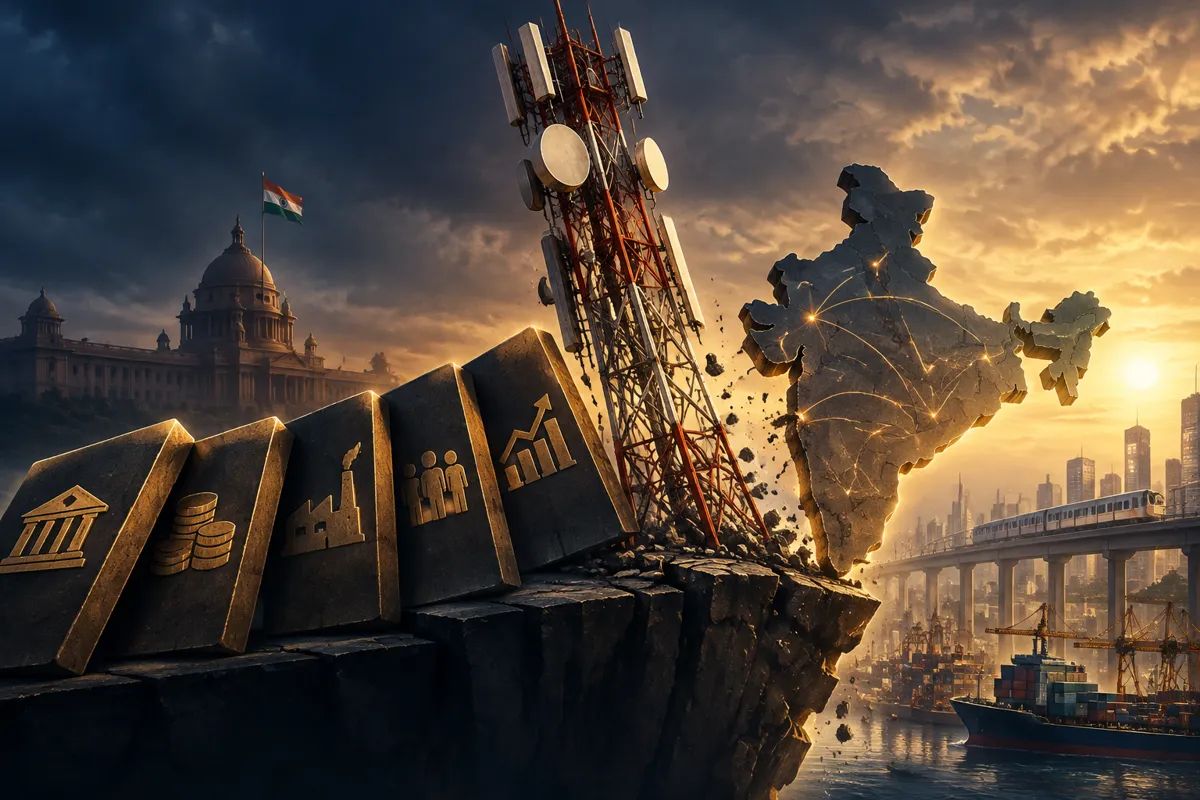
A shaky Vodafone Idea poses a huge risk to Indian economy
With close to ₹140,000 crore in bank credit at stake, here is why Vodafone Idea's collapse poses a major systemic risk to the Indian economy.
How things changed for VI
The problems for Vodafone began way back in 2016 when Reliance launched its Jio. The intense price and service stress meant that Vodafone had little chance of surviving unless it merged. That led to the merger of Vodafone and Idea to create VI. But merging two stressed telecom companies does not make the entity competitive. On the other hand, it just doubles the stress and that is what happened in the case of Vodafone. But the real problems started in Sep-2019. In Sep-19, the Supreme Court rejected any further delays in payment of AGR charges by telecom companies. Bharti was left holding a bill of Rs.55,000 crore but Vodafone Idea ended up with a bill of Rs.83,000 crore in AGR charges and spectrum usage. To be fair, this was the cost that telecom companies always had to pay. But companies like Vodafone, Idea and Bharti and swept it under the carpet and used the funds to expand its top line and valuation. With SC order, that risk came back to roost for VI.
Financials of VI are a mess
Some of the financial numbers of VI are almost scary. It has reported net losses of Rs.120,000 crore in the last two fiscal years alone. Its net worth is already at Rs-36,000 crore. It still owes more than Rs.60,000 crore to the government towards AGR and spectrum usage fees and banks have given loans and credit facilities of close to Rs.140,000 crore to Vodafone. In short, VI poses a major systemic risk for the Indian markets in general and Indian banks in particular. Remember, Vodafone PLC and Aditya Birla Group have already warned that it would be tough to sustain VI as a going concern. Also, Vodafone PLC and the Birla group have refused to infuse any fresh funds into the stressed company.
Have a Plan-B ready
Clearly, the financials of Vodafone India don’t look encouraging. If you add up accumulated losses, market cap, bank debt and the jobs created, the total loss to the Indian economy if VI decides to fold up would be one of the biggest in recent memory. In the current situation when India is still struggling to come out of the COVID syndrome, that is a loss that India can ill-afford. In the last few years, India saw two multi-billion–dollar bankruptcies of IL&FS and DHFL. The downstream impact of VI going bust would be much bigger than all that. It is time that India comes up with Plan-B to handle such eventualities.
Turn market insight into a plan for your money.
Talk to usDisclaimer: This content is for general information and education only and is not a recommendation to buy or sell any security.
Get SERNET Insights in your inbox
Market updates, IPO notes and money guides.
For preference changes, reactivation or unsubscribe, email support@sernetindia.com from your subscribed address.
Was this article helpful?