US-Iran War – Is Iran winning the battle of war economics?
When David beat Goliath, it was clear that victory in war is not just about power, wealth, and big armies. It is also about how time and costs are used as a strategy to fight from a position of apparent disadvantage!
Another David versus Goliath plays out
Across the Middle East, a largely unequal war is being fought. On the face of it, Iran would not be able to match up to the firepower and the deep pockets of the US or the warfare technology of Israel. However, what started as a short war, is still going on with no signs of the war ending. Apparently, the US and Israel were deluded by their success last year, and expected a similar muted response from Iran. This time around, Iran had done its arithmetic on the economics of war to perfection. Iran had realized that fear of loss was more potent than the actual loss. All that Iran had to do was to delay the war and make the war very expensive for the US and Israel. That is now happening!
Intercepting drones at a huge cost
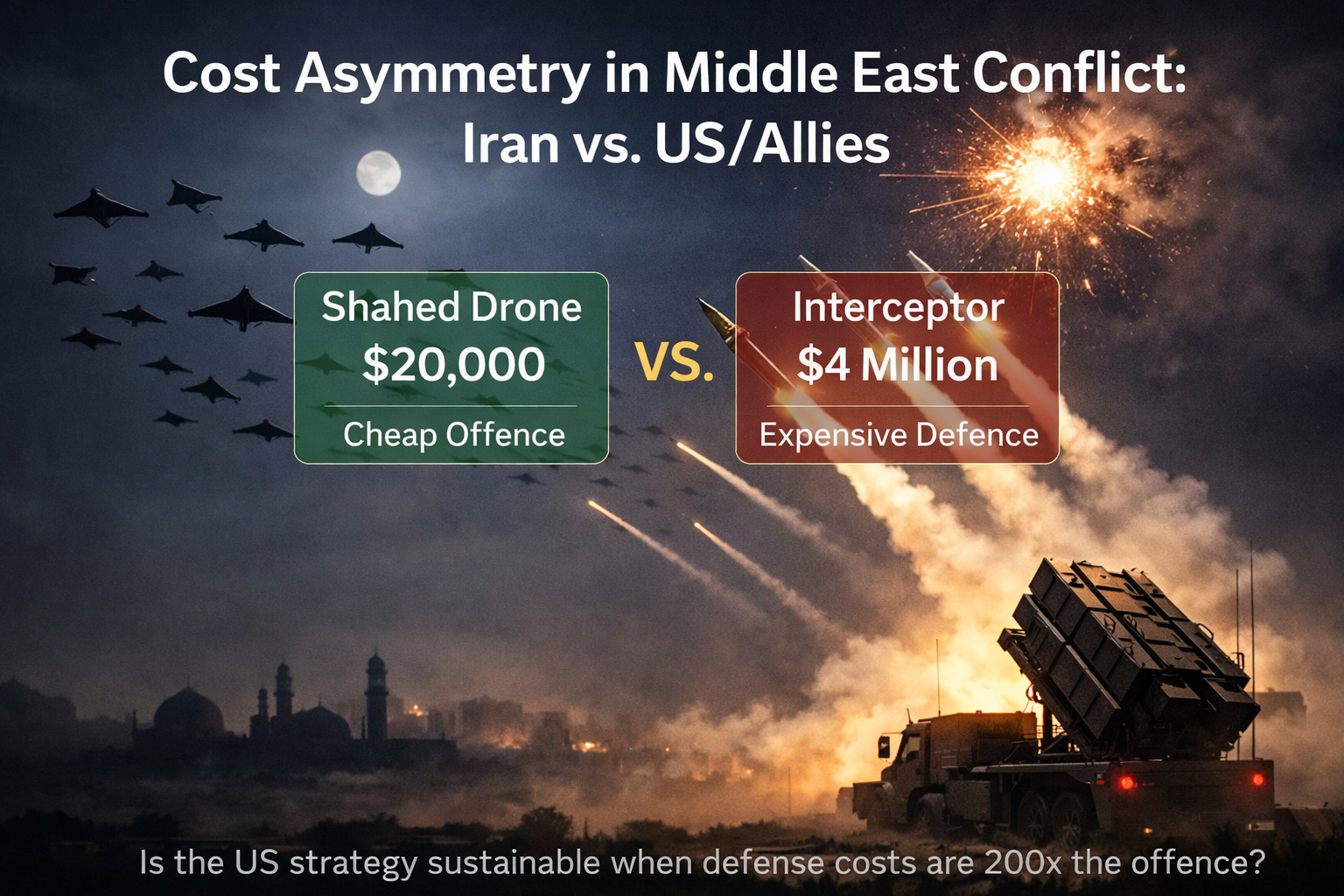
We hear a lot of news about how the US sponsored missile-cover across the Middle East is able to fend off Iranian drone attacks. What the news does not mention is the economics of such attacks. A typical Shahed Drone fired by Iran on its targets (despite its high level of accuracy) costs just $20,000. However, to neutralize this $20,000 drone, the US uses interceptor technology with each defence costing them about $4 million. It is a very simple calculation. If the ratio of defence to offence is 200:1, it is hardly a sustainable strategy for the US. That is exactly what Iran is trying to do. Using their cheaper drones to force the US and its allies to dissipate their stockpiles at a high cost.
Attacking neighbours with US affiliations
That is the second strategy that Iran has used this time around. They have not tried to fire at the American ships. Instead, they have been attacking American installations across the Middle East nations that are allied to the US. Saudi Arabia, UAE, Oman, and Qatar have borne the brunt of the attacks. Each attack on such facilities causes big losses to the US and also reduces its war preparedness in the region. More importantly, the Middle East nations are getting disillusioned about supporting the US, which has resulted in their own people coming under attack. Iran has avoided use of GPS, so the US and Israel have little control over jamming Iranian systems. The real cost is adding up rapidly.
Finally, there is the big uncertainty factor
The US, as per conservative estimates, has been spending nearly $2 billion on the war on a daily basis. In the first 15 days, the cost has gotten close to $40 billion and Trump is likely to requisition another $50 billion from the US Congress. It would be tough to justify with no visible outcomes. But there is a bigger concern for the US. While the US and Israel were prepared for a short war, Iran was prepared for the long haul. As of now, Iran has only fought with drones to make the cost of interception prohibitive. Iran has access to medium-range and long-range ballistic missiles. Will Iran use these missiles; is the big X-factor. Iran seems to be clearly gaining in the battle of economics.
Turn market insight into a plan for your money.
Talk to usDisclaimer: This content is for general information and education only and is not a recommendation to buy or sell any security.
Was this article helpful?