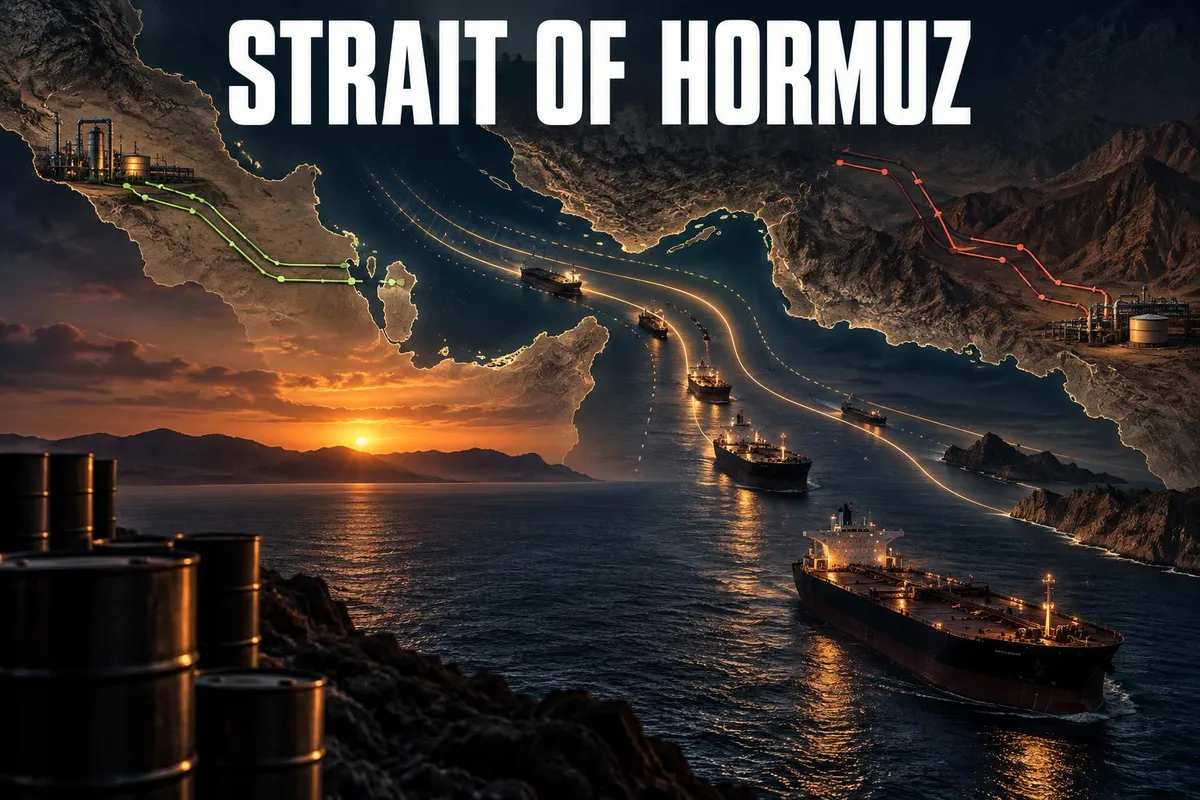
Straits of Hormuz – Will this route be redundant in next 5 years?
As the Straits of Hormuz (which handles 20% of world trade) continues to remain under suspended animation, the big question that is starting to do the rounds is; Whether there is life beyond the Straits of Hormuz? HSBC thinks that...
As the Straits of Hormuz (which handles 20% of world trade) continues to remain under suspended animation, the big question that is starting to do the rounds is; Whether there is life beyond the Straits of Hormuz?
HSBC thinks that Straits of Hormuz is dispensable
At a recent logistics conference in Dubai, HSBC suggested that the Straits of Hormuz could become redundant over the next 5 years. The timeline may not be relevant, but the question is how that could be possible? According to HSBC, a large part of the current oil trade that happens through the Straits of Hormuz could shift to pipelines connecting the Yanbu port in the Red Sea and others. There are also talks of a multi-modal transport plan which covers Asia, Middle East and Europe into one-single market. Once the volumes on the Straits of Hormuz reduce, it is almost as good as redundant.
Pipelines are the real story in Middle East
One major saving grace in this situation has been the East-West Petroline that connects Saudi Fields in the East to the Yanbu port on the Red Sea in the West. It was built with a capacity of 7 million barrels per day (bpd), but it has typically operated at around 40% to 50% of its capacity. That pipeline capacity is expected to go up to 10 million bpd. Then there is the Habshan-Fujairah pipeline that skirts the Straits of Hormuz and can handle about 3.5 million bpd. In addition, major pipeline expansion is also planned traversing through Iraq, Kuwait, and Jordan, with total investments expected at around $1.4 trillion. However, these capacities will only come on board over the next 5-7 years.
Shifting out of Straits of Hormuz will not be easy
The first big constraint is the movement of gas and that is where Qatar would face a problem. Qatar alone accounts for around 20% of global LNG supply. The only way it can move is by ships and through the Straits of Hormuz. Then there is the issue of downstream capacity. For example, oil has to connect to the Sumed pipeline in Egypt to supply to Europe. The constraint is that Sumed has a capacity of just 2.5 million bpd. That is hardly enough to replace the volumes handled by the Straits of Hormuz. Also, the Red Sea itself is a troubled route around the Bab-al-Mandeb. Pipeline infrastructure is never out of reach of Houthi rebel drones, as we have seen in last few seeks.
Watch out for dynamics of oil trade changing
The bigger underlying story of oil is that the dynamics are gradually changing. If you look at the top-10 oil exporters; there are 6 non-Gulf nations. These include, Russia, the US, Canada, Norway, Nigeria, and Brazil. Hence, the clout that the Gulf has today is much lower. There are new oil routes emerging. Russia, China, and India are already using the Eastern sea route quite aggressively. With Norway, Canada, and Russia among the major exporters, expect more movement through the arctic routes. HSBC is correct. The Straits of Hormuz does not have to become totally redundant. Iran and the US will lose interest, the moment its centrality reduces. After that, it will be all about economics!
Turn market insight into a plan for your money.
Talk to usDisclaimer: This content is for general information and education only and is not a recommendation to buy or sell any security.
Was this article helpful?