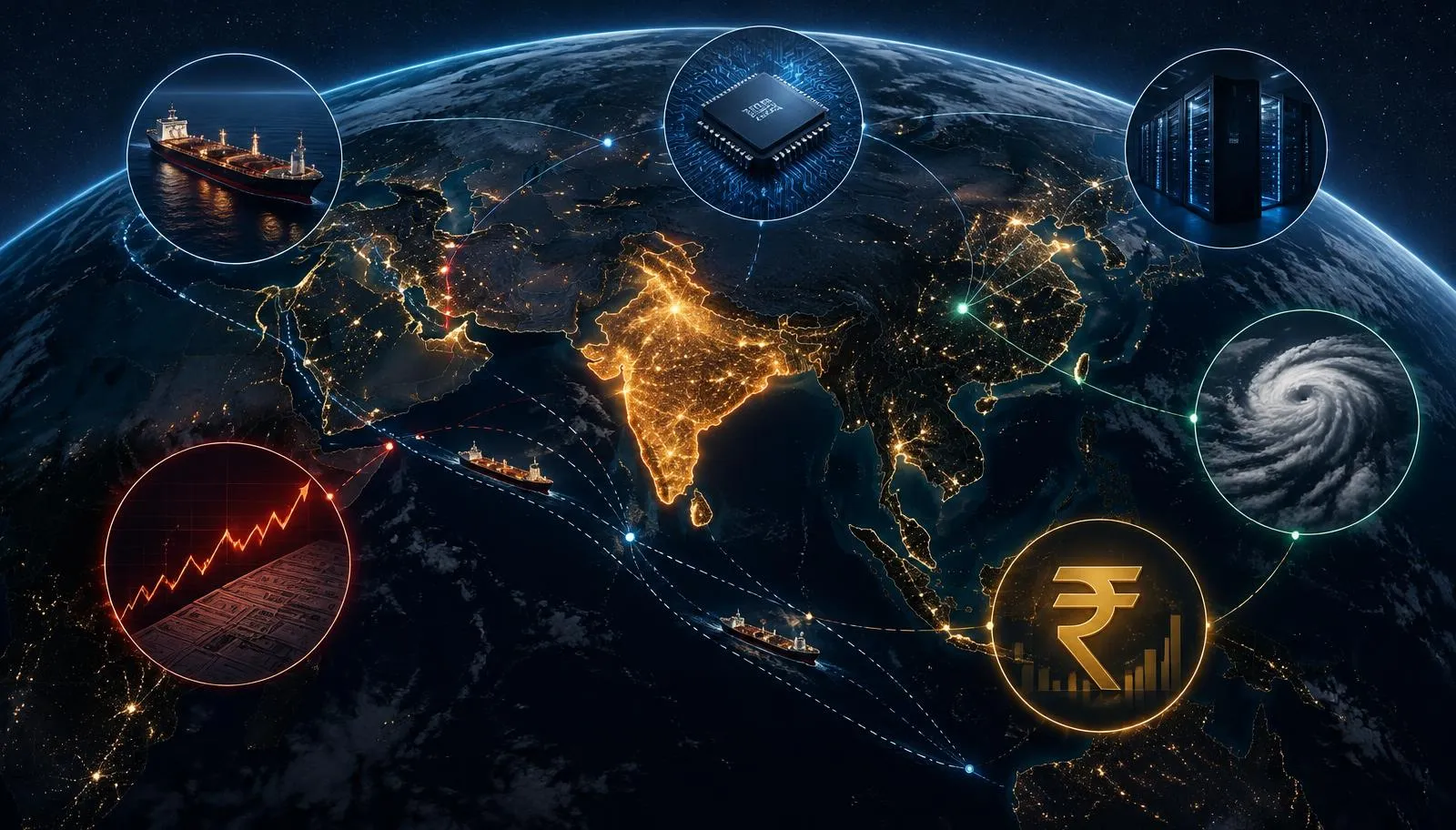
The World Ahead 2027: A Warning of Global Crisis, or India’s Greatest Financial Stress Test?
Decoding The Economist’s 2027 outlook: how energy, debt, AI, Taiwan, climate and margin leverage could test Indian wealth.
*Decoding The Economist’s controversial cover, separating evidence from speculation, and examining how geopolitics, debt, artificial intelligence, climate change and financial leverage could reshape Indian wealth.*
Research edition: 17 November 2026 | Outlook: Calendar year 2027 and beyond
Executive perspective
The world is not necessarily approaching a collapse. But it is entering a period in which economic, technological, environmental and geopolitical risks are becoming increasingly interconnected.
The Economist’s The World Ahead 2027 has attracted attention for its provocative cover: political leaders, artificial intelligence, military equipment, financial symbols, environmental destruction and medical technology coexist in a dense visual composition.
Social media interpretations suggest hidden messages, planned events and even predictions of an approaching global crisis.
Yet the most important story is not hidden in the artwork.
It is visible in the global economy’s growing dependence on debt, energy security, technological infrastructure, political stability and increasingly unpredictable climate conditions.
For India, these developments raise a question more consequential than whether the magazine has predicted the future:
Can an economy with strong growth prospects protect its financial markets, currency, businesses and household wealth when multiple external shocks arrive together?
Three verified developments illustrate why this question matters.
| Indicator | Value | Context |
|---|---|---|
| India GDP growth | 7.0% | IMF projection for FY2026–27, as reported by RBI |
| Crude import reliance | ~88% | Approximately, recent fiscal years |
| Margin-funded positions | ₹1.44 trillion | NSE-reported value, 30 October 2026 |
Sources: RBI’s October 2026 economic assessment citing IMF forecasts; Government of India, Ministry of Petroleum and Natural Gas; NSE figures reported November 3, 2026.
These figures reveal India’s central contradiction: a relatively fast-growing economy that remains exposed to imported energy, international capital conditions and domestic market leverage.
Our central thesis is therefore:
2027 should be approached as a test of financial resilience, not as a predetermined year of financial disaster. The greatest danger is not one crisis, but the possibility of several manageable risks becoming unmanageable when they interact.
1. What The Economist actually predicts
The Economist’s official announcement identifies ten themes for 2027. They are editorial forecasts and risk assessments, not guaranteed outcomes.
| Published theme | Economic significance for India |
|---|---|
| Post-Trump political transition | Trade, tariffs, diplomacy and global capital flows |
| Aftershocks from Iran | Energy, fertilisers, shipping and food security |
| Extreme climate conditions | Agriculture, inflation, power and physical infrastructure |
| AI backlash and financial risks | Technology earnings, debt, valuations and cybersecurity |
| European populist politics | EU policy uncertainty and sovereign borrowing |
| Bond-market pressure | Global funding costs and liquidity |
| Taiwan’s strategic deadline | Semiconductor supply and regional security |
| Weight-loss medicine revolution | Pharmaceuticals and healthcare innovation |
| Cheaper space access | Satellite services, communications and new infrastructure |
| Hollywood’s changing economics | Media business models and consumer behaviour |
Source: The Economist Group, official World Ahead 2027 announcement.
These themes do not all carry equal financial importance.
For Indian investors, the most immediate channels are energy, inflation, capital markets and climate. Taiwan-related disruption is potentially more severe, but its timing and probability remain uncertain.
A crucial distinction must also be made between a magazine’s artwork and its editorial evidence. A missile, oil barrel, clock or political figure is not proof of a scheduled event. Such symbols represent subjects the publication expects readers to consider.
The cover is a risk map, not a calendar of future disasters.
2. The global economy is vulnerable — but it is not forecast to collapse
The IMF’s October 2026 forecasts, as reproduced in the Reserve Bank of India’s economic assessment, provide an important counterweight to catastrophic predictions.
Global growth outlook
| Economy | 2026 projection | 2027 projection |
|---|---|---|
| World | 3.1% | 3.4% |
| India* | 7.0% | 7.0% |
| China | 4.5% | 4.0% |
| United States | 2.3% | 2.3% |
| Euro area | 1.1% | 1.2% |
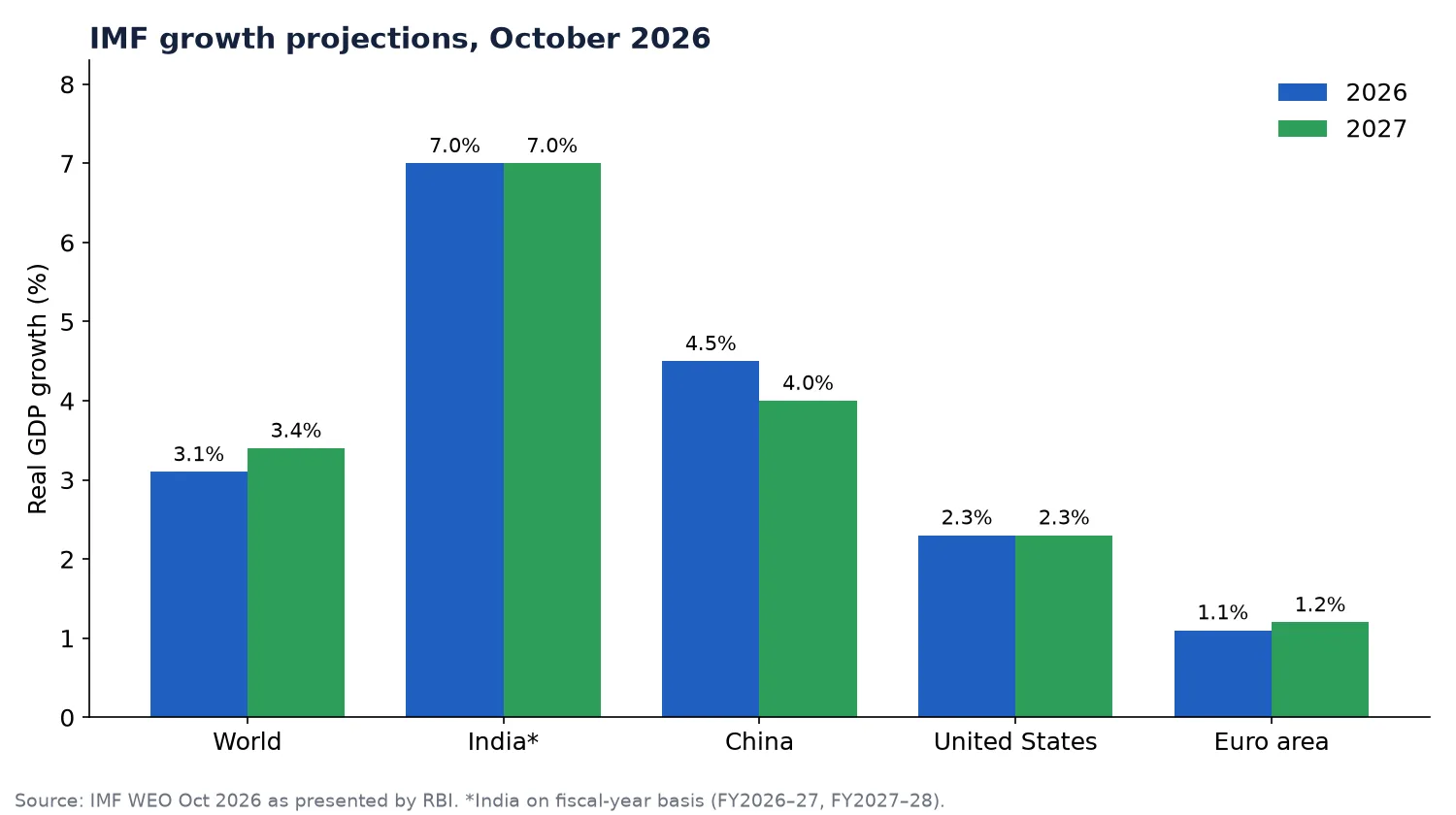
*India’s figures are for fiscal years, while other economies are presented on a calendar-year basis. The table uses the RBI’s presentation of IMF October 2026 projections.
The data suggest three conclusions.
First, the global economy is expected to continue expanding, even as geopolitical and financial uncertainty persists.
Second, India’s projected growth remains materially higher than that of major advanced economies.
Third, economic growth alone cannot guarantee positive investment returns. Market valuations, earnings expectations, inflation and the cost of capital can move independently of headline GDP.
A country can grow rapidly while its stock market experiences a significant correction.
This is particularly relevant when investors have paid high prices for future earnings or financed their investments through borrowing.
3. India’s first vulnerability: Energy security and imported inflation
India’s dependence on imported crude oil is one of the clearest ways geopolitical instability can become a domestic financial problem.
A March 2026 parliamentary response from the Ministry of Petroleum and Natural Gas confirmed that India’s crude import dependence had remained around 88% across recent fiscal years.
How an oil shock spreads through the economy
- Higher crude oil and LNG costs
- Higher import bill
- Costlier transport and production
- Fertiliser and food-price pressure
- Rupee and fiscal pressure
- Lower purchasing power, weaker margins and tighter financial conditions
The World Bank identifies this dual impact on household spending and business profitability as a major vulnerability for South Asian economies.
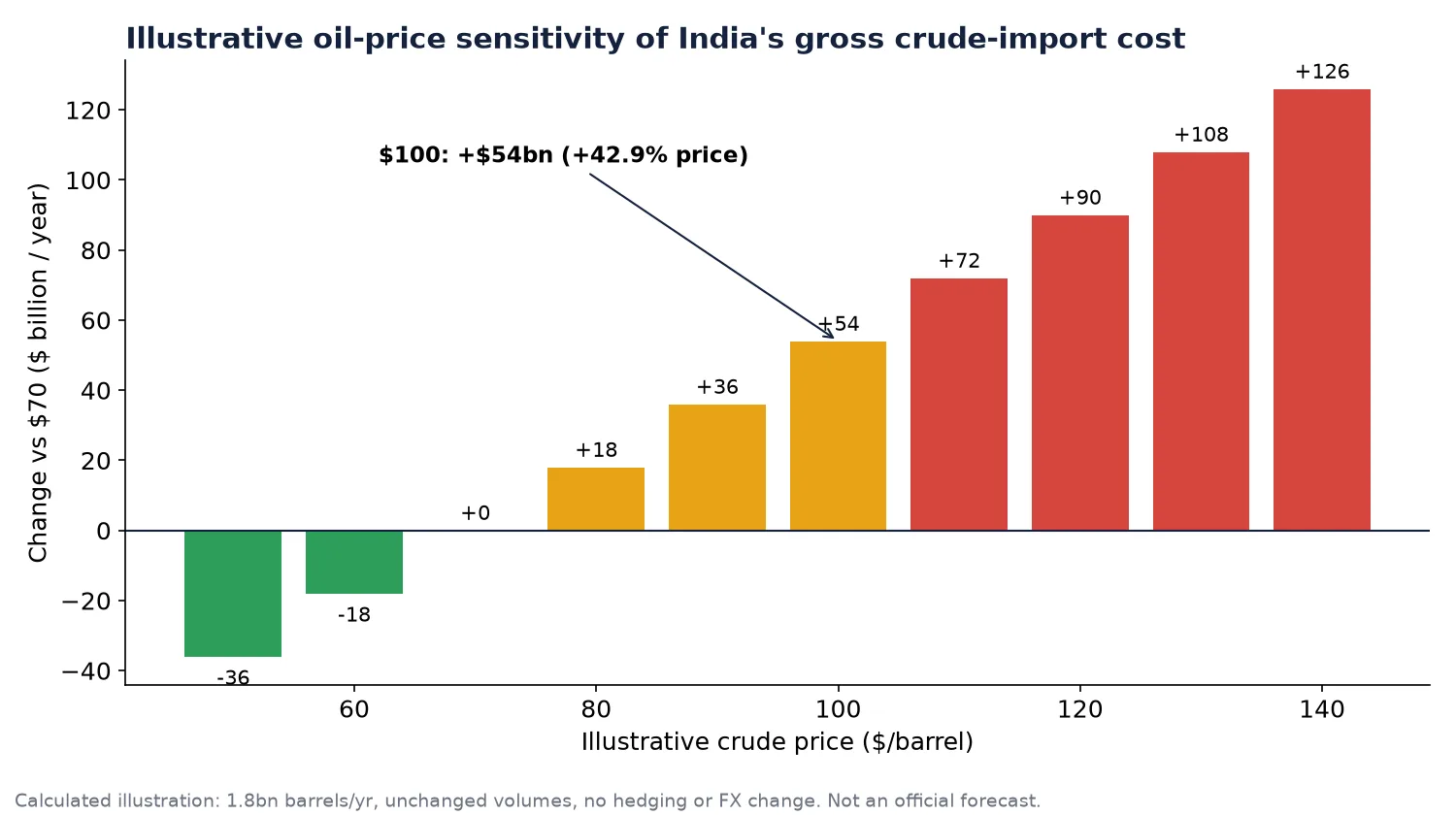
Illustrative oil-price sensitivity
The following model deliberately isolates the direct price effect on a hypothetical annual import volume of 1.8 billion barrels. It is not an official forecast of India’s oil import bill.
| Crude price ($/bbl) | Price change vs $70 | Incremental annual cost |
|---|---|---|
| $50 | −28.6% | −$36.0bn |
| $90 | +28.6% | +$36.0bn |
| $100 | +42.9% | +$54.0bn |
| $120 | +71.4% | +$90.0bn |
| $140 | +100.0% | +$126.0bn |
Assumptions: 1.8 billion imported barrels annually, unchanged volumes and crude mix, no hedging or exchange-rate changes. Excludes refined-product trade, freight, LNG and policy responses. Calculated illustration only.
At $100 per barrel rather than $70, the simplified model produces an additional $54 billion annual gross crude-import cost.
Actual consequences would depend on import volumes, realised prices, refined-product exports, the exchange rate, taxes and government responses.
The inflation warning is already visible
India’s October 2026 CPI inflation reportedly reached 6.09%, with food inflation at 8.94%. This was above the RBI’s 6% upper tolerance level.
That matters because an external energy shock would not be arriving in an environment of negligible inflation.
Investment implications: Evaluate businesses on pricing power, energy intensity, working-capital requirements and debt servicing capacity. Domestic demand does not automatically insulate companies from imported inflation.
4. The global debt problem: Could bond markets become the next source of instability?
One of the strongest aspects of The Economist’s 2027 outlook is its emphasis on sovereign debt and borrowing costs.
The Bank for International Settlements’ 2026 Annual Economic Report warns that high public debt and the growing participation of non-bank financial institutions can amplify sovereign-bond market stress.
This is particularly important because government bonds are not merely investments. They underpin collateral arrangements, bank balance sheets, pension portfolios, derivatives pricing and corporate borrowing.
Why bond prices matter
Bond prices and yields generally move in opposite directions.
An approximate relationship is:
% change in price ≈ − Dmod × Δy
Where *Dmod* is modified duration and *Δy* is the yield change in decimal form.
Consider two bonds with different interest-rate sensitivity.
| Modified duration | Yield rise | Approx. price change |
|---|---|---|
| 2 years | +100 bps | ≈ −2% |
| 8 years | +100 bps | ≈ −8% |
A bond portfolio with modified duration of eight years could experience approximately an 8% price decline if its relevant yield rises by 100 basis points, before convexity and other effects.
This is why fixed income should not automatically be described as risk-free.
What happens to Indian investors?
| Global development | Potential Indian consequence |
|---|---|
| US Treasury yields rise sharply | Pressure on emerging-market valuations and capital flows |
| Global credit spreads widen | Higher offshore financing costs |
| Dollar funding becomes scarce | INR volatility and refinancing pressure |
| Sovereign debt concerns spread | Risk aversion and reduced market liquidity |
| Global recession triggers rate cuts | Potential capital gains in high-quality longer-duration bonds |
The last row is important. The correct bond strategy depends on whether the shock is inflationary or recessionary.
The IMF’s October 2026 Global Financial Stability Report identifies sovereign-yield shocks, AI-related corrections and cyber threats among its major financial stability risks.
SERNET interpretation: The appropriate response is not to avoid debt securities, but to control duration, credit quality, concentration and liquidity risk.
5. Artificial intelligence: A productivity revolution or the next credit cycle?
Artificial intelligence presents two very different investment narratives.
The first is transformational: productivity improvements, automation, new medicines, faster research and entirely new business models.
The second is financial: extraordinarily large infrastructure commitments, uncertain returns on capital, concentration in technology companies and increasing reliance on complex financing structures.
Both narratives can be true simultaneously.
The AI investment chain
- Capital providers — equity, debt and private credit
- AI infrastructure — chips, data centres, power and networking
- AI developers — models, software and cloud services
- Enterprise customers — productivity gains and monetisation
The financial question is whether future cash flows will justify the capital committed across this chain.
If customer monetisation falls short, the consequences could spread from AI software valuations to chipmakers, data-centre developers, infrastructure lenders and power-related investments.
The IMF acknowledges the possibility of an AI-driven market correction, while also observing that the profitability of core AI firms has remained strong. This is not evidence that an AI crash is inevitable.
Implications for India’s technology industry
India’s IT services industry could face both disruption and opportunity.
Traditional labour-intensive delivery models may experience pricing pressure as AI automates routine coding, testing, customer support and business processes.
At the same time, Indian companies can benefit from enterprise AI integration, cybersecurity, data governance, cloud migration and the modernisation of legacy systems.
The important distinction is between companies that sell labour hours and companies that deliver measurable business outcomes.
For investors, the screening criteria should include revenue concentration, AI-related order conversion, margins, free cash flow, client diversification and valuation.
For real assets, data centres require separate scrutiny of power availability, cooling, water access, occupancy commitments, financing costs and technological obsolescence.
A data centre is not automatically a safe infrastructure investment merely because AI demand is growing.
6. Taiwan: A geopolitical risk with disproportionate economic consequences
The year 2027 has long appeared in discussions of Chinese military modernisation and Taiwan.
But a military-readiness objective must not be confused with a confirmed decision to invade.
For financial markets, several forms of disruption are possible, including military exercises, maritime restrictions, sanctions, cyberattacks or an actual armed conflict.
The economic consequences would vary dramatically.
| Type of disruption | Potential economic impact |
|---|---|
| Heightened military exercises | Temporary risk premium and market volatility |
| Shipping restrictions | Higher freight and insurance costs |
| Technology sanctions | Semiconductor and equipment shortages |
| Extended blockade | Severe electronics supply disruption |
| Direct conflict | Potentially systemic global financial and economic shock |
India’s electronics manufacturing, automobiles, industrial automation, defence technology and AI infrastructure depend on international semiconductor supply chains.
Diversification and domestic semiconductor investment can reduce future dependence, but manufacturing capacity cannot be established overnight.
The strategic opportunity is real: India may attract investment from companies seeking more geographically diversified supply chains.
The financial risk is equally real: such projects are capital-intensive and can suffer from delays, technology dependence and weak returns on invested capital.
7. Climate change: The most underestimated risk to Indian real assets
Unlike a geopolitical conflict, climate risk does not require a single triggering event.
It accumulates through heat exposure, rainfall variability, flooding, water scarcity, crop losses, infrastructure damage and rising insurance costs.
There is also a measurable near-term warning.
NOAA’s November 12, 2026 assessment indicates a greater than 79% probability of strong-to-very-strong El Niño conditions persisting through January–March 2027. That is a forecast for ENSO conditions, not a probability of Indian drought.
The IPCC identifies increasing risks from extreme heat, heavy precipitation, urban flooding and infrastructure damage across Asia.
Climate exposure by real-asset category
| Asset | Principal physical risk | Risk-management response |
|---|---|---|
| Residential property | Flooding, water scarcity, extreme heat | Assess drainage, elevation, water supply and insurance |
| Commercial offices | Cooling costs, business interruption | Evaluate energy efficiency and resilience |
| Warehousing | Flooding, logistics disruption | Site-level flood and transport-access assessment |
| Agricultural land | Rainfall variability, groundwater stress | Diversify crops and evaluate irrigation reliability |
| Data centres | Water, cooling and grid reliability | Assess power redundancy and water strategy |
| Renewable infrastructure | Weather variability, physical damage | Resource modelling, insurance and structural resilience |
For Indian real-estate investors, especially in coastal and densely urbanised markets, climate due diligence should become as important as title verification, location and rental yield.
A property can appreciate in nominal terms while becoming more expensive to maintain, insure and protect.
The future value of real estate will increasingly depend not only on where it is located, but on how well that location can withstand environmental stress.
8. India’s domestic amplifier: Margin funding and forced selling
This is an area where we believe India’s 2027 risk debate requires particular attention.
Global shocks become more dangerous when investors have financed their holdings with borrowed money.
According to NSE figures reported by Business Standard, outstanding margin trading positions reached ₹1.51 trillion in September 2026 before declining to ₹1.44 trillion at October-end.
Separately, Reuters reported on November 17 that SEBI was considering additional safeguards for margin-funded stock purchases. Reuters cited a ₹1.53 trillion position figure, reflecting a different reporting reference point. These figures should not be treated as identical-date observations.
Margin-funded equity exposure: selected observations
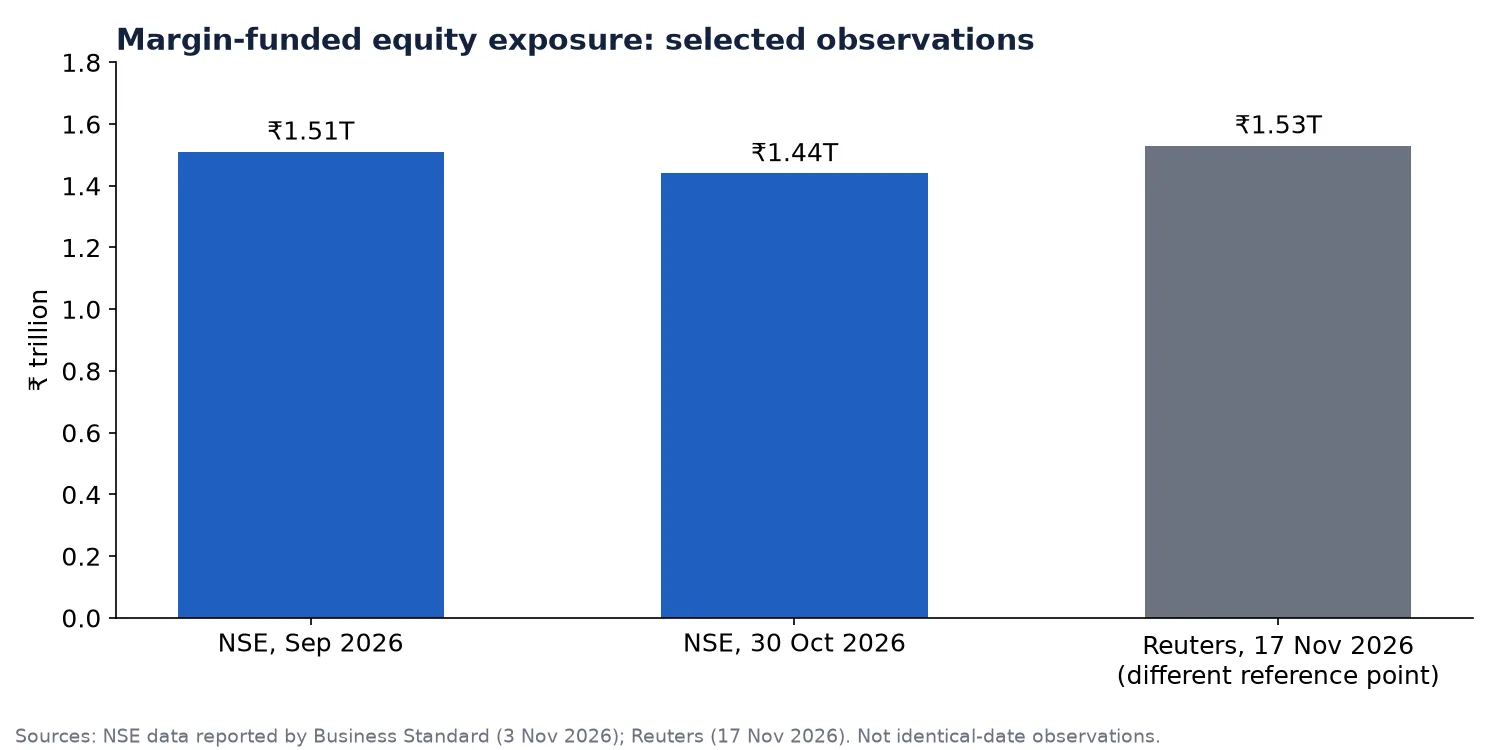
The decline in October is important because it demonstrates that leverage can contract even before a full-scale market crisis develops.
How leverage magnifies losses
Assume an investor purchases ₹4 lakh of equities using ₹1 lakh of personal capital and ₹3 lakh borrowed from a broker.
Leverage stress test
| Market decline | Unleveraged loss | Leveraged equity loss (4×) | Remaining investor equity |
|---|---|---|---|
| 5% | 5% | 20% | ₹80,000 |
| 10% | 10% | 40% | ₹60,000 |
| 15% | 15% | 60% | ₹40,000 |
| 20% | 20% | 80% | ₹20,000 |
| 25% | 25% | 100% | ₹0 |
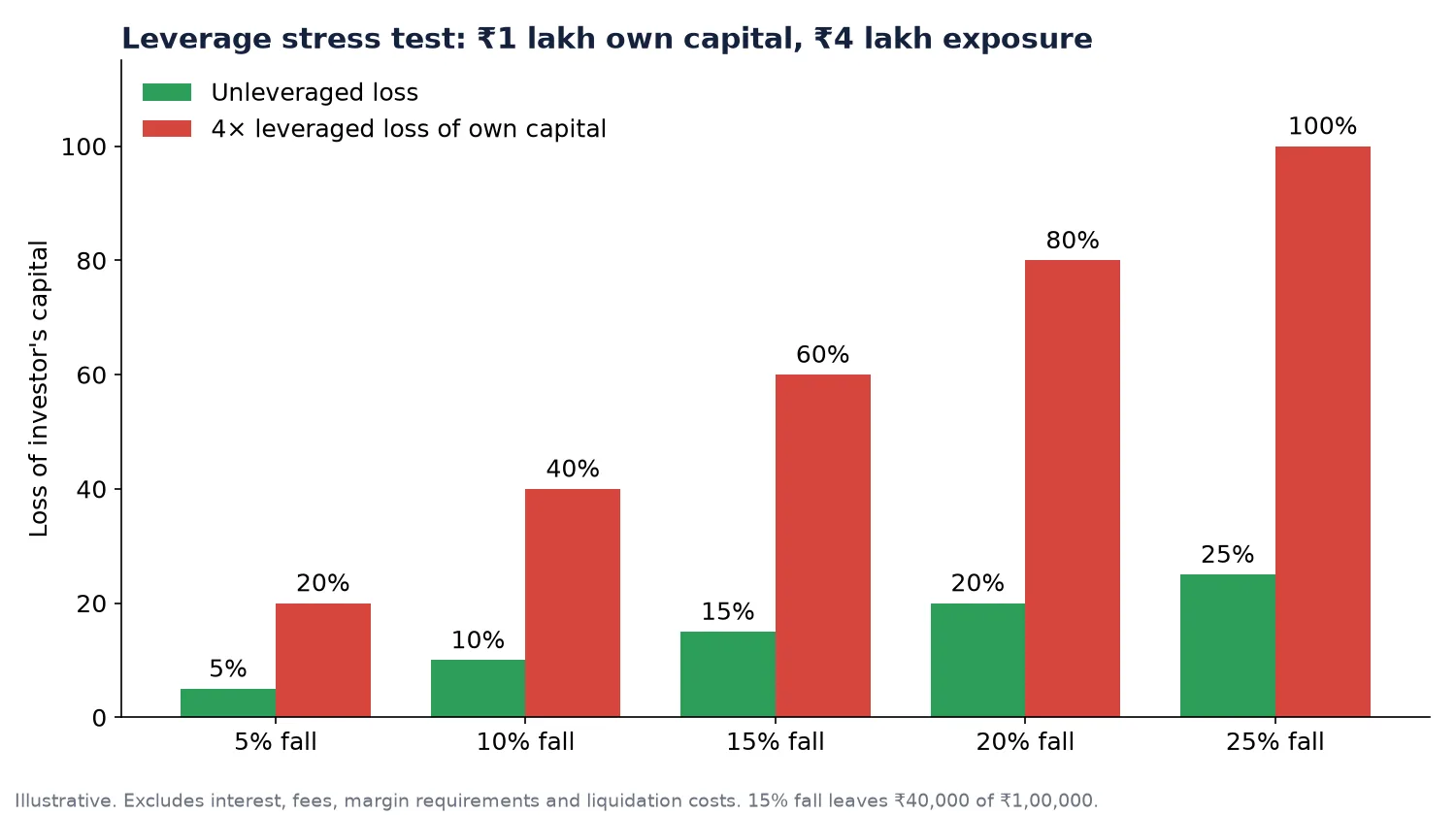
Illustrative 4× gross exposure. Excludes interest, fees, broker margin requirements and liquidation costs. Actual MTF leverage and margin calls depend on the security and broker.
A 15% decline in the underlying equities produces a 60% loss of the investor’s initial capital in this simplified example.
If the broker demands additional collateral, the investor may have to sell shares at precisely the wrong time.
This creates a possible feedback loop:
- Market declines
- Margin shortfalls
- Forced liquidation
- Further price pressure
Reuters reports that SEBI is considering concentration-related restrictions rather than abolishing margin trading. These remain proposals, not final regulations.
Our assessment: Prudent regulation of concentrated leverage is justified because the financial consequences of forced selling can extend beyond the investors who borrowed.
However, market-wide systemic risk cannot be established from the MTF outstanding amount alone. It also requires evidence on collateral, liquidity, concentration, broker exposures and the ability of investors to meet margin calls.
9. Historical evidence: How crises transmit into Indian markets
History does not repeat mechanically. Nevertheless, previous crises help us identify which financial channels are most vulnerable.
| Historical episode | Primary shock | Lesson for India |
|---|---|---|
| 2008 global financial crisis | Banking leverage and credit contagion | Domestic economic growth cannot completely protect equity valuations from global liquidity shocks |
| 2013 taper tantrum | Rising US yields and capital outflows | External financing conditions can destabilise emerging-market currencies |
| 2020 pandemic | Sudden economic shutdown and liquidity shock | Cash-flow resilience and policy response matter as much as asset quality |
| 2022 inflation and rate shock | Energy prices and aggressive monetary tightening | Equities and longer-duration bonds can decline simultaneously |
| 2026 Middle East and energy disruption | Energy supply and inflation pressure | Imported energy shocks can weaken purchasing power and complicate monetary policy |
These episodes are not identical. In particular, India’s banking system, external balances and policy buffers have changed substantially over time.
The World Bank’s April 2026 India Development Update reported a current-account deficit of 1% of GDP and general-government fiscal deficit of 7.4% of GDP, alongside strong growth. It also cautioned that Middle East developments could create additional headwinds.
The lesson is not that another 2008 is approaching.
It is that liquidity, leverage and asset valuation must be examined together, especially when global financing conditions deteriorate.
10. The SERNET 2027 scenario framework
Rather than making a single prediction, we propose three conditional scenarios.
The numerical market and macroeconomic assumptions below are hypothetical stress-test inputs. They are not forecasts, consensus estimates or assigned probabilities.
Illustrative scenarios for 2027
| Assumption | Scenario A: Managed Volatility | Scenario B: Inflation & Funding Stress | Scenario C: Severe Global Disruption |
|---|---|---|---|
| Brent crude | $65–85/barrel | $90–115/barrel | Highly volatile; no reliable fixed range |
| Illustrative equity market outcome | −10% to +15% calendar-year return | −15% to −25% peak-to-trough drawdown | −30% or greater peak-to-trough drawdown |
| Bond market | Stable to moderately lower yields | Higher yields and wider credit spreads | Liquidity stress; yield direction depends on inflation versus recession |
| Currency (INR) | Orderly movement | Depreciation pressure | Potential sharp depreciation and volatility |
| Portfolio response | Maintain diversified strategic allocations and rebalance systematically. | Strengthen liquidity, reduce leverage and stress-test credit exposure. | Prioritise solvency, collateral management, liquidity and capital preservation. |
All three scenarios are hypothetical stress-test assumptions, not verified forecasts, and are not assigned probabilities. Scenario A's equity range is an illustrative calendar-year return, whereas Scenarios B and C show potential peak-to-trough drawdowns; these are different measures and are not directly comparable. None of these ranges are back-tested or statistically validated.
The scenarios illustrate why investment positioning should be conditional.
An inflationary oil shock can hurt both equities and bonds. A recessionary shock may damage equities while benefiting high-quality government bonds. A severe liquidity event can initially cause selling across multiple asset classes.
Consequently, there is no single asset that reliably protects wealth in every possible crisis.
11. Financial assets: Where should Indian investors focus?
The following is a strategic risk framework, not a recommendation to buy or sell specific securities.
| Asset class | Preferred analytical focus | Major risk to monitor |
|---|---|---|
| Large-cap Indian equities | Balance sheets, earnings quality, valuation | Earnings downgrades and foreign flows |
| Mid- and small-cap equities | Liquidity, leverage, cash conversion | Valuation compression and forced selling |
| IT and technology | AI adoption, client diversification | Business-model disruption |
| Banks and financials | Deposit franchise, asset quality, capital | Funding costs and credit deterioration |
| Government bonds | Duration, inflation, yield curve | Interest-rate volatility |
| Corporate bonds | Rating quality, covenants, liquidity | Credit spreads and refinancing |
| Gold | Portfolio diversification and currency hedge | Real yields, volatility and entry valuation |
| International assets | Geographic and currency diversification | Global valuation and policy risks |
| REITs and InvITs | Distributable cash flow, debt and asset quality | Refinancing, occupancy and regulation |
Allocation considerations: Moderate-risk, long-term Indian investor
Illustrative moderate-risk portfolio — investment horizon 5–7 years. This is a strategic allocation illustration, not personalised investment advice or a live recommendation, and is not derived from historical optimisation or a current valuation model.
| Asset class | Illustrative allocation |
|---|---|
| Indian equities | 40% |
| High-quality debt | 30% |
| Gold | 10% |
| International equities | 10% |
| REITs / InvITs | 5% |
| Cash / liquid assets | 5% |
| Total | 100% |
Diversification across the asset classes above is an illustration, not a prescribed defensive portfolio.
An investor with substantial property holdings, irregular cash flows, significant liabilities or a shorter investment horizon may require a very different allocation.
Gold exposure should be assessed across physical holdings, ETFs, funds and any sovereign gold bonds already held. The same underlying exposure should not be counted as separate diversification merely because it is held through different instruments.
12. Real assets: The next generation of risk management
Real assets can provide economic utility and sometimes inflation-linked income, but they are not immune to financial crises.
A commercial property may retain its physical structure while losing rental income. An infrastructure asset may continue operating while its financing costs rise. Agricultural land may appreciate over decades yet suffer substantial annual cash-flow volatility.
For 2027 and beyond, SERNET proposes evaluating real assets using five dimensions:
- Economic utility — Is there durable demand for the asset’s output, services or location?
- Cash-flow quality — Are revenues recurring, collectible and capable of adjusting to inflation?
- Financial structure — Can the asset withstand refinancing costs, vacancies and unexpected expenditure?
- Physical resilience — What are its exposures to flooding, heat, water scarcity and infrastructure failure?
- Liquidity and governance — How easily can ownership be transferred, and how transparent are the legal and operational arrangements?
For Indian investors, this framework is relevant to residential and commercial property, industrial land, logistics parks, renewable-energy assets, REITs, InvITs and agricultural assets.
The key shift is from buying an asset simply because it is tangible to buying an asset because its economic utility, financial structure and physical resilience justify its price.
13. The SERNET India Riskometer: An evidence-led monitoring system
We propose a risk dashboard that distinguishes structural vulnerabilities from actual market deterioration.
Illustrative baseline assessment as of November 17, 2026. Scores reflect editorial judgement, not calibrated default probabilities or a back-tested forecasting model.
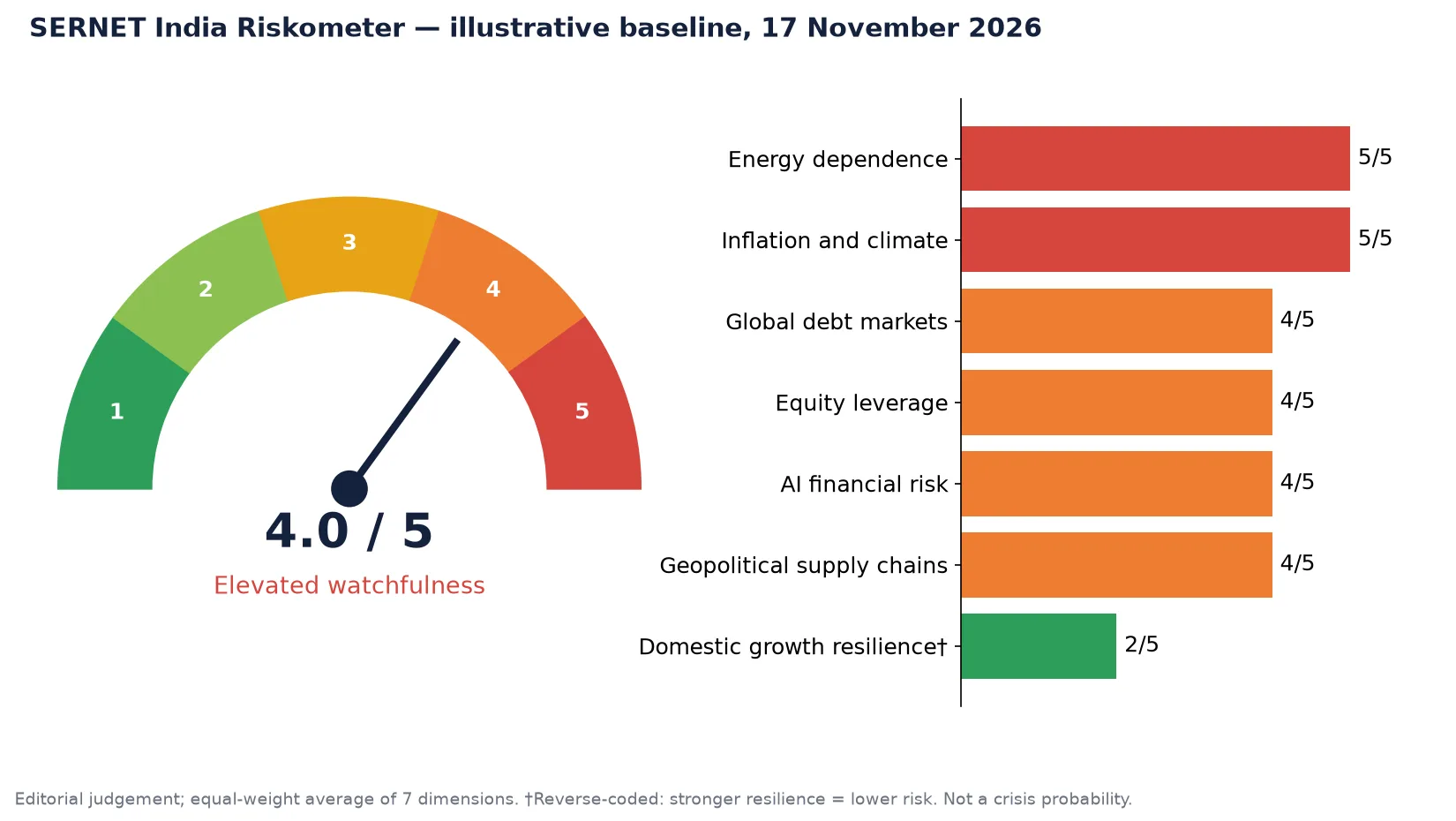
| Dimension | Score |
|---|---|
| Energy dependence | 5/5 |
| Inflation and climate | 5/5 |
| Global debt markets | 4/5 |
| Equity leverage | 4/5 |
| AI-related financial risk | 4/5 |
| Geopolitical supply chains | 4/5 |
| Domestic growth resilience | 2/5 |
Equal-weight average of seven judgemental risk dimensions, rounded to one decimal. Domestic growth resilience is reverse-coded: stronger resilience means lower risk. This score should not be interpreted as an 80% probability of crisis.
Proposed dashboard indicators and escalation triggers
| Indicator | Watch condition | Critical condition |
|---|---|---|
| Brent crude | Above $90 for 20 trading days | Above $110 with supply disruption |
| India CPI inflation | Above 5% | Above 6% persistently |
| USD/INR | Rapid depreciation versus 90-day trend | Disorderly depreciation with liquidity stress |
| US Treasury yields | Sharp 30-day increase | Sustained disorderly repricing |
| India equity volatility | India VIX above 20 | Above 30 alongside falling liquidity |
| MTF concentration | Rising positions in illiquid shares | Forced-selling evidence across multiple securities |
| Corporate credit | Widening spreads | Refinancing failures or clustered defaults |
| Monsoon and climate | Material rainfall deviation | Persistent crop and water stress |
These are proposed monitoring thresholds, not statistically validated investment signals. USD/INR and Treasury-yield triggers should be calibrated using rolling historical distributions. Data should be timestamped and sourced before dashboard publication.
A professional Riskometer should ultimately use objective, regularly refreshed indicators, transparent weights, historical back-testing and documented escalation rules.
Until that methodology is validated, the score above should remain an illustrative editorial assessment.
14. What could go right for India?
An exclusive focus on threats would overlook important structural opportunities.
The same forces creating uncertainty can accelerate changes that benefit India.
| Global disruption | Potential Indian opportunity |
|---|---|
| Energy insecurity | Renewable energy, storage, transmission and efficiency |
| China–Taiwan tensions | Electronics localisation and diversified manufacturing |
| AI transformation | Enterprise technology, cybersecurity and productivity |
| Supply-chain fragmentation | Logistics, industrial infrastructure and specialised manufacturing |
| Climate adaptation | Water management, efficient buildings and resilient infrastructure |
| Healthcare innovation | Pharmaceuticals, biotechnology and contract research |
| Global financial fragmentation | Development of domestic capital markets and financial infrastructure |
These opportunities are not guaranteed returns. Investors must distinguish the growth prospects of an industry from the profitability and valuation of individual companies.
India’s most durable advantage may be its ability to combine domestic demand, entrepreneurial capacity and technological adoption with a more diversified manufacturing and financial ecosystem.
The policy challenge is to translate that potential into productivity, employment, capital efficiency and stable long-term investment.
15. Five principles for protecting Indian wealth in 2027
1. Protect liquidity before chasing returns. Match near-term obligations with liquid, high-quality assets instead of relying on forced sales during market stress.
2. Control leverage across the entire balance sheet. Evaluate stock-market margin funding, business borrowing, property loans and other liabilities together.
3. Diversify by economic exposure, not merely product name. Owning equities, REITs, property and infrastructure funds does not guarantee diversification if they all depend on the same economic conditions.
4. Stress-test financial and physical assets. Assess inflation, interest rates, currency, earnings, credit, climate and liquidity simultaneously.
5. Preserve the capacity to invest during uncertainty. Systematic rebalancing, disciplined valuations and adequate liquidity can turn volatility into an opportunity rather than a financial emergency.
16. Final assessment: Is 2027 something to fear?
The Economist’s cover is provocative. Its underlying themes are serious. But neither the artwork nor the available economic evidence establishes that a global collapse is inevitable.
Indeed, the IMF continues to project positive global economic growth, while simultaneously warning that financial stability risks remain elevated.
These two observations are not contradictory.
The world can continue growing while becoming more vulnerable to sudden financial shocks.
For India, the risks are identifiable: imported energy, inflation, geopolitical supply chains, global borrowing costs, climate exposure and domestic financial leverage.
The opportunities are equally identifiable: infrastructure, manufacturing, technology, healthcare, energy diversification and domestic capital formation.
The challenge for investors is to distinguish between structural opportunity and speculative enthusiasm.
The SERNET perspective
The greatest investment risk in 2027 may not be a global crisis itself. It may be entering that crisis with excessive leverage, inadequate liquidity, concentrated exposure and no contingency plan.
Strong economies can experience weak markets. Good companies can become poor investments at excessive valuations. Tangible assets can become financial liabilities when their cash flows cannot support their borrowing costs.
Resilience must therefore be designed before uncertainty becomes a crisis.
The objective is not to predict every shock. It is to build wealth that can survive shocks, adapt to change and participate in the opportunities that follow.
Research references and verification notes
The following are primary institutional sources and attributed financial reporting used in this article. Forecasts, historical observations, scenario assumptions and editorial judgements have been distinguished wherever possible.
| Source | Evidence used |
|---|---|
| The Economist Group — World Ahead 2027 | Official editorial themes and publication context |
| IMF — World Economic Outlook, October 2026 | Global economic outlook |
| RBI — Economic assessment, October 2026 | Comparative IMF growth projections |
| IMF — Global Financial Stability Report | AI, debt, leverage and systemic risks |
| BIS — Annual Economic Report 2026 | Sovereign debt and market interconnections |
| Government of India — Rajya Sabha reply, March 2026 | India’s crude import dependence |
| NOAA — ENSO Diagnostic Discussion | November 2026 El Niño outlook |
| IPCC — Climate Change Impacts in Asia | Climate and physical-asset risk |
| Reuters — SEBI margin-funding report | Reported regulatory considerations and MTF exposure |
| Business Standard — NSE MTF data | Selected 2026 margin-funding observations |
Editorial note: This article uses data available through November 17, 2026. The IMF’s India figures are fiscal-year projections; some other figures are calendar-year projections. Charts using illustrative inputs are explicitly identified. The article does not establish event probabilities, security-specific valuations or expected investment returns.
Publication disclaimer
This material is published for general information and investor education. It does not constitute personalised investment advice, an offer, or a recommendation to transact in any security or financial product. Market conditions, forecasts and regulations may change. Investors should consider their objectives, risk tolerance, liquidity needs and applicable regulatory disclosures before making decisions. SERNET Financial Services Pvt. Ltd. distributes financial products and services; this publication should not be construed as SEBI-registered investment advisory or research analyst advice.
*Want to stress-test your own portfolio for 2027? Talk to SERNET.*
Turn market insight into a plan for your money.
Talk to usDisclaimer: This content is for general information and education only and is not a recommendation to buy or sell any security.
Get SERNET Insights in your inbox
Market updates, IPO notes and money guides.
For preference changes, reactivation or unsubscribe, email support@sernetindia.com from your subscribed address.
Was this article helpful?