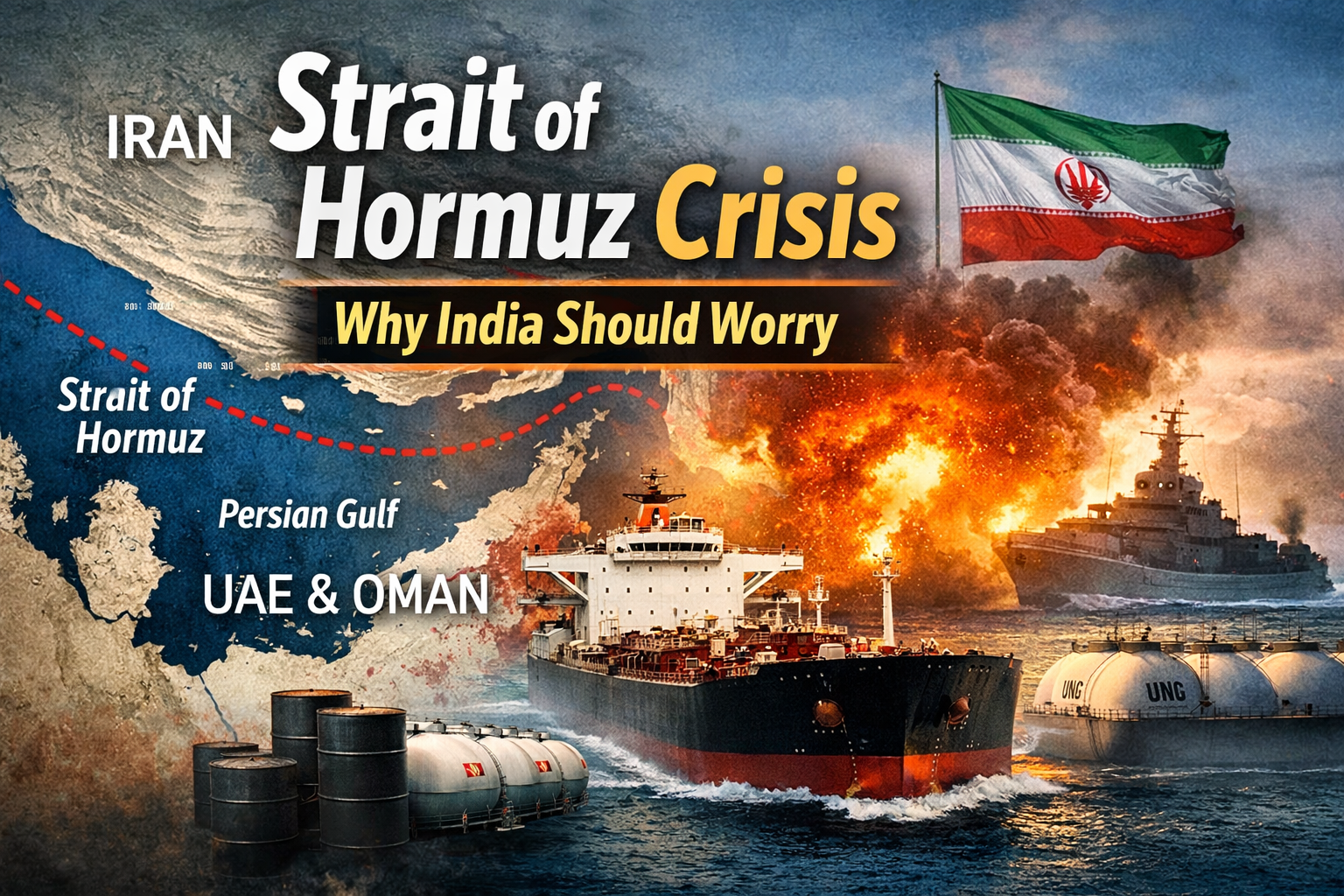
Strait of Hormuz Crisis: Impact on India’s Oil, Gas & Economy
The Strait of Hormuz crisis is disrupting global oil and gas supply. Understand its impact on India’s crude imports, inflation, LNG supply, and economy.
UNDERSTANDING IMPORTANCE OF STRAITS OF HORMUZ
Ever since the Iran-US war began, there has been a lot of hue and cry over the blockade of the Straits of Hormuz. It is a narrow stretch of water between Iran to its east and Oman to its West. However, there is something more that makes this route very strategic. That is the only way out of the Gulf for all the oil and gas that gets shipped out of the East Coast of Saudi Arabia, UAE, Iraq and Qatar.
In short, bulk of the oil and gas that moves from the Middle to the rest of Asia (including India) has to go through the Straits of Hormuz. To be fair, the Straits of Hormuz are not officially blocked, but what Iran has done is to raise the risks of passing through this gateway. In shipping oil and gas, safe passage is a key consideration and with Iran attacking ships in the Straits of Hormuz, most shipping companies are avoiding that route.
That has had a bigger implication for the global oil market. Most of the oil companies in the Middle East have only limited storage space. In that space, they can only handle if shipments are continuous. Now that shipping is almost stopped, most of the oil companies in the region are also shutting production. That is creating a huge demand-supply gap, which is what has led Brent Crude prices to above $100/bbl.
WHAT THIS MEANS FOR OIL SUPPLIES TO INDIA?
India gets substantial supply of crude oil and LNG through the straits of Hormuz. Let us talk about oil first. India in recent months has been getting about 50%-55% of its oil flows from the Straits of Hormuz; mainly from Iraq, UAE, and Saudi Arabia. This is after India shifted much of its oil procurement away from Russia. For now, India does have the Russian floating stocks to fall back upon. However, with the crude price at $104/bbl, these crude stocks are also not going to come cheap.
India uses much of the crude to refine and sell as petroleum products. But there is another relation between crude and inflation. In the past, it has been observed that every $10 increase in the price of Brent crude adds to inflation by around 30 bps. That means; with oil already up $50 in the last 40 days, it would have added about 150 bps to the consumer inflation. That could be the bigger concern, especially since the real GDP growth in Q3FY26 was largely supported by low levels of consumer inflation.
MORE THAN OIL, GAS COULD BE THE REAL CRUNCH
While it is true that oil prices are going to pinch, the bigger problem would be gas (LPG and LNG), where there are no immediate alternatives. Today, India imports about 85% of its daily gas needs. In the case of LPG, almost the entire gas comes from the Middle East, largely from Qatar and Saudi Arabia. In case of LNG, about 50% comes from the Straits of Hormuz. In all these cases, there are no immediate alternatives available to India.
Most of the shipments are going into critical industries like power and fertilizers, so the downstream impact is visible. One classic example is the ceramic industry. The town of Morbi in Gujarat has the world’s largest ceramic industry cluster and generates a turnover of close to $7 billion per annum. Here, all the ceramic units use propane to fire the kilns. With gas supplies almost drying up, this industry is standing on the throes of a shutdown. More than the macro impact, the micro impact will be bigger. For example, cost of home LPG, piped gas, CGD supplies, gas for vehicles are all set to become dearer.
DIASPORA AND DIPLOMACY – THE TWIN IMPACT
Let us first talk about the Middle East diaspora (NRIs). Today, there are 18.5 million Indians living and working abroad, of which 10 million are in the 6 Middle East nations of (Saudi Arabia, UAE, Qatar, Kuwait, Oman, and Bahrain). In FY25 (Apr-Mar), the Indian diaspora remitted nearly $135 billion to India largely helping India bridge the fiscal gap. India records the biggest remittance from the diaspora, compared to any other country in the world. The current stand-off is likely to make remittances more cautious in the coming months as economic activity across the Gulf region is expected to slow amidst higher risk perception.
The other aspect is diplomacy. Indian diplomacy in the region is about politics and economics. While India has maintained cordial relations with most of the region, there are questions likely to be raised about India not openly supporting Iran against US-Israel attacks. There is also the business side. Indian companies have substantial construction and civil contracts going on in the Middle East, with companies like L&T getting most of their incremental orders from the Middle East. Then there is the question about the status of the Chabahar port as India’s direct gateway to Afghanistan and Central Asia.
Apart from these factors, India also has about 15% of its exports going to the Middle East, which will also be impacted. The overall impact would be substantial. It is only when the dust settles that we get a clear picture.
Turn market insight into a plan for your money.
Talk to usDisclaimer: This content is for general information and education only and is not a recommendation to buy or sell any security.
Was this article helpful?