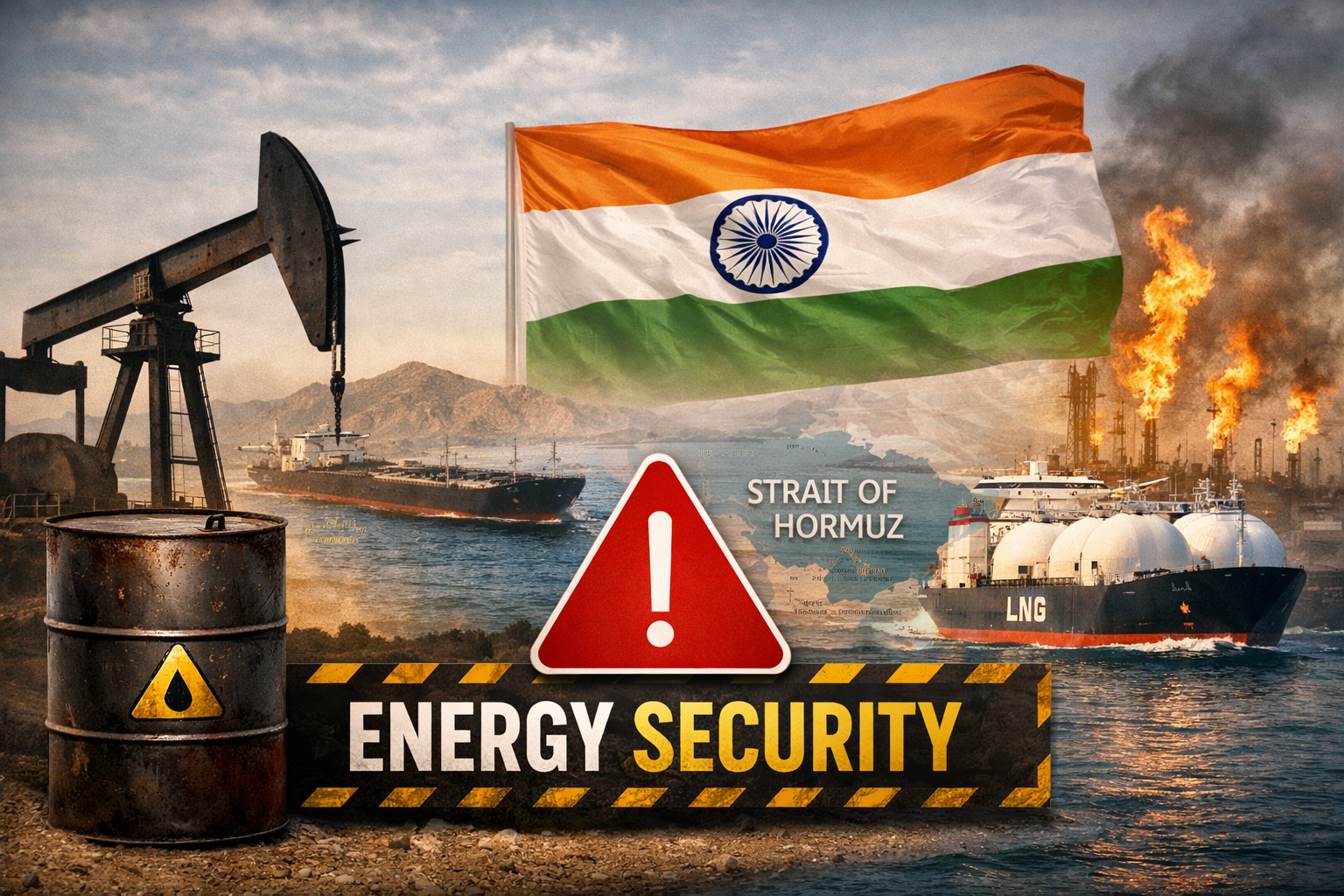
Energy Security – Time to focus more on internal stockpiles
The ongoing war in the Middle East has led to the blockade of the Straits of Hormuz. It has once again raised the very critical question of energy security. Are Indian oil and gas reserves sufficient to handle a prolonged crisis?
Reminded of the PL-480 analogy
PL 480 was a “Food for Peace” program started by the US in the 1960s to help poorer nations stave off the risks of famine and dispose its surplus food stocks. In the mid-1960s, India was perpetually on the throes of famine and depended on wheat shipments from the US under PL-480 to meet its domestic wheat needs. In those days, India hardly had any buffer stocks and literally lived a ship-to-mouth existence. Food security was ushered in when Prime Minister Indira Gandhi triggered off the Green Revolution in the 1960s, which eventually made India a foodgrain surplus country. Today, the issue is not food security, but a similar analogy is playing out in terms of energy security.
What if the Straits of Hormuz stays blocked?
As of now, Iran has allowed passage to some Indian ships through the Straits of Hormuz, but there still are a large number of consignments held up. How much of oil does India really have in its Strategic Petroleum Reserves (SPR)? If you add up the 3 SPRs in India located at Mangalore, Padur (Udupi), and Visakhapatnam; the capacity of 38 million barrels would be enough to meet India’s demand for about 12-14 days. In addition, there are the reserves at refineries and in pipelines; and all that put together may add up to about 25 days inventory. If the war extends beyond that, India would have to rustle up immediate supplies from other sources, probably at a steeper cost.
Situation could be worse in the case of Gas
If India depends on crude oil for 90% of its needs, it is almost similar in the case of Gas, where 80-85% of its gas needs are met through imports. However, there is a difference. In the case of oil, India imports from nearly 40 countries and it has access to Russia, which does not have to worry about the Straits of Hormuz. However, gas supplies come mostly from Qatar and Saudi Arabia; and they transit through the Straits of Hormuz. Not surprisingly, India has put restrictions on gas supply. Only power, transport, and household needs are getting 100% of their average 6-month demand. Gas is being rationed to all other sectors. Gas security assumes more importance than oil.
How India compares with global standards?
Let us look at oil. Indian oil stockpiles are to the tune of about 25 days; compared to 254 days for Japan, 220 days for Korea, and around 120 days for the Philippines. What about gas? When it comes to gas, only Japan has substantial stockpiles of over 200 days. Even Korea has just 9 days stocks. Today, India uses gas extensively. Apart from power, CGD, and transport; gas is extensively used by fertilizers and power sectors too. Also, auto sector and the ceramics sector extensively use propane for high precision tasks. All these sectors are, today, struggling due to the lack of gas supplies. It is time India thinks of gas stockpiles that are, at least, a proportion of Japanese energy gold standard.
Turn market insight into a plan for your money.
Talk to usDisclaimer: This content is for general information and education only and is not a recommendation to buy or sell any security.
Was this article helpful?