 Announcement: Lorem ipsum dolor sit amet, consectetur adipiscing elit. Donec et quam blandit odio sodales pharetra.
Consolidating Cement – Understanding the Adani Cement game plan
Recently, Adani group announced that it will merge ACC and Orient Cement (CK Birla group) into Gujarat Ambuja. This will be subsequently followed by consolidation of Sanghi Cements and Penna Cements also into Ambuja to create a single behemoth.

Written by: SERNET Research Team
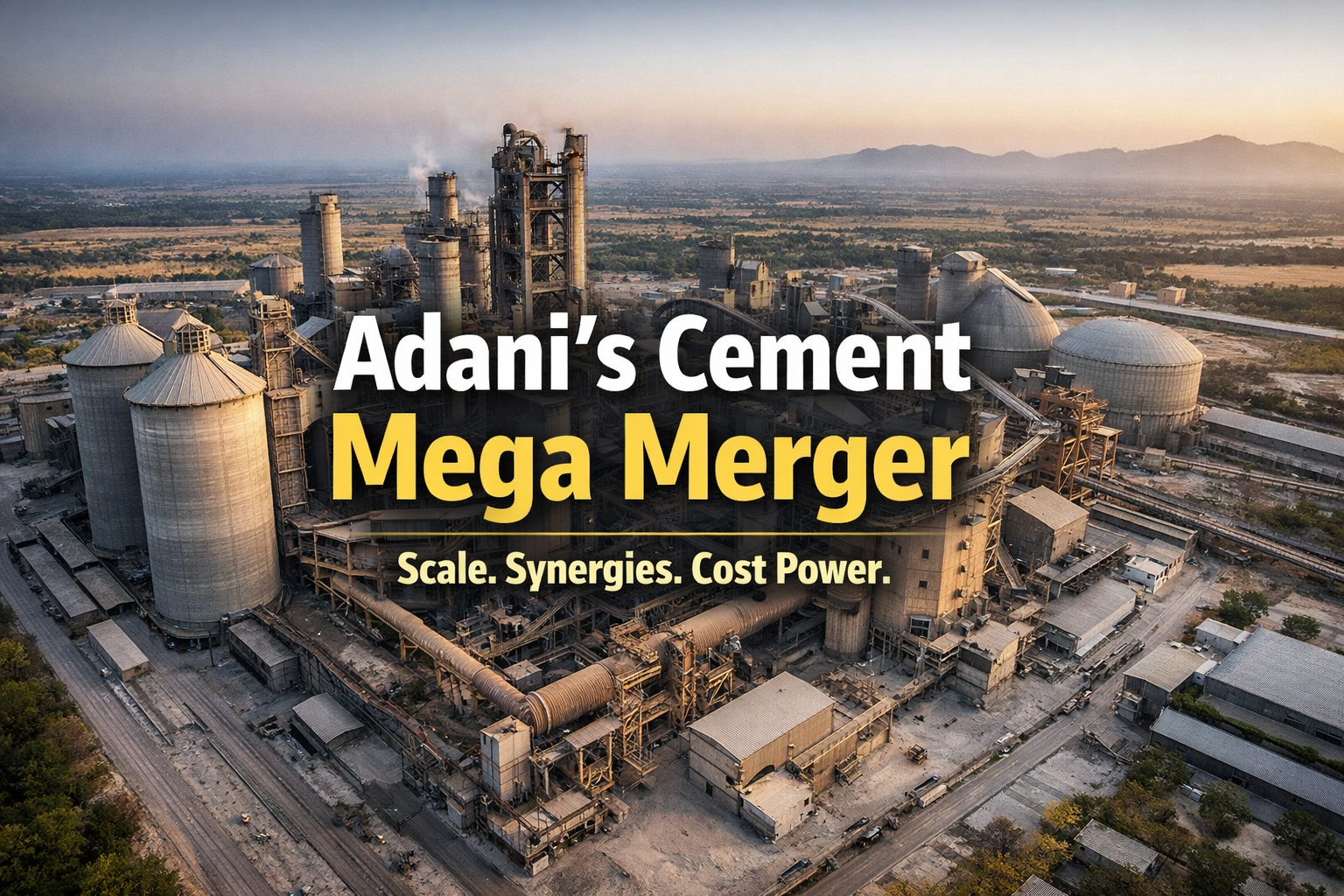
Table of Content
After inorganic burst, it is consolidation
In any merger, the biggest challenge is not executing the merger but integrating the merger. That is what the Adani group appears to be planning for. When Adani took over Ambuja and ACC in 2022, it was clear that eventually they would be merged into a single entity. Such a merger will not only make the structure of the company simpler, but also proffer benefits in the form of lower costs, better logistics control, and better bargaining power with reference to cement dealers, suppliers, and the government. It always made a lot more sense to operate them jointly, rather than as independent entities.
Managing logistics more efficiently
One of the biggest cost items for cement is the logistic part of the business; especially power, fuel, and transportation. These are substantial portions of the cost structure in cement and consolidation allows them much better management. Currently, the Adani cement franchise operates over 24 integrated plants and that calls for a lot of coordination to minimize the logistic costs. Cost saving measures like shift to alternate energy, consolidation of suppliers, captive power usage, integrated limestone supply etc can be better managed if there is one single entity making key decisions. For cement, the management of logistics is everything.
Better cost management through consolidation
While better logistics management is a key driver for consolidation in cement, cost saving is also a key factor. Cost saving will not only arise from better logistics, but also from integrated policy making. For instance, support services like human resources, training, purchase, marketing, finance & accounts etc can be now shared instead of running and maintaining standalone entities and functions. This gives the company single-point scale and allows much better cost management. In fact, the EBTIDA per tonne is expected to grow from ₹795/tonne to ₹1,250/tonne over the next 3 fiscal years. To avoid dilution, brands will be independent, but operations will be centralized.
Taking on industry leader, Ultratech
By March 2026, the consolidated Adani Cements will have total capacity of 118 MTPA (million tonnes per annum), which would still be much lower than 183 MTPA for Ultratech. By 2028, Adani plans to take its cement capacity to 140 MTPA, but Ultratech will be around 240 MTPA by then. Clearly, it will take a long time for Adani Cement to get anywhere close to Ultratech in terms of size and market dominance. However, this consolidation of the cement franchises will be the first step. The good news is that cement demand is likely to grow exponentially in the coming years as construction and infrastructure boom. This is just the starting point!
Comments